ISO lumens and ANSI lumens are two different standards used to measure projector brightness. For those new to these standards, it may be confusing: Why are there two brightness standards? What is the difference between them?
This article will help you gain a basic understanding of and distinguish between these two lumen standards.
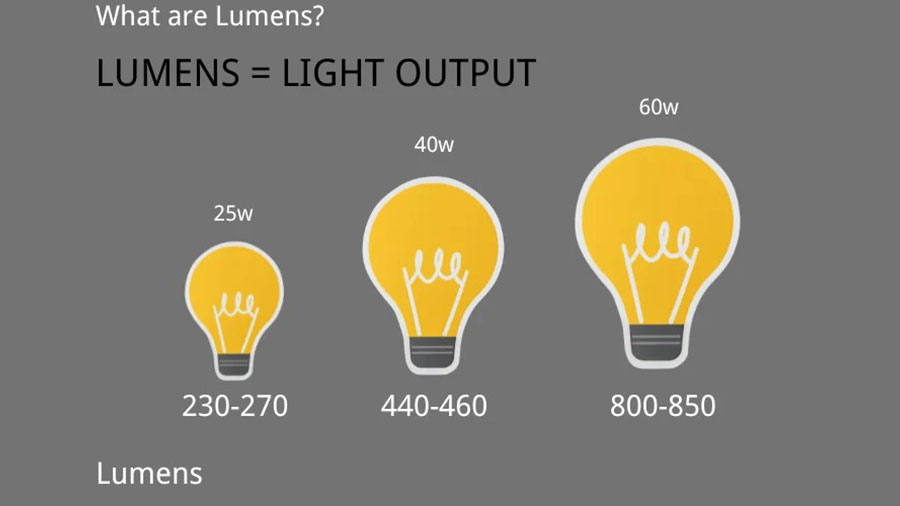
What Are Lumens?
A lumen is the unit of luminous flux, used to measure the total amount of visible light emitted by a light source per unit of time. Luminous flux reflects the human eye’s varying sensitivity to light of different wavelengths.
In the field of projectors, lumens refer to the brightness of the projected image; the higher the lumen value, the brighter the image.
What Are ISO Lumens?
ISO lumens are an internationally recognized standardized method for measuring luminous flux, established and published by the International Organization for Standardization (ISO/IEC 21118) to promote global interoperability, consistency, and quality improvement.
However, testing conditions and the interpretation of test results may vary depending on manufacturers’ production processes and testing environments.
What Are ANSI Lumens?
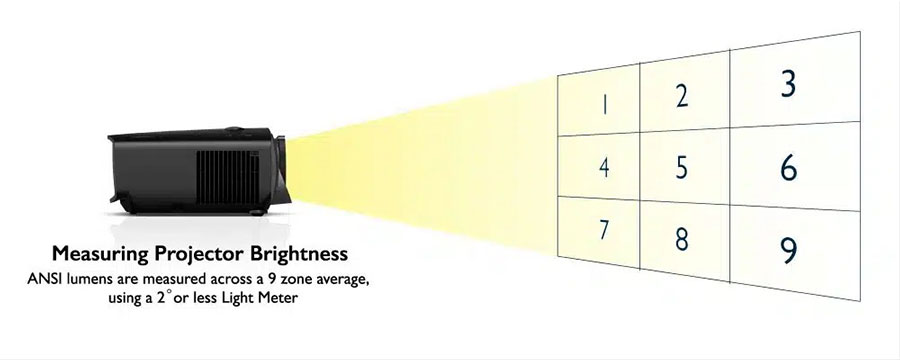
ANSI lumens are derived from the nine-point test method established by the American National Standards Institute (ANSI), which specializes in setting technical standards for various industries in the United States.
Historically used to measure the luminous flux of projectors, this standard is widely adopted by most manufacturers worldwide.
Compared to ISO lumens, ANSI lumens require fewer measurement requirements, are easier to implement, and more conveniently and consistently reflect a projector’s brightness under real-world conditions.
Why Is It Important to Understand ISO Lumens and ANSI Lumens?
ISO lumens and ANSI lumens are two distinct industry standards in the projector sector; both are currently in use and are internationally recognized.
Understanding these two lumen standards helps you make a better-informed choice when purchasing a projector.
- True Brightness: In addition to these two standards, some products on the market are labeled as “light source lumens” or use misleading figures to deceive uninformed customers. However, only ANSI and ISO lumens are scientifically measured, allowing you to know the product’s true brightness during actual use.
- Product Comparison: When products adhere to internationally recognized standards, you can make a general comparison under equivalent conditions during the purchasing process to select the most suitable product, rather than being misled by advertising or making a purchase based solely on marketing hype.
- Making an Informed Choice: Once you understand the specific lumen ratings, you can use these specifications to determine which product is best suited for your specific usage environment (e.g., bright, dim, daytime, or nighttime) and purchase the most appropriate model.
What Are the Advantages of ISO Lumens?
- ISO lumens are defined by the ISO and offer the advantage of international consistency, ensuring that ISO lumen values remain comparable regardless of where you purchase the product.
- ISO lumen measurements are more accurate, taking into account multiple factors such as light loss, projection distance, and screen size, resulting in a more standardized assessment.
- ISO lumen data is more precise, as testing is conducted under strictly controlled environmental conditions, accurately reflecting the projector’s actual brightness performance during use rather than exaggerating the figures.
What Are the Advantages of ANSI Lumens?
- One advantage of ANSI is its uniformity; better uniformity allows ANSI brightness to more closely reflect real-world usage conditions rather than being limited to laboratory settings.
- ANSI lumen testing conditions are more flexible, enabling the derivation of lumen values recognized by both users and the projector industry at a lower testing cost, making it more widely applicable. In the past, it was often the mainstream standard.
- ANSI uses a nine-point measurement method, which is simpler to operate and calculates an average value, resulting in better brightness consistency in the displayed image during actual use.
What Are the Disadvantages of ISO Lumens?
- The disadvantage of ISO lumens is that they do not reflect color accuracy. Projectors with high ISO lumen ratings cannot guarantee that the displayed images will always have vivid colors, and performance with low ISO lumen ratings is further diminished.
- Although ISO lumens is an internationally recognized brightness standard, its use in daily life is limited due to the overly cumbersome measurement process, resulting in low adoption rates in some countries.
- At equivalent brightness levels, ISO lumen values are sometimes slightly lower than ANSI lumen values. This is due to the more complex and flexible testing procedures required; in most cases, ANSI lumen values are higher.
What Are the Disadvantages of ANSI Lumens?
- The nine-point measurement method for ANSI lumens only calculates and tests nine points on the projected image; it does not cover the entire screen and therefore cannot truly represent the brightness level of the entire image.
- ANSI lumen testing is conducted using only a white screen and does not account for the fact that, in actual use, displayed content is not limited to white. Consequently, it cannot accurately reflect the true brightness and colors of color videos or images.
- The ANSI lumen measurement procedure lacks rigor, and the standards are relatively basic. With few restrictions during measurement, some brands’ products may report inflated lumen values.
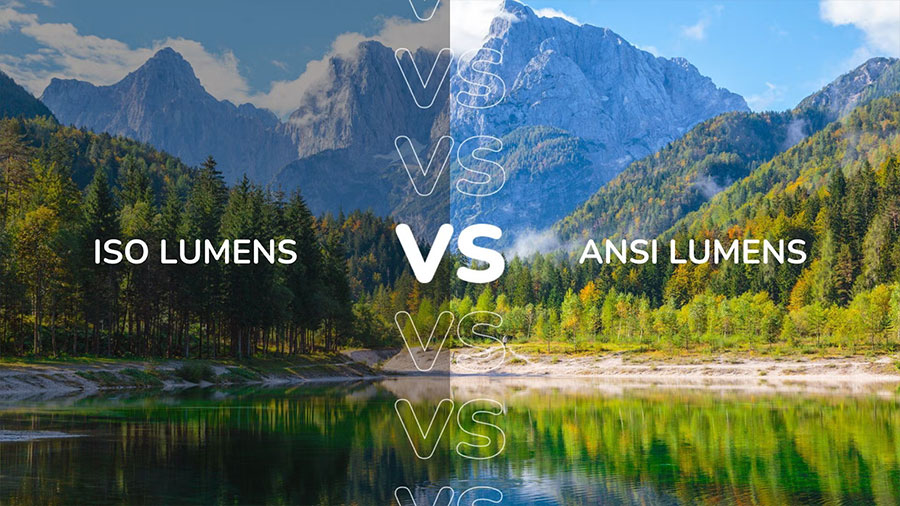
Differences Between ISO Lumens and ANSI Lumens:
Measurement Points
ISO lumen measurement employs a standardized method. While utilizing the nine-point method, it establishes strict standards and limitations regarding external factors such as ambient light, instrument accuracy, and noise, as well as sample inspection.
ANSI lumens use the nine-point measurement method, which simply divides the screen into nine equal parts, measures the midpoint of each region, calculates the average, and reports the result, with fewer restrictions on other factors.
Data Accuracy
ISO lumens involve more restrictive conditions during measurement, making the process more complex and precise, whereas the ANSI lumen testing process is simpler and has fewer restrictions. Therefore, in most cases, ISO lumen data is more accurate than ANSI lumen data.
Standard Development
ISO lumens were established through the collective participation and consensus of global experts and stakeholders, with the primary goal of establishing standardized specifications to promote quality, efficiency, and safety in trade between countries.
ANSI lumens were developed by a consensus committee composed of various U.S. stakeholders from government, academia, and industry to ensure compatibility with domestic regulations and meet domestic market demands.
Regions of Application
The ISO lumen standard is used worldwide, but it is more prevalent among certain original equipment manufacturers (OEMs) in parts of Asia and Europe.
The ANSI lumen standard is gradually being phased out, but it can still be found in best-selling brands in the North American market.
Conversion Between ISO Lumens and ANSI Lumens
Although both ISO lumens and ANSI lumens use “lumens” as their unit of measurement, they are two distinct standards and cannot be directly converted.
However, based on experience, a rough conversion ratio has been established: 1 ISO lumen (ISO 21118) = 1.2 to 1.4 ANSI lumens.
For example, a projector rated at 400 ISO lumens would have approximately 480–560 ANSI lumens. This conversion allows you to make a rough comparison when dealing with different standards.
If you have high demands regarding lumen output, you should still compare devices based on their actual performance in specific usage scenarios, rather than relying solely on numerical values. This conversion ratio is not scientifically rigorous.
Summary
The above explains the differences between ISO lumens and ANSI lumens. ISO lumen measurement is more complex but yields more accurate results, while ANSI lumen measurement is simpler but often results in higher values.
If you’re simply looking to meet personal needs, you can choose based on the display quality at different lumen levels.
FAQs
How are ISO lumens measured?
To measure ISO lumens, the projected image is first divided into nine zones. The brightness at the center of each zone is measured, and the average is calculated. This average is then multiplied by the projected area to determine the lumen value.
During this series of calculations, external factors such as projection distance, noise, and light source power must be strictly controlled and accounted for to minimize their impact on the lumen value.
Why are there two standards: ISO lumens and ANSI lumens?
This situation stems from a combination of political, economic, technological, and cultural factors.
Factors that must be taken into account include policy differences across countries, rapid technological advancements, considerations driven by self-interest, and variations in viewing habits resulting from regional and cultural differences.
Since a unified standard cannot be achieved at this stage, different regions adopt the standard that best suits their specific needs.
Which is more commonly used in everyday applications: ISO lumens or ANSI lumens?
In the past, ANSI lumens were widely adopted and used frequently, but today, ANSI lumens are on the decline, while ISO lumens are more commonly used in everyday applications.
Is 700 ANSI lumens sufficient for everyday use?
This depends on the specific usage environment. In a small presentation space or a room with dim ambient lighting, 700 ANSI lumens is sufficient for everyday use and provides a good viewing experience.
However, in larger spaces or brighter environments, image visibility will decrease, requiring a higher lumen rating to ensure image clarity.
Are ISO lumens and ANSI lumens used in LED displays?
No. Lumens are commonly used in projectors, which project light onto a screen or wall to create an image that is then reflected into the viewer’s eyes—a process known as passive light emission.
LED displays, on the other hand, use self-emitting technology, which is a form of active light emission. The light does not need to be reflected; it enters the viewer’s eyes directly, delivering clear and vivid images.