If you frequently work with LED displays, you’ve probably wondered how they adjust content distribution, manage playback order, and control display effects.
In fact, all of this relies on the powerful management capabilities of LED screen control systems. So, how exactly do these systems manage display playback functions? Read this article to find the answers to these questions.
What Is an LED Screen Control System?
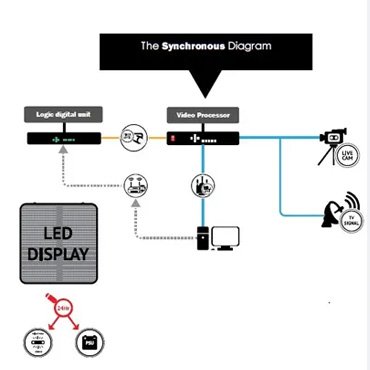
An LED screen control system refers to the control devices and software systems used to manage the display of content on LED screens. It converts signals from content sources into a format that LED screens can read and sends these signals to the receiver cards of the LED modules.
Additionally, the LED screen control system can adjust screen parameters, manage image cropping and display positioning, and optimize the screen’s display quality.
An LED screen control system consists of the following core components:
Master Control Device: Computers, smartphones, tablets, etc., used to issue management commands to the screen.
- Control Devices: These include control cards, transmitter cards, video processors, video controllers, media players, and more; they are the core devices that enable control functions.
- Control Software: Software used in conjunction with control devices to allow users to manage the screen more conveniently and efficiently.
- Transmission System: Includes wireless network transmission and wired transmission systems.
The control system supports a wide range of control functions and features an easy-to-use management interface, making it an indispensable tool for users managing LED screens.
Since the LED screen control system supports both synchronous and asynchronous control modes, and asynchronous control mode places lower demands on the master control device, the components described above may not apply to all modes. Next, we will take a detailed look at the differences between these two control modes.
Synchronous Control Mode vs. Asynchronous Control Mode: A Comparison
For LED screen control systems, selecting different control modes will result in variations in operational convenience and management capabilities.
We have provided a simple comparison of the synchronous and asynchronous control modes for LED screen control systems:
Operating Principles
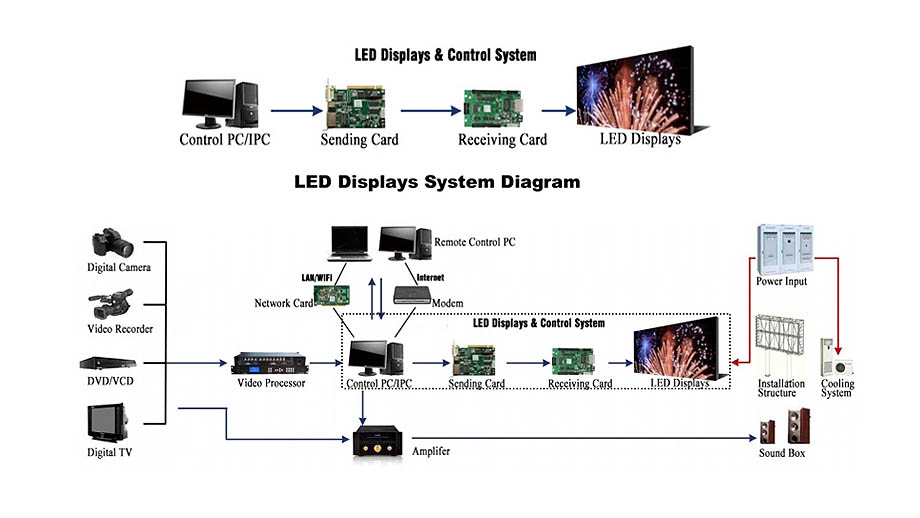
- Synchronous Control Mode: Through real-time signal transmission from the control device, the LED display plays content that matches the source device (such as a computer or camera), achieving synchronized display.
- Asynchronous Control Mode: By loading the content source signal to be played onto the LED screen control system in advance via a USB flash drive or other content source device, you can continuously loop the uploaded content without needing to connect the content source device afterward.
Content Source Signal Volume
- Synchronous Control Mode: In synchronous mode, the system can continuously transmit content source signals and support a large volume of content sources; however, it is subject to limitations imposed by the processor’s specifications. In this mode, attention must be paid to the number and specifications of the processor’s connection ports. If the processor’s processing speed is slow, the screen display may experience stuttering, lag, or other issues.
- Asynchronous Control Mode: In asynchronous mode, the content that the LED screen can display is limited by the storage capacity of the LED control device. Content sources that exceed this storage capacity cannot be uploaded, saved, or played back normally.
Creative Support
- Synchronous Control Mode: Synchronous control mode supports a wide range of display functions. In addition to image roaming mode, it allows for real-time adjustment of image position, size, and aspect ratio, as well as the splicing of multiple images for display. Synchronous control offers extensive display management capabilities, providing unlimited creative possibilities for professional display scenarios.
- Asynchronous Control Mode: The asynchronous control mode of the LED screen control system supports limited methods for displaying content. Common display types for images and text include scrolling up, scrolling down, sliding, and pop-up effects.
Ease of Operation
- Synchronous Control Mode: Synchronous control mode requires real-time management of screen content, and you must continuously monitor the correct connectivity between content source devices, control devices, and the LED display. If the connection is interrupted, display abnormalities will occur.
- Asynchronous Control Mode: Management in asynchronous control mode is very simple. Once the content source signal has been uploaded, you can directly preset the playback mode and sequence for the content; there is no need to use a laptop to manage the screen’s playback effects afterward.
Scope of Application
- Synchronous Control Mode: LED screen control systems that support synchronous control mode typically offer richer functionality and stronger load-bearing capacity, though their procurement costs are relatively higher. They are better suited for large-scale projects and high resolution applications.
- Asynchronous Control Mode: LED screen control systems that support asynchronous control mode generally have simpler functionality, are easier to manage, and have relatively lower procurement costs. They are a cost-effective choice for small LED screens and display projects with very simple content.
Synchronous Control Mode vs. Asynchronous Control Mode: Quick Comparison Table
| Comparison of Features | Synchronous Control Mode | Asynchronous Control Mode |
| How It Works | Transmits and displays video source signals in real time | Plays back content after uploading the source signal in advance |
| Content Source Size | Unlimited | Limited by storage capacity |
| Creative Support | Extensive control functions provide robust creative support | Fewer display modes; creative support is moderate |
| Ease of Operation | Requires real-time management; operation is relatively complex | Simple to operate |
| Cost | Higher cost | Lower cost |
| Scope of Application | Large-scale LED screens, high-end professional display scenarios | Small-scale LED screens, display projects with simple content |
As can be seen, the synchronous control mode of LED screen control systems can handle larger volumes of content source data and offers more comprehensive management functions, making it more suitable for large-scale and high-end professional display scenarios.
In contrast, the asynchronous control mode has lower costs and simpler, more convenient management, making it more suitable for small-scale projects. You should choose the appropriate control method based on your actual needs.
Main Functions of LED Screen Control Systems
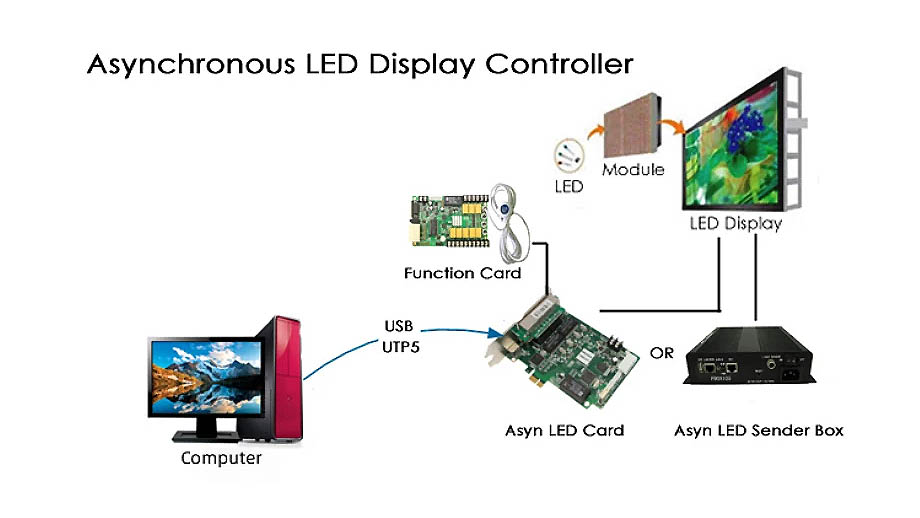
In an LED screen control system, the core control devices provide a wide range of screen management functions, such as:
Automatic Image Scaling
The video controller can automatically scale the input content source signal to match the screen’s resolution. For example, suppose the resolution of your input content source is 3840 × 2160 pixels, while the LED display’s resolution is 1920 × 1080 pixels.
You can set the resolution directly to 1920 × 1080 pixels in the video controller. Once the source signal is read, it will automatically be converted to the set resolution, ensuring the content matches the screen’s resolution for optimal display quality.
Screen Parameter Adjustment
The control device can adjust screen parameters such as brightness and contrast to enhance image quality.
It also supports integration with color calibration devices to perform full screen color calibration periodically, ensuring that the brightness of the LED lamps and color accuracy remain highly consistent, thereby achieving an optimal playback effect.
Seamless Content Switching
Depending on the model, the controller can simultaneously connect to multiple content sources and adjust the content source displayed on the main layer at any time as needed, achieving seamless switching between display screens.
Multi-Screen Tiling
If you need to display multiple screens from different content sources simultaneously, you can use the controller to configure multi-screen tiling or multi-layer display modes:
- Multi-Screen Tiling Mode: All screens are tiled across the LED display in a specific order and at uniform sizes.
- Multi-Layer Display Mode: Multiple content source screens are arranged into multiple layers for display, with the topmost layer’s content displayed first. The order, size, and position of different layers can be adjusted at any time.
Adding 3D Effects
Some controllers also support adding 3D effects to LED screen displays by incorporating auxiliary equipment such as 3D transmitters, transforming originally two-dimensional images into more three-dimensional and visually striking presentations.
For events such as product exhibitions and commercial advertisements, the ability to add 3D effects to displays is highly practical, leaving a profound impression on viewers of the items showcased on screen.
Remote Cluster Management
Some video players support remote cluster management of LED displays. If you have LED displays installed in remote locations or need to manage multiple LED displays within a given area.
The remote cluster management feature of the control equipment can significantly improve your screen management efficiency, allowing you to easily adjust the content displayed on multiple screens without leaving your home.
Well-Known Brands of Control Devices in LED Screen Control Systems
As the core component of an LED screen control system, selecting the right brand of control device can help you achieve optimal management results:
Novastar
Novastar is a leading supplier of LED screen control systems in China, possessing numerous independent intellectual property rights and cutting-edge technologies.
The company offers a range of high quality control devices capable of driving high resolution screens, such as the Novastar VX Series and Novastar H Series; it also provides more affordable options with standard load-handling capabilities, such as the Novastar TB Series.
If your project has a sufficient budget and you require LED screen control devices with powerful, professional management features, Novastar products are an excellent choice.
Colorlight
Colorlight is committed to producing feature-rich LED screen control systems by combining powerful computing capabilities with high quality chips. Its control devices feature an extremely stable synchronization system, and the controllers enable precise content management and screen parameter management for different areas of the LED display.
The company’s popular products include the Colorlight X Series. For LED display projects with moderate budgets and events involving rental LED displays, Colorlight’s LED screen control systems offer better value for money than Novastar products.
Huidu
Huidu is a company specializing in the production of cost-effective LED screen control systems. With over 180 patents, the control devices developed by its engineers, including an IP-free automatic connection system and a cloud-based management platform, significantly enhance management efficiency for LED screen users.
In terms of information security, Huidu’s products have also achieved significant results, with some even obtaining Level 3 Internet Information Security Protection Certification. The company’s popular control devices include the Huidu A Series and Huidu C Series. If you’re looking to set up a small-scale LED screen control system at a low cost, Huidu products are an excellent choice.
Linsn
Linsn is a supplier specializing in the R&D of hardware and software for LED screen control systems. Its equipment features a highly efficient automatic drive system and supports customized services, ensuring strong compatibility between the products and your project.
In terms of software development, Linsn offers the well-known LEDStudio and LedSet; in terms of hardware production, it features the Linsn X Series and Linsn Y Series. For most standard LED projects, choosing Linsn’s LED screen control system can provide you with high management efficiency and excellent value for money, as its products have a very wide range of applications.
FAQ
Are There Any Distance Limitations for Remote Management of LED Screen Control Systems?
If you choose to add a 4G module to your LED screen control system, as long as there is a signal tower in the area where the LED display is installed and the screen maintains a stable network connection, there are no distance limitations when using the media player to manage the LED display’s content playback.
How Do I Choose the Right Software for an LED Screen Control System?
Generally, the user manual for the LED screen control system will specify the control software compatible with the equipment, which you can download directly from the official website. Please note that controllers from different brands can only use the control software from their respective brands.
What Should I Do if the LED Screen Control System Isn’t Working?
If the LED screen control system isn’t functioning properly, you should check the following:
- Check whether the power and signal connections between the control devices, the master controller, and the LED display are loose.
- Check the software configuration version and verify that the software is compatible with the control devices.
- Verify that the load capacity of the receiver cards matches the signal transmission capacity.
Which Brand of Video Control Equipment Is Best Suited for Stage LED Displays?
Since stage LED displays are typically large in scale and have high resolutions, we recommend using LED screen control systems from Novastar. Their products are specifically designed to handle and manage high resolution screens.
Are LED Screen Control Systems Expensive?
The price of an LED screen control system depends on factors such as the product model, load capacity, and other features. Systems with more features and greater load capacity tend to be more expensive. If your display has a lower resolution, you may opt for a budget-friendly LED video player or control card instead.
Summary
An LED screen control system is the key infrastructure for publishing content on LED screens and adjusting display effects. Choosing an LED screen control system with features that match your needs can provide you with more ideal display results and more convenient management and operation.
If you have any further questions about LED screen control systems or LED screens, please feel free to contact JYLED for more information.