As we drive on the roads every day, we’re sure to notice road signs of various colors and shapes. But do you truly understand the meanings of all these signs and the warnings they convey? Let’s follow this guide to take a detailed look at the types and meanings of road signs.
What Are Road Signs?
Road signs, also known as traffic signs, are primarily placed alongside roads and use different shapes and patterns to alert or warn people. Most road signs are made of metal, but in some remote areas and at border crossings, signs are often carved from stone to prevent vandalism and theft.
You can run a quick test to see if you can recognize the traffic signs mentioned in the YouTube video below.
Why Is It Important to Understand Road Signs?
Reducing Accident Rates
When driving through areas with obstructed visibility—such as curves or tunnels—signs indicating curves, tunnels, speed limits, and no-parking zones appear along the roadside. Upon seeing these signs, drivers instinctively slow down in advance and proceed only after ensuring the road is safe. These reminders from road signs can significantly reduce the likelihood of accidents on the road.
Avoiding Traffic Fines and Criminal Detention
Many countries and regions use road signs to warn the public, especially at intersections with heavy traffic. If people ignore the warnings provided by these signs, the consequences range from fines and corrective measures in minor cases to direct detention or imprisonment in more serious cases.
For example, in mid-July 2026, in Ontario, California, a heavy semi-trailer truck traveling on Highway 10 completely ignored road signs indicating the need to slow down and traffic flow warnings, resulting in an 8-vehicle pileup that killed three innocent civilians. The driver was sentenced to nearly five years in prison and, due to his status as an undocumented immigrant, will also face subsequent immigration law charges.
Ensuring Efficient Traffic Flow
Traffic signs erected along roads are established through professional data analysis and surveys based on the actual conditions of the road section (such as traffic volume, sharp curves, and schools), helping pedestrians and vehicles move efficiently. If anyone violates road signs, it can easily lead to various unforeseeable accidents, resulting in traffic congestion. This is particularly evident on highways during holidays.
Ensuring Safety
Whether for pedestrians or drivers, understanding and following the meaning of road signs can effectively ensure safety. A significant portion of the numerous traffic accident reports each year result from pedestrians or drivers failing to follow traffic signs, leading to tragic outcomes. According to statistics and projections released by the U.S. National Highway Traffic Safety Administration (NHTSA), the number of traffic-related fatalities across the United States in 2024 is projected to be approximately 39,254.
Among all instances of driver misconduct leading to fatal accidents, “failure to obey traffic signals, signs, or police directions” was directly linked to approximately 3.7% to 4.4% of driver fatalities. This means that approximately 1,452 to 1,727 people lost their lives needlessly due to failure to obey traffic signs.
Common Road Signs and Their Meanings
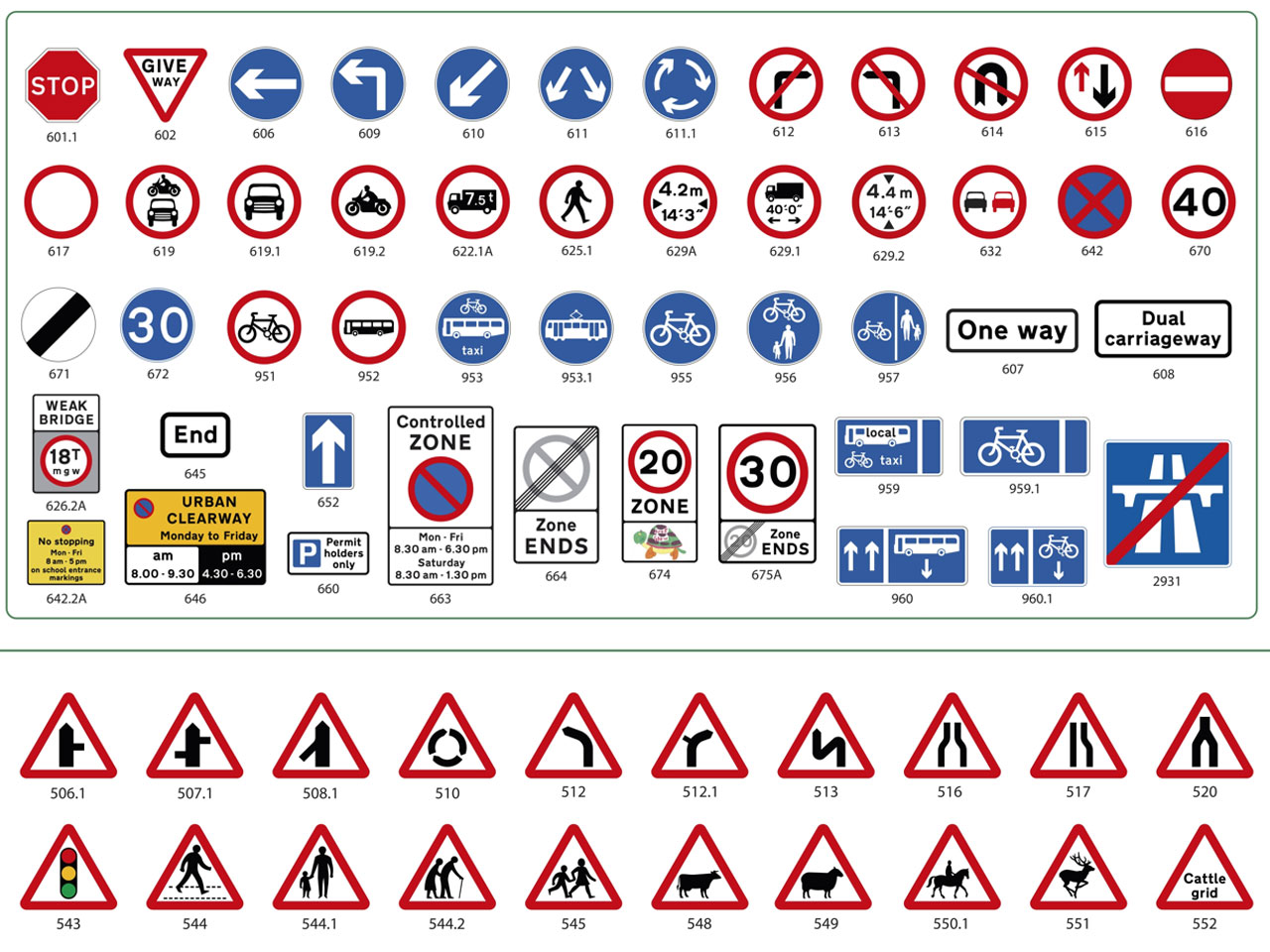
- Stop Sign: Octagonal in shape, consisting of white lines and a red octagon. Meaning: You must stop when pedestrians are crossing, look both ways, and proceed only after confirming it is safe to do so.
- Yield Sign: Triangular in shape, consisting of white lines and a red triangle. Meaning: Give way to pedestrians and other vehicles. If no other vehicles are present, you may proceed.
- Speed Limit Sign: Rectangular or circular in shape; the rectangular version features black text on a white background, while the circular version consists of red outlines with black text on a white background. Meaning: Indicates the maximum speed limit for vehicles; exceeding this speed will result in a fine.
- Crosswalk Sign: Diamond-shaped or rectangular, featuring a yellow background with a black figure. Meaning: Drivers must slow down and proceed with caution within the crosswalk area.
- Traffic Light Ahead Sign: Rhomboid-shaped, with a yellow background and red, green, and blue symbols. Meaning: A traffic light is located ahead; be sure to follow the color signals when proceeding.
- No Parking Sign: Rounded rectangle with a white background, a red circle, and black text in the center. Meaning: Parking is prohibited in this area.
- No U-Turn Sign: Shaped like a rounded rectangle, it features a white background with a red circle and a black U-turn symbol in the center. Meaning: U-turns are prohibited ahead.
- School Zone Sign: Shaped like a regular pentagon, it features a yellow background with black text and symbols. Meaning: A school zone is located ahead; be sure to slow down.
- Railroad Crossing Sign: This sign features a cross and a circle. The cross has a white background with black letters, while the circle has a yellow background with black letters. Meaning: Railroad tracks are present ahead; proceed with caution.
- Construction and Detour Signs: These signs are diamond-shaped or rectangular, featuring an orange background with black letters and symbols. Meaning: Construction ahead, please slow down and drive slowly.
Other Important Traffic Signs
- Speed Bump: Shaped like a rounded triangle, consisting of red lines, a white background, and black graphics. Meaning: A speed bump is ahead; please be aware.
- Slippery Road: Shaped like a rounded triangle, consisting of red lines, a white background, and black graphics. Meaning: Vehicles may skid easily on this section of road; please slow down.
- Lane Merger Sign: Shaped like a diamond, consisting of a yellow background and black graphics. Meaning: Lanes will merge ahead; watch carefully.
- Keep Left or Right Sign: Shaped like a circle, with a blue background and white graphics. Meaning: Stay in the left or right lane and continue driving.
- Deer Crossing: Shaped like a diamond, with an orange-yellow background and a black deer graphic. Meaning: Be aware that deer may cross the road.
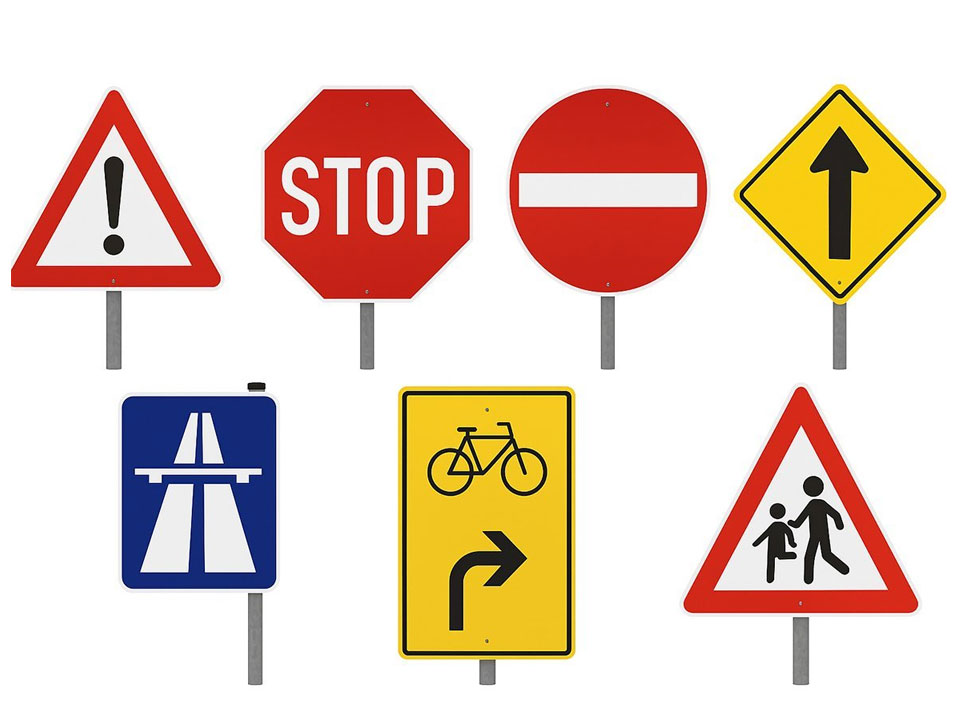
Meanings of Road Signs with Different Colors and Shapes
The various shapes and colors of road signs we see on the road are not randomly designed but follow a strict set of standards. This is to help pedestrians and drivers develop muscle memory. According to the strict regulations of the Manual on Uniform Traffic Control Devices (MUTCD) and the Occupational Safety and Health Administration (OSHA), road signs on public roads must conform to specified colors and shapes. We have summarized some common road sign colors in the table below:
Color | Significance | Flag type |
red | Stop, Prohibit, or Danger | No parking, no U-turns, no entry, no driving against traffic, etc. |
yellow | Warnings and alerts or slowing down | Continuous curves, steep slopes, narrow roads and bridges, pedestrian crossings, slippery road surfaces, etc. |
green | Directional guidance and smooth passage | Exits, place names and boundaries, and signs for highways and expressways, etc. |
blue | Instructions, directives, and place name/route information | Go straight, drive in lanes, place names and route guidance, etc. |
brown | Tourist attractions | Mainly tourist area guides |
White | Different background colors have different meanings. | |
orange color | Road work areas and construction sections | Road construction, detour routes, be aware of animal sightings, etc. |
yellow-green | Warnings related to pedestrian and child safety | Be aware of children, pedestrians, school zones, etc. |
In addition to specifying color coding, MUTCD also established strict standards for the shapes of road signs in the United States. We have compiled some common road sign shapes in a table:
Shape | Meaning | Common uses |
octagon | Stop and yield | Parking sign |
An inverted equilateral triangle (with the apex pointing downwards) | Slow down and yield | Yield sign |
diamond | warn | Bends, deer sightings, merging into traffic, construction zones, etc. |
Rectangle and Square | Vertical rectangle (height greater than width): Regulatory sign Horizontal rectangles and squares: Directional, informational, and service signs | Vertical rectangles: speed limits, no-turn zones, one-way streets, no-entry zones, parking restrictions, etc. Horizontal rectangles and squares: Directional distance forecasts, road names, service areas, gas stations, hospitals, etc. |
round | Warnings and Prohibitions | Railway crossings and no-entry zones |
Pentagon (point pointing upwards) | School area | School intersection, school speed limit |
Long triangle (point to the right) | No overtaking zone | No overtaking sign |
X-shaped | railroad crossing | Railway crossing signs |
Shield | Route number sign | Navigation Identity |
What is the best way to learn road signs?
Method 1: Memorize Common Colors and Shapes
Whether for U.S. road signs or those in other countries, the meanings of colors and shapes are universal. Even if there are minor adjustments, they do not affect the core meaning. For example, the “Danger Ahead” sign is a pointed-corner diamond in the U.S. and Canada, while in Ireland it is a rounded-corner diamond. These subtle differences do not affect overall legibility.
Method 2: Study via the MUTCD Official Website
The MUTCD official website features an 1,162-page PDF document that covers all types of traffic signs. It’s ideal for those who want to delve deeper into traffic sign knowledge.
Method 3: Mobile Apps
Simply search for “traffic signs” in the Google Play Store, and it will list various apps for learning traffic signs. You can download the one that suits you best based on the app’s ratings, description, and screenshots. Whenever you want to learn about a specific traffic sign, you can simply tap on the corresponding icon to study it. Some apps even support photo recognition—when you encounter an unfamiliar sign, just take a photo of it and upload it to easily identify its meaning.
Method 4: Inferring Meaning from Graphics
The meaning of the vast majority of traffic signs can be inferred from their graphics. Only a small number—such as “Give Way to Oncoming Traffic,” “Yield to Oncoming Traffic,” and “Main Road Has the Right of Way”—can be confusing. For example, the “Caution: Pedestrians” sign features a small black figure walking. Combined with the yellow background (which indicates a warning), it’s easy to deduce that pedestrians are crossing ahead and that you should slow down.
Another example is the more abstract “Right-of-Way” sign, which resembles a rocket icon and stumps many people. In reality, it’s quite simple to interpret: when you see this icon, it means you can travel as fast as a rocket in your current lane, and other drivers must yield to you.
Frequently Asked Questions About Road Signs
What does an “activated blank” road sign mean?
This is an electronic traffic sign and also a dynamic blank sign, which does not display any information when not activated. The sign appears white or black. When needed, it is remotely activated to enforce speed limits, prohibit U-turns, or restrict traffic. Therefore, these types of traffic signs are primarily designed to convey real-time information.
Why do some road signs display a bear symbol?
Because some roads pass through dense forests where herds of deer, wild boars, bears, and other wildlife may appear at any time. These warning signs are posted to alert passing drivers. It’s important to note that bears are large and highly aggressive. When driving through these areas, you must slow down and stay alert; it is strictly prohibited to get out of the car, stop, or linger.
Why are some road signs black and white?
Black-and-white road signs are regulatory signs, meaning that violating the instructions on these signs may result in legal liability.
Why are some road signs movable?
Some road signs are integrated with trailers and equipped with LEDs to enable flexible, dynamic traffic control. The most common example is the temporary placement of LED speed limit signs and radar warning signs in construction zones to alert drivers to upcoming roadwork and urge them to slow down.
Summary
Road signs are closely intertwined with our daily lives. Understanding and properly following the instructions they provide can make our lives safer. Through this guide, you’ll gain a detailed understanding of common road signs and learn more about how to interpret them.