Although LCD displays may look similar at first glance, the types of panels they use vary significantly. The three most common types are VA, TN, and IPS.
How much do you know about these three panel types, and what are the differences between them? How should you choose?
The following section will provide a detailed introduction to the differences between these three panel types to help you better distinguish and select the right one.
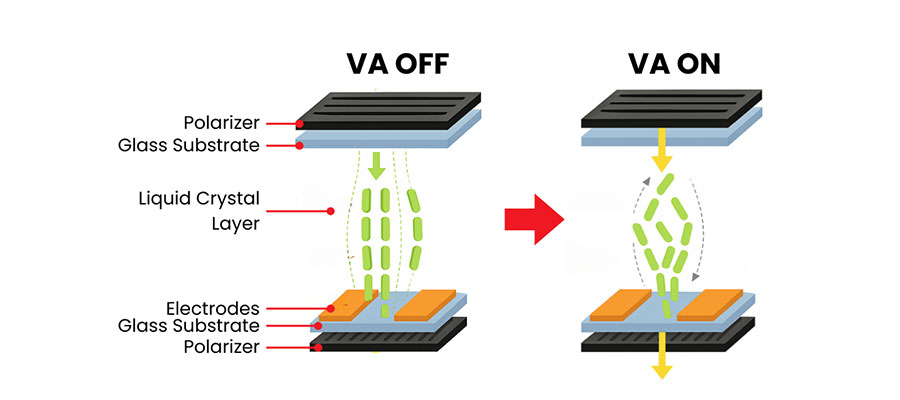
What Is VA
VA (Vertical Alignment) refers to the vertical alignment of liquid crystal molecules. In a VA panel, the liquid crystal molecules are arranged perpendicular to the glass panel. When inactive, they block the backlight, resulting in deeper blacks.
When an electric current is applied, the liquid crystal molecules are activated, tilting to allow light to pass through, thereby forming an image.
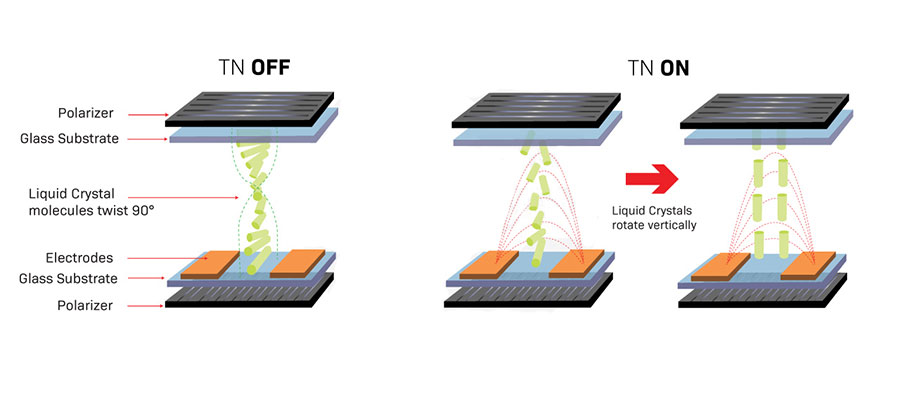
What Is TN
TN (Twisted Nematic) also uses liquid crystal molecules to display images. In a TN panel, the liquid crystal layer is sandwiched between two polarizing filters.
When inactive, the liquid crystal molecules are twisted into a spiral shape (90°) in the middle, allowing polarized light to pass through and form bright areas.
When a voltage is applied, the liquid crystal molecules untwist and align vertically, blocking light to form dark areas, thereby creating variations in brightness.
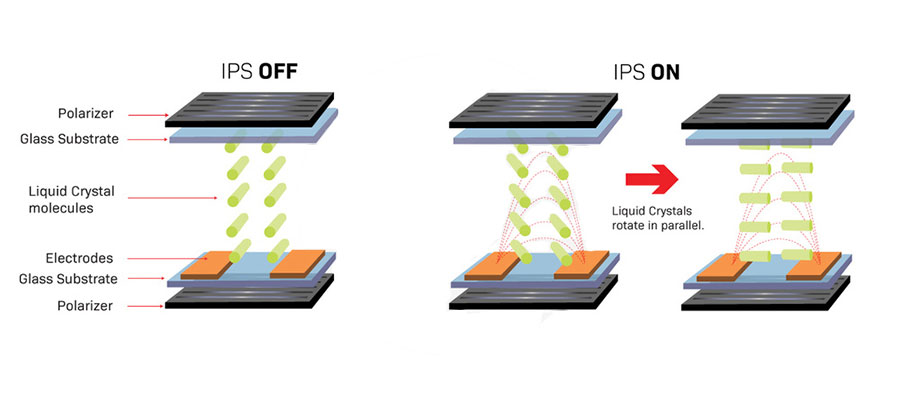
What is IPS?
IPS (In-Plane Switching) refers to the arrangement of liquid crystal molecules parallel to the two substrate layers. When no voltage is applied, the liquid crystal molecules allow light to pass through, producing an image.
With electrodes placed on the same plane, applying a voltage creates a transverse electric field that causes the liquid crystal molecules to rotate parallel to the two-dimensional plane.
This rotation alters the polarization state of the light, and by controlling the light that passes through, the brightness of the image is adjusted.
VA vs. TN vs. IPS: Differences
Contrast Ratio
VA:
Displays made with VA panels typically have a contrast ratio of 3,000:1 to 5,000:1. This is because, when no voltage is applied, the vertically aligned liquid crystal molecules effectively block light, preventing light leakage at the four corners and producing deep blacks.
When voltage is applied, the light output is ample, resulting in a distinct contrast between light and dark areas, thus achieving a high contrast ratio.
VA panels also offer the highest contrast ratio among the three panel types.
TN:
Displays made with TN panels typically have a contrast ratio of only 1,000:1. The arrangement of their liquid crystal molecules provides poor light-blocking performance, resulting in significant backlight bleed.
They are unable to display deep blacks, leading to poor image depth and a low contrast ratio.
IPS:
Although IPS panels cannot completely block the backlight resulting in backlight bleed and poor black levels. However, depending on the backlight technology used and differences in manufacturers’ calibration techniques, the contrast ratios of IPS displays vary between low-end and high-end models.
Low-end IPS displays have a contrast ratio of only 1000:1, which is not much different from TN displays, while high-end models, when combined with high-zone Mini LED backlighting, can achieve a contrast ratio of up to 1,000,000:1.
Color Gamut Coverage
VA:
VA displays have a slightly narrower color gamut than IPS, but they still cover approximately 90% of the DCI-P3 color gamut. Compared to TN displays, this represents a significant improvement in color gamut coverage, delivering richer visuals while meeting everyday usage needs.
TN:
TN panel displays fall far short of the other two panel types in terms of color gamut. With a narrow color gamut covering only 100% of the sRGB space and lower color accuracy, they are suitable only for most everyday use and situations where image quality is not a priority.
IPS:
Displays using IPS panels currently cover 95% to 100% of the DCI-P3 color gamut. With a wide color gamut, they deliver accurate colors, making them a good choice for professional designers.
Response Time and Refresh Rate
VA:
Currently, VA displays on the market commonly feature a refresh rate of 60 Hz, while some high-end models can reach 120 Hz. They are affordable, and VA displays with a high refresh rate of 175 Hz are also readily available.
However, their response time is as long as 4 milliseconds or more, making them the slowest of the three panel types in terms of response time and the lowest in refresh rate. They fully meet everyday and multimedia needs and hold a significant share of the display market.
TN:
The mainstream refresh rates for TN displays generally range from 60 to 140 Hz, with response times as low as 1 millisecond—making them the fastest of the three panel types.
Their extremely high refresh rates and lightning-fast response times make them the top choice for esports monitors today, effectively preventing motion blur and ghosting in competitive gaming.
In some high-end gaming monitors, refresh rates have been upgraded to 400–420 Hz, delivering an exceptionally smooth visual and gaming experience.
IPS:
The refresh rates of IPS displays have also increased from the traditional 60–144 Hz to the current 240 Hz or 360 Hz, with response times improving to 1–3 milliseconds.
These significant improvements in refresh rate and response time have enhanced visual smoothness, but when it comes to pursuing the ultimate in speed and competitive gaming performance, TN displays still have the edge.
Viewing Angles
VA:
VA displays offer viewing angles as wide as 160° or 170°, allowing content to be clearly seen from most directions with virtually no blind spots. This makes them well-suited for multi-user scenarios such as office collaboration and group movie viewing.
TN:
Although TN displays offer excellent speed, their viewing angles are limited—typically 90° horizontally and approximately 60° vertically—which prevents them from delivering optimal display performance in applications that demand high visual clarity.
IPS:
IPS displays also feature wide viewing angles of 178°/178°. They ensure consistent, accurate colors from all viewing angles without color shifts or discrepancies, making them perfectly suited for group viewing.
Cost
VA:
VA displays offer performance that falls between TN and IPS displays, and their price is similarly mid-range, typically costing several hundred dollars.
Although they lack the color accuracy of IPS displays, they offer better viewing angles and image quality than TN displays, making them a highly cost-effective choice.
TN:
TN displays are the most affordable of the three types, available for as low as around $100. With extremely high refresh rates and lightning-fast response times, TN displays are the best choice for users who prioritize response speed over image quality and viewing angles.
IPS:
IPS displays are generally the most expensive, with some high-end models costing several thousand dollars. Their superior image quality, high color accuracy, and wide viewing angles account for their high price and are key reasons why they are the top choice for professional designers.
Below is a table to help you better understand the differences between these three panel types:
| Different | VA | TN | IPS |
| Contrast | 3000∶1-5000:1 | 1000:1 | Low-end:1000:1 High-end:1000000:1 |
| Colour accuracy | Approximately 90 per cent of the DCI-P3 colour gamut | 100% sRGB colour gamut | 95%–100% DCI-P3 colour gamut |
| Response time | ≥4ms | ≤1ms | 1-3ms |
| Refresh rate (max) | 240Hz | 600Hz | 1000Hz |
| Viewing angle | 160°/170° | 60°/90° | 178°/178° |
| Price | middle | low price | high price |
VA vs. TN vs. IPS: How to Choose Among These Three Panel Types
VA
- If you enjoy watching movies and have certain expectations for image quality, but your budget is limited.
- If you often play video games in dimly lit environments but aren’t chasing the absolute highest frame rates.
- If you want to experience a curved screen and vivid, high-contrast visuals.
If your needs match the conditions above, a monitor with a VA panel is your best choice.
TN
- If you frequently play fast-paced competitive games like FPS and MOBA titles.
- If you have extremely high demands for monitor response time.
- If you’re not concerned about image quality but prioritize the gaming experience or have a limited budget.
A TN monitor will be your best choice, allowing you to get a better gaming experience at the lowest price.
IPS
- If you’re engaged in professional creative work and frequently need to collaborate with others.
- If you have higher demands for color accuracy and reproduction.
- If you need detailed, vivid display effects and a superior visual experience.
An IPS monitor should be your top consideration—it not only delivers high-quality visuals but also meets virtually all your professional design and gaming needs.

Besides these three LCD display technologies, what other display technologies are available?
Currently, direct-view LED and OLED display technologies are also commonly used on the market.
Direct-view LED is a self-emissive display technology. Direct-view LED screens are typically assembled from modular LED cabinets, making disassembly and assembly more convenient and flexible.
In practical applications, LED screens can be custom-sized to meet project requirements, delivering seamless large-screen displays with vivid visuals and an excellent viewing experience. They adapt well to both indoor and outdoor environments.
OLED display technology is also a self-emissive technology capable of displaying true black, offering unlimited contrast. Its wide color gamut ensures that displayed colors appear true to life and natural, enabling accurate color reproduction.
However, its brightness is relatively low, making content difficult to see under direct sunlight, and there is a risk of screen burn-in.
Summary
Based on the above introduction to the three panel types, we know that IPS panels currently dominate the market, offering a wider color gamut and viewing angles, as well as higher contrast and refresh rates—though they also come at a higher price.
TN panels have the fastest response time and are the most affordable. VA panels fall between the two, offering a high cost-performance ratio.
In addition to the three panel types introduced above for general consumers, if you are interested in commercial displays and have customization needs, please feel free to contact us at JYLED. We will tailor LED displays specifically to your project requirements.
FAQs
Do different panel types cause different levels of eye strain?
No. The panels themselves do not cause eye strain; however, prolonged use of electronic devices and poor usage habits can lead to this condition. Proper and moderate use can significantly reduce and prevent this issue.
Which panel is best suited for gamers?
It depends on the specific game genre.
If you frequently play FPS games like CS:GO or MOBA games like League of Legends, prioritize competition and combat, and aren’t concerned with the visual fidelity of the game—but instead value every millisecond of gameplay—then a TN panel is your best choice.
If you prefer to experience a game’s storyline and appreciate its visuals—playing mostly AAA titles like Red Dead Redemption and Elden Ring or indie games—an IPS panel is your best choice. Its excellent color reproduction allows you to immerse yourself in every frame.
Which panel technology is currently the most widely used on the market?
LCD panel technology is currently the most widely used on the market. It has matured significantly and is used in everyday life, industrial manufacturing, and medical equipment.
Additionally, with its many sub-technologies, LCD technology is applied in everything from small screens costing as little as a few dozen dollars to display devices priced in the thousands.
VA, TN, IPS: Which of these three panel types is the most common?
IPS panels. IPS panels are currently the most widely used on the market. They lack any significant or critical drawbacks, such as the poor image quality of TN panels or the excessively long response times of VA panels.
They strike a good balance between work and gaming, making them suitable for a wider range of applications.
Is it still worth choosing a TN panel monitor today?
It depends on the situation:
If you’re on a tight budget but want a relatively fast monitor with decent performance, there’s absolutely no need to choose a TN panel monitor.
At lower price points, TN monitors aren’t much faster than IPS monitors in the same price range, and their performance doesn’t measure up to IPS either. In this case, an IPS panel monitor is a better choice than a TN monitor.
If you have an unlimited budget and are solely pursuing the highest possible refresh rate—perhaps for use as a professional esports player—you might consider purchasing a professional-grade TN-panel monitor.