When shopping for an LED display, refresh rate is often one of your top considerations, as this parameter significantly impacts the display’s visual quality.
As the most widely used refresh rate in today’s display market, 3840 Hz strikes the optimal balance between price and display performance, offering you excellent value for your money.
Let’s take a closer look at what 3840 Hz really means and how it achieves this balance between performance and cost.
What Is a 3840 Hz Refresh Rate on an LED Display?
The refresh rate of an LED display refers to the frequency at which the screen repeats the current image per second, measured in hertz (Hz). It is closely related to the visual experience of the displayed content, including but not limited to playback stability and screen flicker.
What Does 3840 Hz Represent?
In the context of LED displays, 3840Hz indicates the number of times the LEDs switch on and off—3840 times. Simply put, the LEDs flash 3840 times.
What’s the difference between an LED display’s refresh rate and its refresh frequency?
The refresh rate of an LED display refers to the number of times an image is repeated per second, while the refresh frequency refers to the number of times the screen updates its image data per second—that is, how many images can be displayed within a second.
Due to these different definitions, the refresh rate of an LED display is typically a multiple of 1,920, while the refresh rate is usually a multiple of 60.
In which types of LED displays is a 3840 Hz refresh rate commonly used?
As a refresh rate widely used in JYLED’s current product lineup, 3840 Hz can be found in many types of LED displays.
Fixed LED Displays
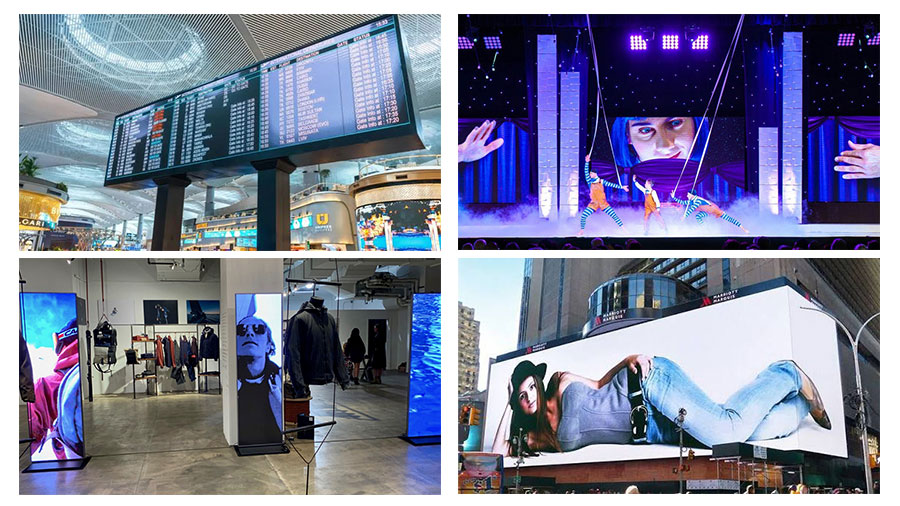
Fixed LED displays are commonly used in large stadiums, airports, train stations, and similar settings. A 3840 Hz refresh rate ensures that the LED display maintains smooth and stable visual effects during information transmission and display, delivering an excellent viewing experience and effective information dissemination.
Rental LED Displays
Rental LED displays are frequently seen at large-scale events such as corporate annual meetings and concert stages. A 3840Hz refresh rate ensures basic quality for on-site photography; the LED screen is less likely to exhibit motion blur or screen flicker, resulting in relatively clear photographs.
LED Posters
LED posters are commonly used for brand promotion or event advertising in shopping malls. In most cases, a higher refresh rate results in better display quality. Therefore, LED screens with a 3840 Hz refresh rate can produce detailed, high-quality images that attract more customers’ attention, making brand promotion more effective.
Outdoor LED Displays
In high-traffic outdoor areas such as large shopping malls and commercial streets, using large outdoor screens with a 3840 Hz refresh rate can produce bright, vivid visuals while ensuring the display remains stable and reliable for viewers outdoors.
Why Has 3840 Hz Become a Common Refresh Rate for LED Displays?
Reducing the Frequency of Scan Lines in Recorded Videos
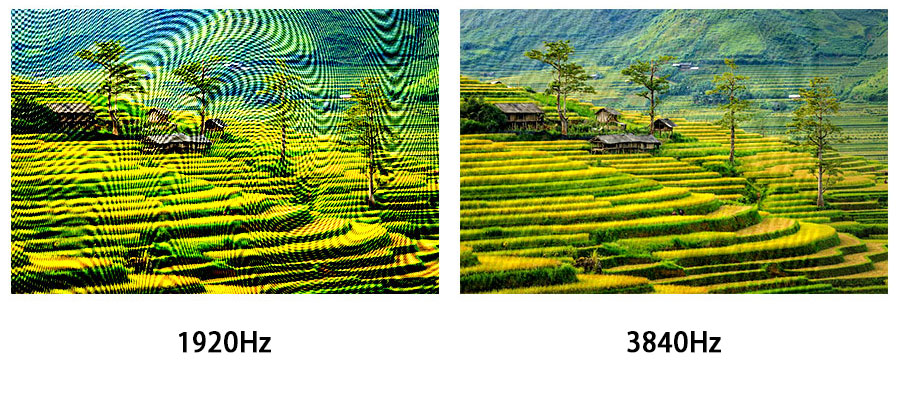
In the past, with 1920Hz LED screens, the refresh rate was too low, causing black horizontal lines—known as scan lines—to appear in videos recorded with a smartphone.
Although these lines are invisible to the naked eye, they create noticeable patterns in the recorded footage, which can hinder further sharing on social media platforms.
LED displays with a 3840Hz refresh rate, however, can significantly reduce this phenomenon. Content recorded from these displays remains virtually unaffected for viewing.
For those seeking to facilitate further sharing and expand the reach of their content, choosing a 3840Hz LED display is an excellent option.
Reducing Screen Flicker
Whether viewed with the naked eye or captured by a device, a 3840 Hz LED screen generally exhibits no noticeable screen flicker. In contrast, screens with lower refresh rates and mismatched timing may cause flickering or distortion during recording.
Additionally, LED screens with lower refresh rates may exhibit screen flicker, which can strain the eyes during prolonged viewing, leading to fatigue and dryness. In contrast, the higher-refresh-rate 3840Hz LED screen effectively prevents this issue.
Reducing Pattern Interference During Filming
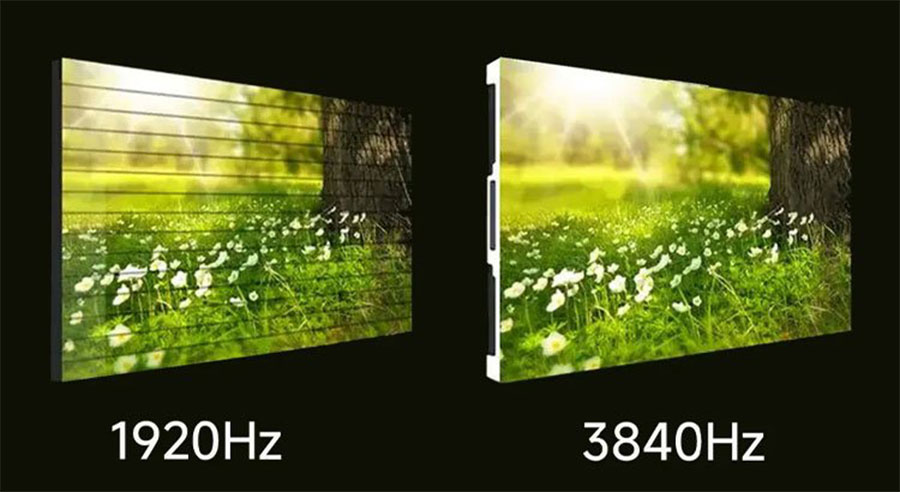
Whether using a 1920Hz LED screen with a lower refresh rate or a 3840Hz LED screen with a higher refresh rate, some rippling patterns will appear in the screen content when captured on camera.
However, in images taken with high-refresh-rate screens, the pattern area is smaller and the impact is less significant, ensuring a satisfactory viewing experience for the displayed content.
The three points above are the main reasons why 3840Hz has become a common refresh rate for LED displays, but another important factor is the purchase price.
Currently, the price of LED displays with a 3840Hz refresh rate is not significantly different from those with 1920Hz, truly achieving a perfect balance between price and performance. They meet the needs of most applications and offer excellent value for money.
How to Determine if an LED Display Truly Reaches 3840Hz?
There are many ways to determine whether an LED screen truly achieves 3840Hz. Below, we introduce several simple, convenient, and reliable methods:
Check the Driver IC and Product Specifications
The simplest way is to directly visit the official website or consult the printed manual to review the specific specifications of the product’s driver IC and refresh rate parameters.
Note that most LED screens with a 3840Hz refresh rate use PWM-SS driver ICs; if the driver IC specifications differ, you should pay special attention.
Conduct a Shutter Test Using a Camera
You can also use a smartphone, camera, or other imaging device to verify this. JYLED’s 3840 Hz LED screens do not typically exhibit large-area pattern interference when viewed through a camera lens, so it won’t significantly affect the viewing experience.
If scan lines or ripples are particularly severe, it indicates a lower refresh rate that does not meet the 3840 Hz standard.
Testing at Different Brightness and Gray Scale Levels
This method is more complex than the previous two and requires the use of professional photodetectors and digital storage oscilloscopes.
By inputting different LED screen brightness and LED display gray scale levels, the repetition period of the photocurrent pulses is calculated to determine whether it remains stable at around 260 microseconds (i.e., 3840 Hz).
Avoid Relying Solely on Nominal Values in Software
When purchasing, it is also important to note that some unscrupulous manufacturers may present falsified data—manipulated via control software—as the display’s actual performance.
In other words, although the software may indicate a 3840 Hz LED screen, the actual refresh rate in use may only reach 1,920 Hz. Therefore, when making a purchase, pay attention to the actual data measured by instruments to avoid being misled by false advertising.
Is it still necessary to choose a 1920 Hz refresh rate today?
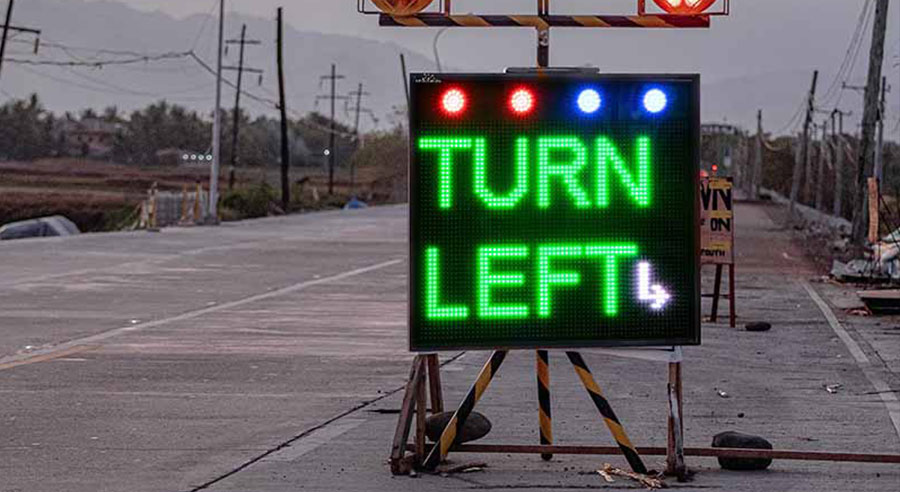
While a 3840 Hz refresh rate is now widely used, and most LED displays start at 3840 Hz, for certain traffic signs—which are typically used solely for information display and have limited budgets—a 1920 Hz refresh rate can still be a viable option.
Conclusion
This article provides a detailed overview of 3840Hz LED displays, covering what a 3840Hz refresh rate is, its advantages, and how to identify it. We hope this information will assist you in selecting an LED display.
If you are interested in purchasing a 3840Hz LED display but still have questions about the specific selection process, please feel free to contact us at JYLED. We will provide you with expert guidance and the most reliable display equipment.
FAQs
Are there other refresh rates besides 3840 Hz?
Yes. There are also 1920 Hz, 7680 Hz, and others; however, the 1920 Hz refresh rate is gradually being phased out of the LED display market. Currently, the mainstream options are 3840 Hz and 7680 Hz.
What is the future outlook for the 3840 Hz refresh rate?
The 3840 Hz refresh rate will continue to be widely used for the time being. However, in the future, as LED screen hardware performance improves and display technology advances, the 3840 Hz refresh rate may be replaced by 7680 Hz and gradually phase out of the LED display market.
Is a higher refresh rate always better for LED displays?
Theoretically, the higher the refresh rate of an LED display, the better the image quality.
However, in practical use, the display quality of an LED screen is not determined by the refresh rate alone but by the combined performance of all its electronic components (such as the driver IC model and PWM dimming capabilities).
If only the refresh rate is increased while the performance of other hardware components remains inadequate, the display quality will not improve—it may even deteriorate.
Can the naked eye directly distinguish between a 1920 Hz display and a 3840 Hz display?
No. Both 1920 Hz and 3840 Hz displays exceed the limits of human visual perception. We can, however, use a lens to observe whether horizontal scan lines are visible in the image, which provides a simple and clear way to determine the display’s refresh rate.
How can the refresh rate of an LED screen be increased?
The refresh rate of an LED display can be increased by upgrading the performance of electronic components and technologies—such as changing the driver IC model, enhancing PWM dimming capabilities, and improving pre-shipment calibration techniques.
Among these, the most effective method is to replace the LED display drivers.