Flip chip LED displays vs SMD utilize two distinct packaging technologies, each offering unique advantages. Let’s delve into the differences between these two packaging methods to help you make a more informed choice.
What is an SMD LED Display?
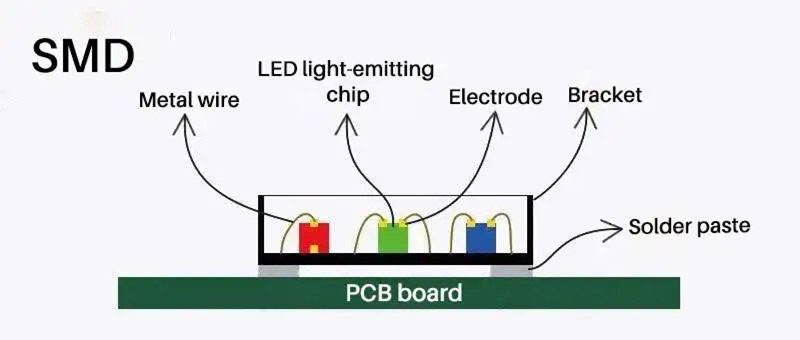
SMD displays utilize Surface Mount Device (SMD) packaging technology. This method involves mounting components directly onto a PCB board, where the light-emitting chip is assembled into an individual LED lamp bead.
This packaging technique is simpler and applicable to a broader range of LED display applications.
What is a Flip Chip LED Display?
A flip chip LED display utilizes flip chip COB packaging technology. Essentially a type of COB LED display, it employs a more sophisticated packaging technique where the chip is mounted upside down within the LED housing to achieve superior heat dissipation.

Flip Chip LED Display vs SMD: Key Differences
Having covered the basics of flip chip LED displays vs SMD, let’s explore their key differences.
Brightness
In terms of brightness, SMD LED displays generally offer higher luminance. This versatility makes them suitable for both indoor and outdoor applications. Their compact size and large surface area contribute to higher brightness levels.
Therefore, compared to flip chip LED displays, SMD LED displays demonstrate superior brightness.
Color Accuracy
Both SMD and flip chip LED displays offer excellent color accuracy. However, if forced to choose a winner, flip chip LED displays edge out slightly due to their more precise design, which enables perfect color matching.
Environmental Resistance
Regarding environmental resistance, flip chip LED displays employ more intricate and complex packaging technology, making them less resilient to external forces. SMD LED displays, however, can be used both indoors and outdoors, offering relatively stronger environmental resistance and durability.
Maintenance Requirements
Regarding maintenance, SMD LED displays are less prone to damage due to their superior environmental resilience. Even when damaged, SMD displays are simpler to replace and repair, resulting in lower overall maintenance costs.
The intricate structure of flip chip LED displays extends repair times, leading to slightly higher maintenance expenses.

Flip Chip LED Displays vs. SMD: Suitable Applications
Regarding application scenarios, flip chip LED displays, with their lower brightness, are more suitable for indoor use. Their high precision makes them ideal for LED displays requiring higher resolution and smaller pixel pitch.
SMD LED displays, however, cover a broader range of packaging technologies, making them suitable not only for indoor but also outdoor applications, such as LED billboard for promotion and display.
Flip Chip LED Displays vs. SMD: Which Has Higher Costs?
Cost analysis can be approached from both initial purchase price and long-term expenses:
- Initially, flip chip LED displays carry a higher procurement cost than traditional lighting solutions, while SMD LED displays offer relatively lower upfront expenses. However, an exception exists: for ultra-fine pixel pitch displays like P1, flip chip technology-based LED displays become more cost-effective.
- Long-term costs reveal that flip chip LED displays may incur slightly higher maintenance expenses than SMD displays. Consequently, SMD LED displays generally offer lower long-term costs.
Overall, except in specific scenarios, SMD LED displays represent the more economical choice.
Flip Chip LED Displays vs. SMD: How to Choose?
Flip chip LED displays vs SMD each offer distinct advantages. Select based on your specific requirements, considering environmental factors, pixel density, and budget before purchasing.
If you have sufficient budget and plan to install a large high-definition display indoors, we recommend flip chip LED displays. Compared to other high-definition large displays, they can be more conveniently transported indoors and assembled on-site. Conversely, for outdoor large LED display installations, SMD LED displays are recommended.
Considering these factors will help you quickly identify the most suitable LED display for your needs. Should you have any questions, feel free to contact JYLED Display Manufacturer via the contact information on the right. We will provide you with a perfect LED solution.