



LED display flat cables are essential components widely used in LED cabinets to connect internal components.
When assembling an LED display, have you ever wondered what role they play? This article provides a detailed introduction to LED display flat cables to help you fully understand them.
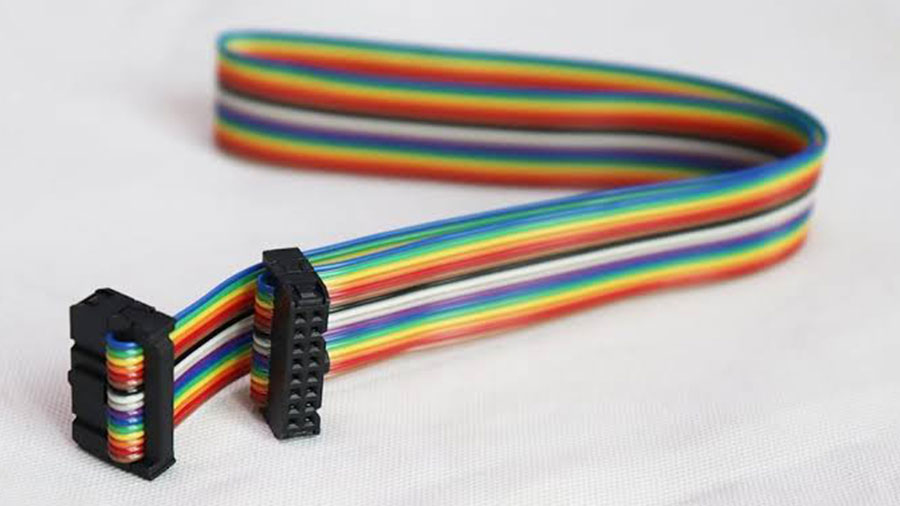
What Is an LED Display Flat Cable?
An LED display flat cable consists of a row of conductive wires arranged in parallel within a wide, flat ribbon cable base; it is also known as a flat cable. It is commonly used to transmit commands and data from the control card to each LED module, serving as a data transmission medium.
Components of a Flat Cable
A complete flat cable primarily consists of three parts: conductors, insulation, and connectors.
Conductors
Conductors are the “core wires” of the cable. Most are made of bare copper wire or tinned copper wire. They come in both single-strand and multi-strand varieties, and the choice depends on various factors such as the cable’s electrical characteristics and intended application.
Insulation
The insulation layer surrounds the conductors and is commonly made of materials such as polyvinyl chloride (PVC), cross-linked polyethylene (XLPE), or fluoroplastics.
Currently, PVC is the most widely used material. It keeps water, air, and other substances out while containing the electrical current inside, thereby preventing electrical leakage and short circuits and ensuring the safety of users.
Connectors
The quality of the connectors also determines the quality of the cable to a certain extent. The connectors in LED display flat cables are commonly referred to as “IDC connectors.”
They are primarily made of engineering plastics such as PBT, PA6T, or PA46, which are heat-resistant and durable. The main difference among these connectors lies in the number of pins.
Advantages of LED Display Flat Cables
Flat cables offer many unique advantages in practical applications:
- Lightweight, Thin, and Compact: Flat cables are lightweight and thin overall, taking up minimal space, making them an excellent choice for ultra-thin LED cabinets and portable rental displays.
- High Convenience: Flat cables feature unique connectors; users simply need to locate the corresponding interface on the component. Since the interfaces generally correspond to the components and the cables are neatly arranged, no extra time is required to organize the wires.
- Neat and Aesthetic: When used in LED displays, the length of flat cables generally matches the distance between components, eliminating excess cable length. After connection, cable ties are used to organize the power cables, resulting in a neat and aesthetically pleasing arrangement.
- High Flexibility: Flat cables can withstand minor bending and twisting, allowing them to flexibly change shape without damaging the internal conductors.
- Reliable and Durable: Flat cables effectively block external interference with transmitted signals, ensuring stable signal transmission and consistent, clear screen images. This is due to the high electrical and dielectric properties provided by their special structure.
Classification of Flat Cables
Flat cables are further subdivided based on their length and number of pins.
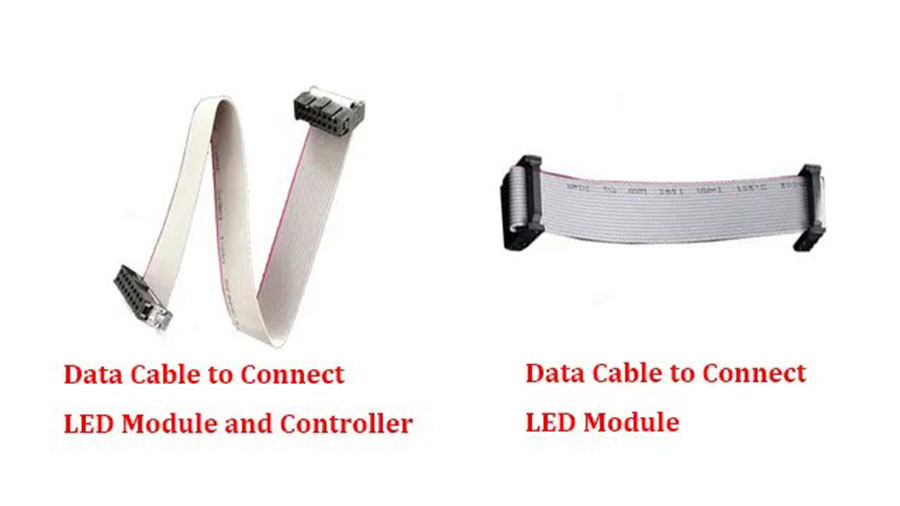
Classification by Length
We classify the lengths of LED screen flat cables based on the common cabinet dimensions of 500 × 500 mm or 500 × 1000 mm.
Short Flat Cables
Flat cables with lengths between 80 and 100 cm are typically classified as short flat cables. Since a single control card in a cabinet can drive 4–6 modules simultaneously, short flat cables connect the modules within the LED cabinet to one another, enabling the modules to display content simultaneously and fully utilizing the control card’s load-carrying capacity.
Long Flat Cables
When the distance between modules and control cards is significant, longer flat cables are required for connection.
Therefore, long flat cables range in length from 120 to 150 cm. They are commonly used to connect control cards to modules within LED cabinets and to transmit data from the signal card to the modules for playback.
The table below provides a visual comparison of the two cable types
| Name | Long flat cable | Short flat cable |
| Length | 120- 150 cm | 80- 100 cm |
| Link items | Control cards and modules | Module and Module |
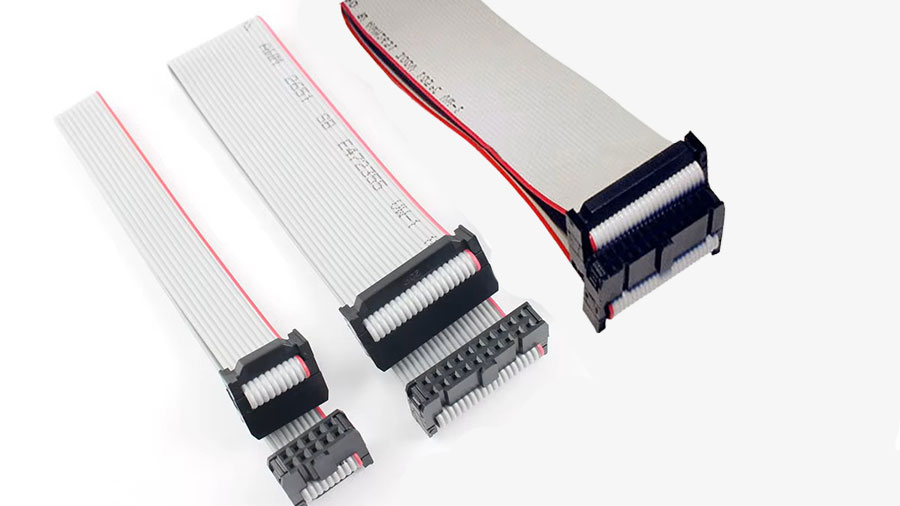
Classification by Number of Pins
The most common connector pin counts on the market are 16P, 20P, and 26P. While the pin counts are mostly standardized, there are a few modules with special formats that require custom pin counts, though these typically require a minimum order quantity.
16P Flat Cable
The 16P flat cable corresponds to the HUB75E interface in LED modules, which has 16 pins and is specified as a 2×8 dual-row pin header. In IDC connectors, the pitch between pins is generally 1.27 mm.
Due to the limited number of pins, data transmission capabilities are modest; these cables are commonly used for indoor module interfaces and in small monochrome LED displays or simple information displays.
Additionally, because of the limited number of pins and simple structure, 16P flat cables have a lower cost and are correspondingly more affordable, making them a good choice for LED display projects with modest requirements and limited budgets.
20P Flat Cable
The 20P flat cable corresponds to the HUB75 connector, which has 20 pins arranged in a 2×10 dual-row configuration. The connector is typically an IDC connector with a standard pitch of 2.54 mm or 2.0 mm.
The increased number of pins significantly enhances the cable’s data transmission capacity, enabling the transmission of color images and animations.
It is frequently used in medium-sized LED displays, such as those for indoor advertising, information signage, or conference room screens.
Additionally, 20P flat cables are often used in LED displays that require control functions, as the extra pins allow for features such as screen zoning and brightness adjustment.
26P Flat Cable
The 26P flat cable has 26 pins (2×13 dual-row pins) and is compatible with the HUB26 interface or certain highly compatible HUB75/HUB75E expansion interfaces, with a standard pitch of approximately 2.54 mm.
Compared to the two models above, the 26P flat cable takes both control capabilities and data transmission capabilities to new heights.
At the same time, upgrades in anti-interference and shielding technologies ensure that the 26P flat cable can meet the data transmission and application requirements of both large outdoor LED displays and high-end indoor fine-pitch screens, delivering clear and smooth image display.
Use the table below to quickly understand the three types of flat cables
| Name | 16-pin flat cable | 20-pin flat cable | 26P flat cable |
|---|---|---|---|
| Number of pins | 16 (2×8 dual-row pin header) | 20(2×10 dual-row pin header) | 26(2×13 dual-row pin header) |
| Corresponding interface | HUB75E | HUB75 | HUB26 or certain HUB75/HUB75E models with high compatibility expansion ports |
| Pin pitch | 1.27mm | 2.54mm or 2.0mm | 1.27mm or 2.54 mm |
| Areas of application | Indoor modules or small monochrome displays | Indoor full-colour medium-sized display or control panel | High-end full-colour indoor and outdoor displays |
Introduction to Other LED Display Cables
In addition to flat cables for LED screens, LED cabinets contain several other types of cables. Below is a brief introduction based on the different conductor materials used inside the cables.
Bare Copper Flat Cable
Bare copper flat cables are now very rare in the LED display market and are virtually phased out. This is because bare copper flat cables are made solely by coating brass wires with oxygen-free copper.
Their relatively simple construction results in poor signal transmission, a short service life, and low flexibility, making them prone to breakage.
It can be said that, aside from their low price, they have virtually no other advantages. Currently, almost no LED displays use this type of cable.
Aluminum-Magnesium Flat Cable
Aluminum-magnesium flat cables, as the name suggests, use aluminum-magnesium alloy wire—composed of aluminum and magnesium (1–3%) as the conductor.
Upgrades in manufacturing processes and the addition of magnesium have significantly improved performance and offered more practical advantages.
While maintaining a low price, these cables can adapt to a wider range of operating environments, provide better heat dissipation, effectively extend service life, and are lighter in weight.
However, in addition to its advantages, aluminum-magnesium flat cable also has some drawbacks that cannot be overlooked: its transmission distance is limited, as is its data transmission capacity, making it unsuitable for scenarios requiring long-distance, high-data-volume transmission.
Tin-Plated Copper Flat Cable
Tin-plated copper flat cable is the most widely used of these three types in LED displays. The primary material is oxygen-free copper wire or gold wire, with a thin layer of tin applied to the outer surface of the copper wire via a hot-dip tinning process.
The introduction of the tin-plating process has brought a qualitative improvement to the overall performance of the flat cable, providing it with longer transmission distances and corrosion resistance.
It has a service life of 5–8 years and offers a certain degree of interference resistance, ensuring clear data transmission.
Tin-plated copper flat cables and bare copper flat cables are opposites: the only drawback of tin-plated copper flat cables is their price, while the only advantage of bare copper flat cables is their lower cost.
Tin-plated copper flat cables are typically 20%–40% more expensive than aluminum-magnesium alloy cables, making them the most expensive of the three cable types; however, when considering their service life, they offer the best value for money.
Precautions for Using LED Display Flat Cables
When using LED flat cables in practice, pay attention to the following points to ensure correct and safe operation:
- Before use, verify the voltage and current in advance to ensure the cable’s rated current meets the total load power. This prevents power mismatches that could cause the LED screen’s image to fail to display properly.
- Select an IP protection rating and temperature range suitable for the specific operating environment; otherwise, the flat cable’s service life may be reduced to some extent.
- Pay attention to installation force and product limitations; when bending the cable, verify that it complies with usage requirements to prevent internal breaks.
- Ensure the power is turned off before performing any wiring work; all wiring must be carried out with the power completely disconnected.
- During installation, control the force applied; do not pull, squeeze, or twist the cable with excessive force to avoid damage.
- Once installation is complete, use cable ties to secure the various cable sections. This keeps the setup neat and prevents the cables from becoming tangled during subsequent handling.
Summary
The above provides a detailed introduction to various types of LED flat cables. As one of the most common components, LED screen flat cables are typically used in conjunction with other components.
If you’d like to learn more about other components, please feel free to contact us at JYLED—we’ll be happy to provide you with further expert insights.
FAQs
Can a longer flat cable be used as a substitute for a shorter one?
If the two cables are the same model but differ only in length, a longer flat cable can be used as a substitute for a shorter one.
There is essentially no functional difference between the two; however, a longer flat cable may not look as neat as a shorter one.
Which conductor material provides the best performance?
Flat cables using tinned copper as the conductor offer the best performance.
As the current industry standard and a mature technology, tinned copper provides excellent service life, corrosion resistance, electromagnetic interference (EMI) resistance, and flexibility, making it the best option among the three materials.
Are there other cables that can replace LED display flat cables?
Currently, there are no other cables that can serve as a direct replacement.
However, we can integrate the control card and flat cable onto a single hub board and mount the LED modules directly onto the hub board, thereby eliminating the need for the flat cable and optimizing the system.
What impact does poor contact in flat cables have on LED displays?
Poor contact in LED flat cables can obstruct data signal transmission, causing partial or complete blackouts on the LED display.
Sometimes, this can also result in distorted images, color distortion, or flickering, which degrades the overall display quality or even renders the LED display inoperable. Prolonged poor contact may also lead to localized short circuits, damaging the LED display.
Can I purchase LED display flat cables separately from JYLED?
Of course. However, we generally do not recommend purchasing LED display flat cables separately because they are relatively inexpensive and required in small quantities, resulting in high overall shipping costs.
We recommend shipping them as LED display accessories along with the LED screens for your project, which eliminates the need for additional shipping charges.

