For professionals in the electronics industry, hobbyists, and anyone else involved in electronic circuit design, understanding diodes is essential. As a fundamental electronic component, the diode plays a crucial role in circuit systems.
The following section provides a detailed introduction to diodes, covering their principles, functions, and applications, to help readers gain a comprehensive and efficient understanding of diodes.
This knowledge will enable you to use diodes more safely and accurately in your future circuit designs.
What Is a Diode?
A diode is a two-terminal electronic component that allows current to flow in only one direction.
The “Di” in “diode” stands for “two,” and “ode” stands for “poles,” indicating that it is typically composed of two types of semiconductor materials, also referred to as two terminals: p-type (anode) and n-type (cathode).
Its two terminals are often connected to form a PN junction that controls the direction of current flow (from the anode to the cathode) and strictly restricts and blocks current flow in the opposite direction. In circuit diagrams, the direction of current flow is commonly indicated by the orientation of the vertex of a triangular symbol.
How a Diode Works
A diode utilizes the PN junction to achieve different operating modes, which are specifically divided into two types:
- Forward-biased state: Current flows normally.
- Reverse-biased state: Current flow is blocked.
A special region called the depletion region forms at the junction of the PN junction. The depletion region changes depending on the polarity of the applied voltage, as follows:
- When the P-type terminal is connected to the positive terminal and the N-type terminal is connected to the negative terminal, a forward voltage is applied. The diode is in a forward-biased state, the depletion region disappears, and current can flow normally without obstruction. In this case, the diode acts as an efficient conductor.
- When the P-type and N-type terminals are connected incorrectly, a reverse voltage is applied, and the diode is in a reverse-biased state. In this state, the depletion region expands, acting as an insulating layer that prevents current from flowing normally.
Therefore, we can say that a diode acts as a bridge in a circuit: when forward-biased, the bridge is established, allowing current to flow smoothly; when reverse-biased, the bridge collapses, preventing current from flowing and causing the circuit to cease operation.
This is precisely why diodes play such a crucial role in electronic circuits.
What Are the Uses of Diodes?
Current Conversion
Converting alternating current (AC) to direct current (DC) is one of the most common uses of diodes; this function is also known as rectification.
By leveraging the diode’s property of unidirectional conduction, various rectifier circuits can be constructed to convert the negative component of the current into a positive component (i.e., DC), thereby enabling current control.
Circuit Protection
Diodes can effectively prevent circuit damage caused by reverse battery connection. Generally speaking, when reverse-biased, a diode acts as an insulator, preventing damage to components caused by reverse connection and thereby protecting the circuit and equipment.
However, it is important to note that even when reverse-biased, a circuit will still experience a small reverse leakage current, which may have a minor impact on the circuit.
Since conventional diodes incur significant power loss when blocking reverse current in a circuit, manufacturers typically use Schottky diodes with lower reverse breakdown voltages for circuit protection.
Voltage Regulation
Installing diodes in a circuit can effectively prevent potentially harmful reverse voltages, transient voltages, and other unsafe voltages from affecting the circuit and other electronic components.
Zener diodes are typically added to form forward-limiting and reverse-limiting circuits to regulate voltage, ensuring it remains within the maximum rated range during operation. This voltage regulation function can also be applied to power supply lines and power control lines.
Brightness Display
When a forward current flows through a diode, it emits light—a characteristic unique to light-emitting diodes (LEDs). Within the LED’s maximum rated current range, its brightness is often proportional to the current flowing through it; that is, the higher the current, the brighter the light.
Due to this light-emitting property, LEDs are commonly used in electronic display devices such as LED screens and illuminated signs.
Preventing Key Sticking
Diodes can isolate different keys on a keyboard to prevent them from sticking together. In the circuit design of everyday keyboards, a keyboard matrix is commonly used for key control.
For example, 8 pins can typically control 16 keys. However, because a single pin controls a large number of keys, pressing multiple keys simultaneously can result in key sticking or misinterpretation; in such cases, diodes must be used in conjunction with the circuit to prevent key sticking.
Advanced Signal Processing
In advanced signal applications such as communications and audio, diodes can be used to modulate or reshape signals.
The unidirectional conduction characteristic of diodes allows them to separate audio signals from carrier waves in amplitude modulation (AM) modulators.
When reverse-biased, PIN diodes can produce audio clipping effects and are commonly used in more advanced audio applications such as guitar effects pedals.
Common Types of Diodes
There are many types of diodes, each with its own characteristics and advantages.
Next, we will introduce eight of the most common diodes found in everyday life, covering their definitions, principles, applications, and symbols.
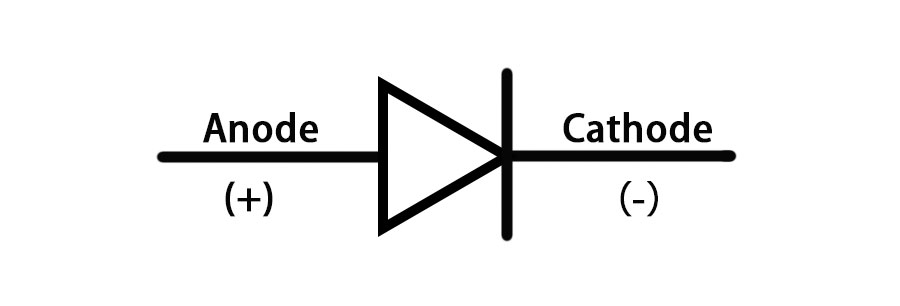
Standard Diode
- Basic Definition: A standard diode is a semiconductor device with two distinct terminals (anode and cathode) that controls the direction of current flow in a circuit.
- Working Principle: By applying different voltages across its terminals, a diode enters different bias states, thereby controlling the flow of current.
- Widespread Applications: The standard diode is one of the simplest types of diodes in terms of function. Its unidirectional conduction characteristic allows it to convert alternating current (AC) to direct current (DC), and it commonly serves as a current converter in basic circuits and cell phone chargers.
- Circuit Symbol: The symbol for a standard diode is an equilateral triangle with one vertex touching a vertical line, and the two terminals (cathode and anode) labeled. The circuit symbols for other types of diodes are derived from this basic design.
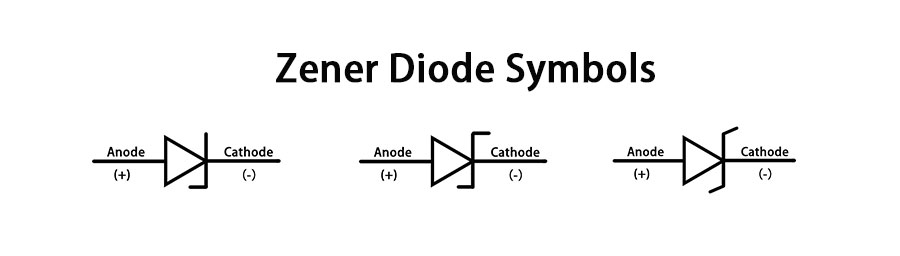
Zener Diode
- Basic Definition: Unlike other diodes that operate under forward bias, a Zener diode is a type of diode that can still function under reverse bias; it is also known as a reverse-breakdown diode.
- Working Principle: When the reverse voltage applied to a Zener diode reaches a certain threshold (breakdown voltage), reverse current flow is established, thereby regulating the circuit voltage. The specific threshold breakdown voltage in a Zener diode is also known as the Zener voltage.
- Widespread Applications: Zener diodes can maintain a nearly constant breakdown voltage across their terminals and are used in applications such as voltage stabilizers and waveform shaping.
- Circuit Symbol: There are typically three different ways to draw its symbol, but the styles are quite similar—all consist of an arrow pointing toward a curved line. The main difference lies in the direction of the curve.
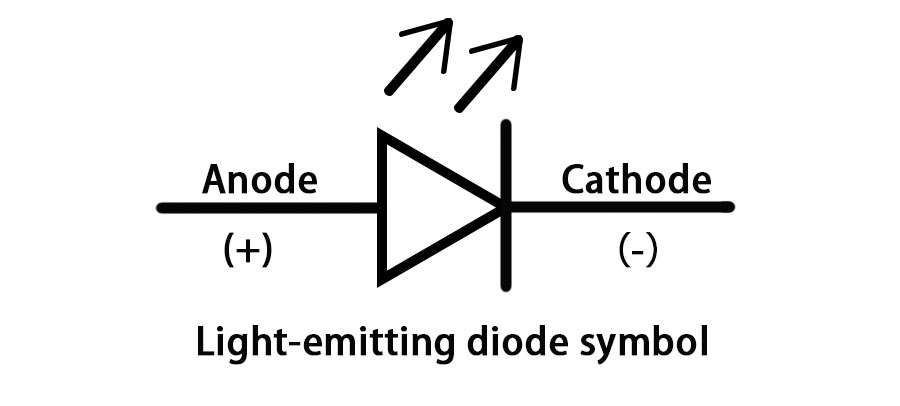
Light-Emitting Diode (LED)
- Basic Definition: A light-emitting diode, commonly abbreviated as , is a semiconductor electronic component that emits light when a forward current flows through it. It has different emission modes and can emit visible light of various colors, invisible infrared light, or laser light.
- Working Principle: An LED emits light by applying a forward current to the PN junction of a semiconductor. When current flows, the charge carriers (electrons and holes) inside the diode move and recombine, converting excess electrical energy into light energy and releasing it. At the same time, the color emitted varies depending on the doping materials used in the semiconductor during the diode’s fabrication.
- Wide Applications: Because LEDs generate little heat and have a high light-to-energy conversion efficiency, they are commonly used in various display and lighting devices. As a result, LED lighting fixtures are gradually replacing traditional incandescent bulbs and have taken a leading role in the lighting industry. They are also widely used in display applications such as , televisions, and signage.
- Circuit Symbol: The key feature of the light-emitting diode symbol is the two outward-pointing arrows. These arrows are added to the standard diode symbol to indicate its light-emitting characteristic.
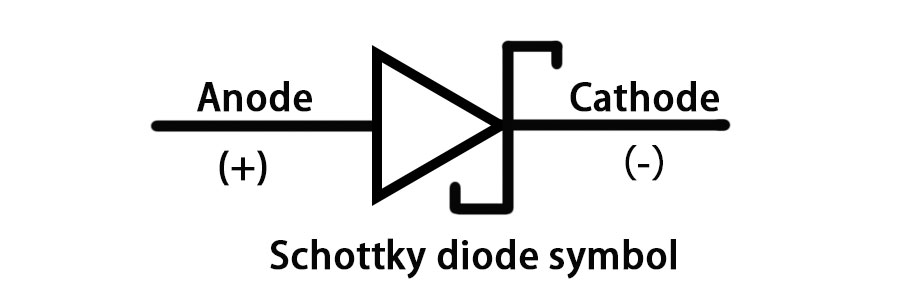
Schottky Diode
- Basic Definition: It is a special semiconductor device formed by the combination of a semiconductor and a metal, featuring an extremely low forward voltage drop and extremely fast switching speed. A Schottky diode is also known as a Schottky barrier diode or a hot-carrier diode.
- Working Principle: The Schottky barrier in a Schottky diode varies depending on the input current; its overall operating principle is similar to that of a standard diode, in that current flows only when forward-biased.
- Widespread Applications: The low forward voltage drop of Schottky diodes allows them to be used in rectifiers to regulate voltage and protect other electronic devices; their extremely fast switching speed enables higher communication efficiency in smart electronic devices (such as Wi-Fi and Bluetooth). Therefore, the unique properties of Schottky diodes make them commonly used in high-speed applications.
- Circuit Symbol: The circuit symbol retains the triangular body, but the straight line connecting to the apex of the triangle is modified. The upper and lower ends of the line curve outward, giving the overall shape a resemblance to the letter “Z.”
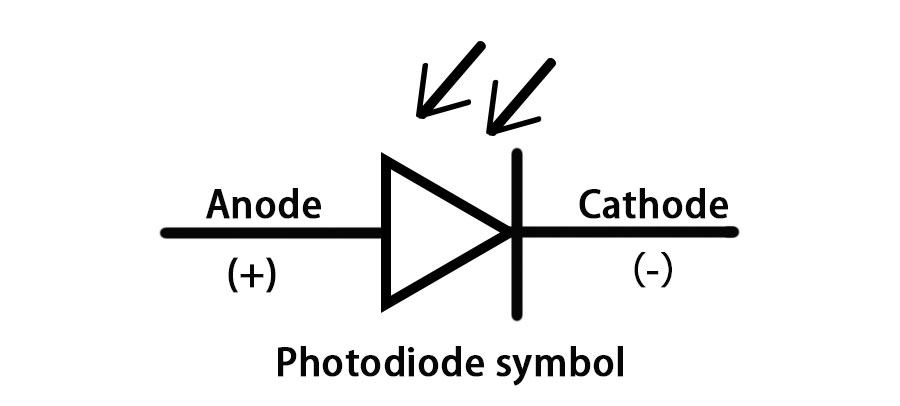
Photodiode
- Basic Definition: A photodiode is a diode that is sensitive to light and capable of absorbing photons.
- Working Principle: Photodiodes have two operating modes: photovoltaic and photoconductive. In photovoltaic mode, a small current flows through the diode due to a small voltage generated by light exposure; in photoconductive mode, which occurs under reverse bias, current flows normally once the diode detects light.
- Widespread Applications: Due to their light-sensitive nature, photodiodes are commonly used in sensors, solar cells, and consumer electronics. Examples include photodetectors, fire sensors, and infrared remote controls.
- Circuit Symbol: The symbol for a photodiode is very similar to that of an LED; simply point the arrow inward to indicate light incidence.
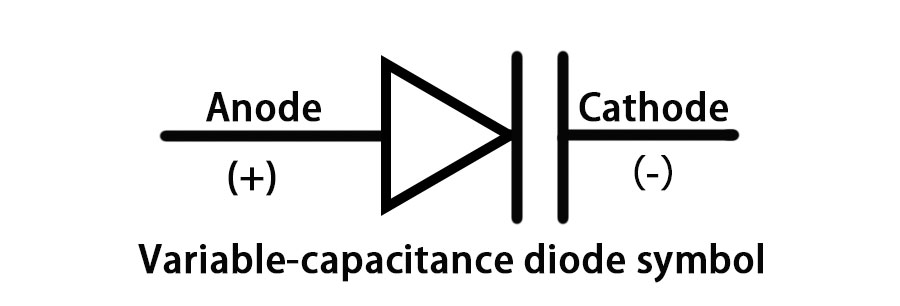
Varactor Diode
- Basic Definition: A varactor diode, also known as a varactor capacitor, is a type of diode designed to operate under reverse bias, where its internal capacitance varies with the applied reverse voltage.
- Working Principle: A varactor diode changes its capacitance based on the thickness of the depletion region. This capacitance is inversely proportional to the thickness of the depletion region (reverse bias voltage), thereby allowing the capacitance to be adjusted via the reverse voltage.
- Widespread Applications: The capacitive characteristics of varactor diodes make them widely used in fields such as precise tuning and voltage-controlled capacitance. Common applications include voltage-controlled oscillators (VCOs) and phase shifters.
- Circuit Symbol: The symbol for a varactor diode is created by adding a vertical line to the standard diode symbol; it uses two vertical lines to represent the cathode.
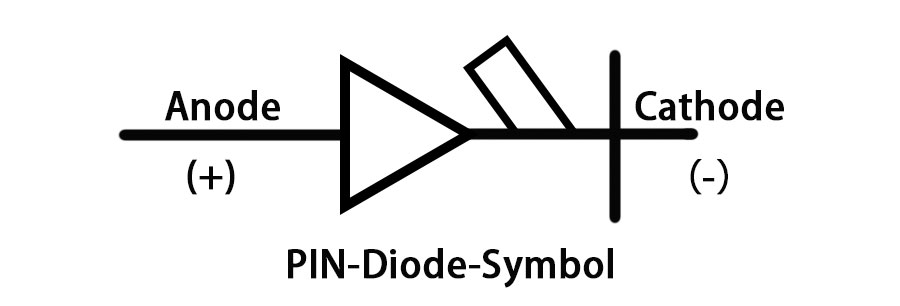
PIN Diode
- Basic Definition: A PIN diode is a special type of diode composed of three different semiconductor layers. It consists of P-type and N-type semiconductor layers, with a thick intrinsic semiconductor layer (I) between them.
- Working Principle: In different bias conditions, the amount of charge contained in the intrinsic layer determines the transition between high resistance and low resistance, thereby controlling whether a signal can pass through.
- Widespread Applications: They are commonly used in high-frequency, radio-frequency, and high-voltage rectification applications. These diverse applications are made possible by the diode’s ability to control high-frequency signals and the high charge storage capacity of the intrinsic layer (I).
- Circuit Symbol: The PIN diode symbol is similar to the standard diode symbol overall, with the addition of a slanted horizontal line between the apex of the triangle and the straight line; the rest of the symbol remains unchanged.
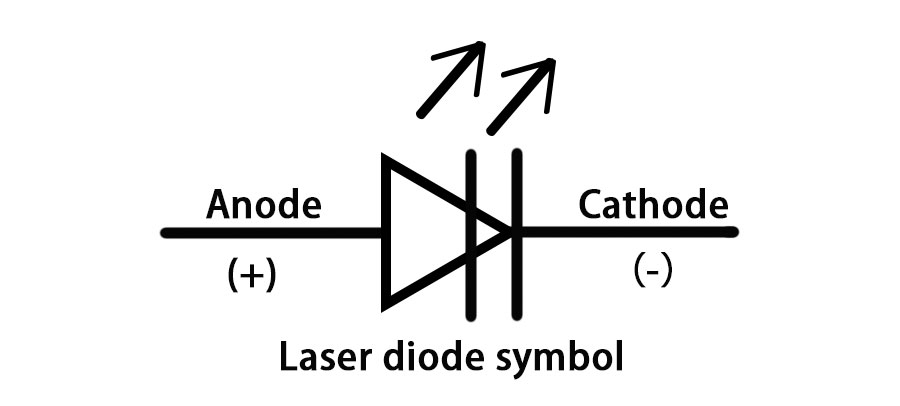
Laser Diode
- Basic Definition: A laser diode, abbreviated as LD, is a type of semiconductor laser capable of generating a focused beam. Its overall function is similar to that of an LED, but unlike an LED—which emits light in all directions—its light waves are emitted in only one direction.
- Working Principle: Its working principle is generally similar to that of an LED, as both utilize the principle of electroluminescence. When a forward current flows through the diode, electrons and holes recombine, releasing energy in the form of photons, which in turn produce a light beam.
- Widespread Applications: The high-intensity, focused beam of a laser diode makes it suitable for numerous fields, including medical equipment, laser cutting, and radar detection.
- Circuit Symbol: Its circuit symbol simply adds a vertical line to the triangle; otherwise, it is identical to the light-emitting diode (LED) symbol.
Table Classifying Diodes by Application, Type, and Structure
| Type | Structure | Main Applications | Operating Conditions |
|---|---|---|---|
| Standard Diode | PN Junction | Current Conversion (AC-DC) | Forward Bias |
| Zener Diode | PN Junction | Stabilizer, Voltage Regulation | Forward and Reverse Bias |
| Light-Emitting Diode | PN Junction | Lighting, Displays | Forward Bias |
| Schottky Diode | Semiconductor-Metal Junction | Switching Power Supplies | Forward Bias |
| Photodiode | PN Junction | Optical Sensors | Forward Bias |
| Varactor Diode | PN Junction | Frequency Modulation | Reverse Bias |
| PIN Diode | PN Junction | High-Frequency Rectification | Forward Bias |
| Laser Diode | PN Junction | LiDAR, Engraving | Forward Bias |
How Do LED Display Packaging Methods Relate to Light-Emitting Diodes?
Differences in Physical Form
Depending on the packaging technology used for the screen, the physical form of the LEDs on the panel may vary to some extent.
DIP
LEDs using DIP technology have pins of varying lengths and are referred to as a dual in-line package. After inserting the two leads of a DIP LED into through-holes, they are soldered to the PCB.
Physical Characteristics of DIP LEDs:
- Their bullet-shaped casing is robust, providing the LED panel with high reliability and a long service life.
- The separate LED chips and long leads offer better heat dissipation for LED screens.
- Due to the nature of this packaging method, have a larger —typically P10 or higher—making them more suitable for outdoor displays.
SMD
SMD technology features a 3-in-1 package combining red, green, and blue chips, which are bonded to the surface of the PCB using surface-mount technology.
By combining the different brightness levels of these three chips, the LED display can produce a wide range of colors.
Physical Characteristics of SMD LEDs:
- support small-sized packages, enabling pixel pitches ranging from P1.25 to P8.
- Each SMD LED consists of three chips: red, green, and blue.
- The independent SMD LED structure simplifies maintenance and provides better heat dissipation.
COB
Unlike the individual LED packaging methods used in DIP and SMD technologies, COB technology directly bonds multiple LED chips together onto a PCB, hence the name “chip-on-board” technology.
Physical Characteristics of COB LEDs:
- The frameless structure of COB LEDs allows the LED chips to be arranged more closely together, achieving pixel pitches of less than 2 mm.
- The epoxy resin layer covering the surface of COB LEDs creates a smooth, seamless panel and effectively enhances the overall performance of the LED display (protection, impact resistance, etc.).
Differences in Core Performance
In addition to the physical structural differences these three packaging methods bring to LED panels, there are also significant differences in the display quality of the screens.

DIP
- DIP LED panels have a larger pixel pitch and are best viewed from a distance. For the same display area, they offer lower overall and are more suitable for large-scale outdoor display projects.
- The larger LED chip size allows for a higher maximum brightness; DIP LEDs can deliver up to 10,000 nits.
- The high brightness and low pixel density of DIP LEDs allow them to effectively meet outdoor display needs at a lower cost.
- DIP LEDs have a narrow and are usually best viewed head-on.
Therefore, DIP LEDs are most commonly used for large-scale outdoor advertising or traffic signage, where they provide excellent visibility as outdoor LED screens.

SMD
- Compared to DIP LEDs, SMD technology enables the production of LED screens with smaller pixel pitches; you can choose pixel pitches ranging from 1.25 to 8 mm based on your needs.
- Indoor SMD LED screens support brightness levels of 500–1,200 nits, while outdoor screens range from 3,500 to 6,500 nits. This wide brightness range makes them suitable for a wider variety of applications.
- SMD LEDs feature a wider viewing angle of up to 160°, meeting the viewing needs of audiences from various angles.
As the current mainstream packaging technology, SMD LEDs offer balanced display performance and the ability to be customized for specific projects, making them suitable for virtually any indoor or outdoor display scenario.
If you’d like to learn more about SMD LEDs and select the right LED screen for your project, please contact JYLED’s online customer service. We’ll provide you with the most professional service and the highest-quality customized solutions.

COB
- COB LED screens maintain high grayscale levels even at low brightness, ensuring a comfortable viewing experience during extended use.
- The dense arrangement of LEDs provides higher pixel density, resulting in richer image detail. Compared to other packaging methods, COB LED screens offer higher image clarity and superior display performance.
- COB LED screens also feature excellent viewing angles, typically reaching 170°, allowing the screen content to be visible over a wider range.
The small pixel pitch of COB LEDs makes them particularly suitable for indoor small-pitch LED screens, such as high-end business conference displays and high-end shopping mall advertisements.
Comparison Table of DIP LED, SMD LED, and COB LED
This table helps you quickly understand the differences between the various packaging methods.
| Differences | DIP LED | SMD LED | COB LED |
|---|---|---|---|
| Chip Size | Larger | Medium | Smaller |
| Cost (Mass Production) | Higher | Lower | Higher |
| Time of Adoption | Early mainstream application | Mainstream packaging technology for nearly two decades | Extremely popular in recent years |
| Brightness | 8,000–10,000 nits | Indoor: 500–1,200 nits Outdoor: 3,500–6,500 nits | Around 1,000 nits |
| Pixel Pitch | P10-P16 | P1.5-P8 | P0.6-P1.95 |
| Viewing Angle | 100°-120° | 160° | 170° |
| Heat Dissipation | Good | Good | Average |
| Applications | Large outdoor LED displays, outdoor advertising LED displays | Indoor LED displays, outdoor LED screens | XR LED displays, fine-pitch LED displays |
Precautions Regarding Diodes
- To ensure a diode conducts normally, the voltage must be sufficient, and the current direction must be correct. In most cases, the voltage ranges from 0.7V to 1V, and the current flows from the anode to the cathode.
- When a diode is reverse-biased and the voltage reaches the breakdown voltage, current will flow in the opposite direction.
- The operating conditions for different types of diodes vary and may even be opposite. For example, capacitive diodes and Zener diodes must be used under reverse bias conditions, whereas most diodes are used under forward bias.
- Complete blocking of a diode under reverse bias exists only in theory; in practical applications, a very small amount of leakage current will still flow.
Summary
As the most basic electronic component in a circuit, a diode primarily controls the current to ensure it flows in the correct direction (from the anode to the cathode).
There are numerous types of diodes, each with its own characteristics in terms of usage and applications; care must be taken to distinguish them carefully during use.
Selecting the appropriate type of diode allows it to perform its specific functions correctly, ensuring optimal performance in various fields such as electronic devices and display systems.
FAQs
What happens when the current exceeds the diode’s rated value?
When the current exceeds the diode’s rated value, two situations typically occur:
- Short circuit: The diode loses its ability to block current flow in one direction, allowing current to flow in both directions.
- Open circuit: The diode fails to conduct normally; current cannot flow, and the circuit is in an open-circuit state.
Both of these conditions can affect the normal operation of the circuit and may even damage electronic components.
How is a diode connected to a circuit?
First, you need to distinguish between the positive and negative terminals of the power supply and the anode and cathode of the diode.
Based on the application scenario and the bias state of the specific diode type, connect the terminals correctly: for forward bias, connect the anode to the positive terminal of the power supply; for reverse bias, connect the anode to the negative terminal.
As long as the diode is connected in the correct bias state, it will function properly.
Is there an upper limit to the brightness of a light-emitting diode (LED)?
Yes. The brightness of an LED is theoretically limited by a combination of factors, including the materials used and the size of the LED.
Why can’t other types of diodes be used as substitutes for the light-emitting diodes in LED displays?
Not all diodes can emit light and meet the display requirements of LED screens.
Additionally, LEDs have high optical efficiency, a high conversion rate of electrical energy, and offer a wider variety of light emission patterns.
Even laser diodes can emit light, but they emit a single-wavelength beam rather than the diffused light of LEDs, so they cannot be used as substitutes.
Are there other uses for light-emitting diodes besides LED displays?
Yes. Light-emitting diodes can replace traditional incandescent bulbs in lighting fixtures; they can also be used as backlights for LCD displays.
Besides the diodes mentioned above, what other types of diodes are there?
In addition to the diodes commonly used in daily life mentioned above, there are dozens of other types, including avalanche diodes, constant-current diodes, thermal diodes, gold-doped diodes, breakdown or step-recovery diodes, and transient voltage suppression diodes.
How do you use a digital multimeter to check if a diode is functioning properly?
Use the diode test mode on a digital multimeter to test a diode:
Under forward bias, a standard diode in operation has a voltage between 0.5 and 0.8 volts and a resistance between 10 and 1,000 ohms.
Under reverse bias, the digital multimeter will display “OL,” indicating an “open circuit” or infinite resistance.
By observing the digital multimeter’s readings under these two different conditions, you can determine whether the diode is functioning properly.
Which type of diode is most commonly used in everyday life?
Light-emitting diodes (LEDs) and standard diodes are the most commonly used types in daily life.
LEDs can be found in display devices, lighting equipment, and common LED displays. The current-conversion function of standard diodes makes them highly popular in power supply circuits; for example, they play a role in various household chargers, wall outlets, and power control cables.