


Nowadays, most in-car displays, televisions, computer monitors, and other screens use Mini LED technology, but do you really understand it? Do you know what its specific advantages are? What challenges does it still face? Let’s find out together.
What Is Mini LED?
Mini LED stands for “Miniature Light Emitting Diode” and is a backlight display technology. It uses chips smaller than traditional LEDs (less than 0.2 mm) as the backlight source for LCD screens.
These chips are arranged more densely, resulting in superior local dimming performance.
How Mini LED Works
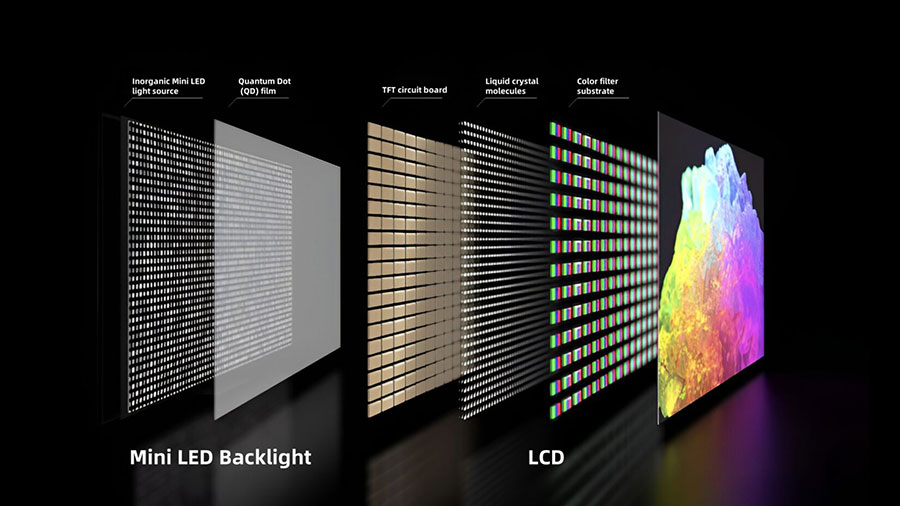
Mini LED divides the densely packed LED backlight into multiple distinct zones. By controlling the brightness of each zone individually, it achieves precise brightness control and more refined local dimming.
Advantages of Mini LED
Compared to other backlighting technologies, Mini LED offers several unique advantages, which are outlined below:
Energy Efficiency
Through local dimming technology, Mini LED precisely controls the brightness of each section, delivering higher energy efficiency and lower power consumption—something traditional backlights cannot achieve.
For example, when displaying dark areas of an image, a Mini LED screen can dim or even turn off the LEDs in those areas to reduce power consumption.
Contrast
Mini LED divides the backlight into multiple zones to control brightness independently.
When displaying an image, dark areas are dimmed further while bright areas are enhanced, resulting in deeper blacks and brighter whites, and thus higher contrast.
Brightness
Although Mini LED uses smaller LED chips, compared to traditional LEDs, increasing the number of Mini LEDs at the same power level can achieve higher peak brightness.
Black Level
Mini LED displays black by turning off specific backlight zones.
While Mini LED can completely turn off LEDs in localized areas, the LEDs influence one another; lit LEDs cast light onto nearby, completely turned-off LEDs, creating a halo effect. Consequently, it cannot display true, pure black like OLED.
However, compared to other backlight display technologies, its black levels are already exceptional.

Image Quality
Mini LED features more backlight zones, a higher density of LED arrangements, and smaller LEDs, enabling better control and more precise processing of image details. As a result, the screen displays more vibrant colors and higher-quality images.
Some higher-end Mini LED displays also feature additional dimming zones, which can effectively reduce the halo effect seen on LCD screens.
Disadvantages of Mini LED
Although Mini LED has many advantages, it may have the following drawbacks due to factors such as panel technology, chip algorithms, and graphics card performance:
Halo Effect
While additional dimming zones can mitigate the halo effect, Mini LED cannot completely eliminate it. Halos may still appear around some bright images, which can affect the overall viewing experience and the uniformity of blacks.
Viewing Angles
The viewing angles of LCD screens using Mini LED backlight technology vary depending on the display technology employed, typically ranging from 140° to 170°.
For example, screens using TN technology have a maximum viewing angle of only 60°, while those using VA technology can reach 120°. If viewed from angles beyond the specified range, color shifts may occur, making them unsuitable for group viewing.
Motion Blur
When displaying dynamic images, monitors using Mini LED backlight technology may exhibit varying levels of motion blur depending on the monitor’s performance.
If the processor’s performance is insufficient, the Mini LED display may be unable to respond quickly enough, leading to motion blur and screen tearing, which degrades the overall display quality.
Purchase Price
Mini LED backlight technology requires more LEDs, a more complex circuit layout, and more precise brightness control.
These requirements place higher demands on manufacturing equipment, driving up production costs. Consequently, LCDs produced using Mini LED technology are generally more expensive than LCDs with other backlight types.
Comparison of Mini LED, OLED, and Direct-View LED
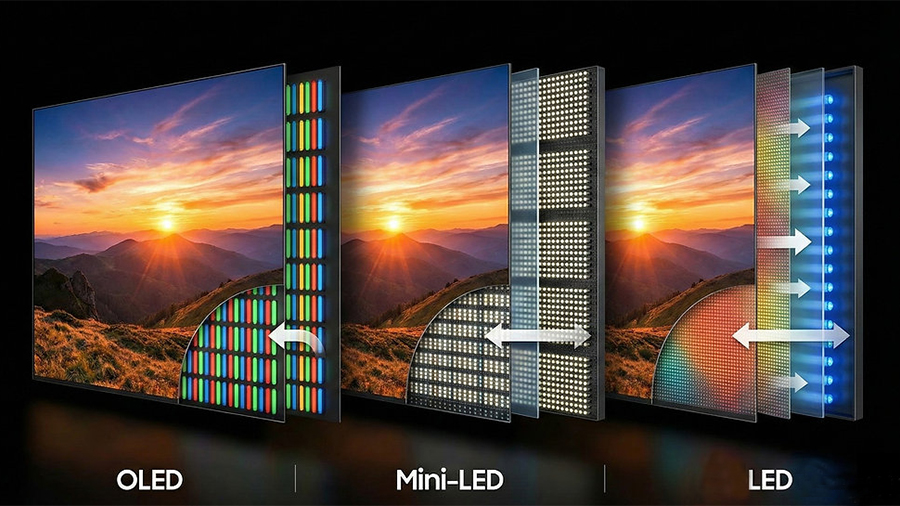
Mini LED, OLED, and direct-view LED screens are all types of displays we use and encounter in our daily lives. Due to differences in manufacturing processes, they vary significantly in display performance and application areas.
For example, when it comes to black level performance, only OLED screens can display true black; in terms of brightness, only direct-view LED screens can reach over 5,000 nits; and regarding screen size and usage environments, direct-view LED screens face the fewest restrictions.
Below, I will use a table to provide a visual comparison of these three screen types:
| Different | Mini LED display | OLED display | Direct-view LED display |
| Core Processes | LCDs with Mini LED backlighting | Displays made using OLED technology | An LED display screen formed by assembling LED modules |
| Black level performance | Deep black; due to the interaction between the LED chips, true black cannot be displayed | True Black | As close as possible to true black. Due to the stroboscopic delay, true black cannot be achieved. |
| Brightness | 1000–3000nits | 600–1000 nits | Indoors: 500–1,200 nits Outdoors: 4,000–10,000 nits |
| Screen size (MAX) | 115 inches | Around 110 inches | No upper limit |
| Colour accuracy | The colour accuracy of the two is almost identical | Slightly lower than the first two | |
| Suitable environments | Suitable for small to medium-sized indoor screens | Suitable for medium to large screens, both indoors and outdoors | |
Number of Mini LED Zones and Product Variations
Mini LED divides the screen into dimming zones, with the number ranging from as few as under 100 to as many as over a thousand.
Although all such products on the market are referred to as Mini LED, the differences in the number of zones result in significantly different performance and product characteristics.
It is worth noting that the number of zones is only one of the metrics for evaluating Mini LED performance; a comprehensive assessment must also consider screen size, zone density, dimming algorithms, panel type, peak brightness, and actual test results.
Fewer than 300 zones:
The dimming effect is only slightly better than that of standard direct-lit LED backlights. Haloing is noticeable, and display quality is average; this is suitable only for entry-level products.
300–700 zones:
While haloing remains somewhat noticeable, performance in dark scenes is significantly improved. This is also the preferred choice for most people experiencing Mini LED technology for the first time.
700–1,500 zones:
Haloing is extremely rare during everyday use; the image offers higher contrast, is clearer and more visible, and features good color accuracy. This is commonly found in mid- to high-end display devices.
1,500–3,000 zones:
Within this range, haloing is negligible and only visible under extreme testing conditions. It offers excellent HDR performance and, as a technological choice for high-end products, delivers outstanding picture quality and a superior visual experience.
3,000 zones or more:
Mini LED products with this number of zones can achieve a contrast ratio of up to 1,000,000:1 during actual viewing, delivering astonishing image performance; they are used exclusively in flagship products.
However, the high cost of production technology significantly increases the purchase price, resulting in lower sales volumes compared to standard products.
When purchasing products with Mini LED backlight technology, pay close attention to the specific screen size and number of zones. Although they are all labeled “Mini LED,” their actual performance can vary greatly.
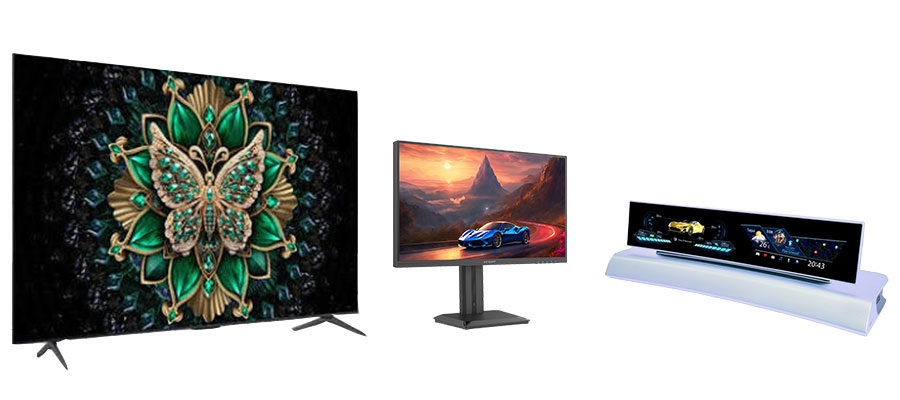
Common Applications of Mini LED
Mini LED TVs
Mini LED backlight technology was initially widely adopted in the television industry, but with advancements in backlight technology, it is now primarily used in high-end large-screen TVs.
Large-screen Mini LED TVs feature more zones and superior image quality, delivering an immersive viewing experience to users. They are an excellent choice for those seeking top-notch picture quality.
Mini LED Monitors
Mini LED is commonly used in the professional monitor sector. With a color gamut reaching 99.9% DCI-P3 and over 97% Adobe RGB, it delivers superior color accuracy.
For professionals, whether in film grading or color correction, Mini LED monitors are an ideal choice.
In-Vehicle Displays
Mini LED is currently the mainstream backlight technology for in-vehicle displays in high-end automobiles. Thanks to its higher brightness and contrast, content remains clearly visible even in well-lit car interiors during the day.
The smaller screen size allows for better control of brightness across different zones, providing an excellent experience for singing along to karaoke or watching movies in the car—effectively turning the vehicle into a compact home theater.
What Does the Future Hold for Mini LED Technology?
Regarding the future development of Mini LED technology, while we cannot predict industry trends or consumer demand with certainty, one thing is clear: as an emerging technology, Mini LED is currently in its growth phase.
In terms of chip size, it will evolve toward Micro LED display technology; in image display, it will advance toward RGB direct-view technology; and manufacturing costs will continue to decrease, making it a product accessible to a wider audience.
FAQs
What other factors affect Mini LED quality?
In addition to the number of zones, Mini LED quality is influenced by a combination of factors, including the performance of the driver chips, thermal management solutions, dimming algorithms, and lens technology.
Is a higher number of zones always better for Mini LED?
Not necessarily. A higher number of zones places greater demands on the performance of the driver chips and significantly increases the complexity of the dimming algorithms, making it easier for control inaccuracies to occur and resulting in poorer picture quality.
The number of zones in a Mini LED display should be determined by comprehensively considering the device’s hardware capabilities and algorithms.
Besides Mini LED and OLED, what other display technologies are available?
In addition to Mini LED and OLED, other mainstream display technologies on the market include direct-view LED and Micro LED, among others.
Do Mini LED TVs have a risk of screen burn-in?
Virtually none. Unlike OLED TVs, Mini LED TVs rely on liquid crystal display (LCD) technology to produce images, so pixel burn-in does not occur.
They can easily display static images for extended periods at high brightness levels, making screen burn-in a virtually non-issue.
Is Mini LED more durable than LED?
There isn’t much difference in their lifespan. Both Mini LED and LED use LEDs; the only difference is the size of the LEDs used. Their lifespan is primarily influenced by variations in the manufacturers’ production standards, which can lead to differences in durability.