COB LED and SMD LED are two of the most popular LED chip packaging technologies on the market. LED panels produced using these different packaging technologies exhibit significant differences in display quality, luminous efficiency, heat dissipation, and cost.
This article will provide a detailed introduction to both COB LED and SMD LED technologies and compare their respective advantages and limitations, to help you quickly understand and select the LED panel produced using the packaging technology that best suits your needs.
What Is SMD LED?
SMD LED refers to a packaging technology that uses SMD (Surface Mount Device) methods to produce LEDs. Each individual LED typically contains red, green, and blue LED chips. By combining different brightness levels of these three-color chips within the LED lamp, rich full-color displays can be achieved.
Thanks to their excellent color reproduction, high brightness, and cost-effectiveness, SMD LED displays are currently the top choice for installing LED screens in most indoor and outdoor environments.
What Is a COB LED?
COB LED refers to an LED packaging technology that uses COB (Chip-on-Board) technology to package LED chips in bulk. Compared to SMD technology, this bulk packaging simplifies the structure of bonding LED chips to the PCB.
This enables LED screens to achieve a more compact pixel pitch, higher optical efficiency, and more uniform brightness and color reproduction, making COB LED displays an ideal choice for indoor fine pitch LED screens.

COB LED vs. SMD LED: A Comparison of Advantages and Limitations
Both COB LED and SMD LED technologies have their own technical advantages and limitations, for example:
Packaging Technology
COB LED
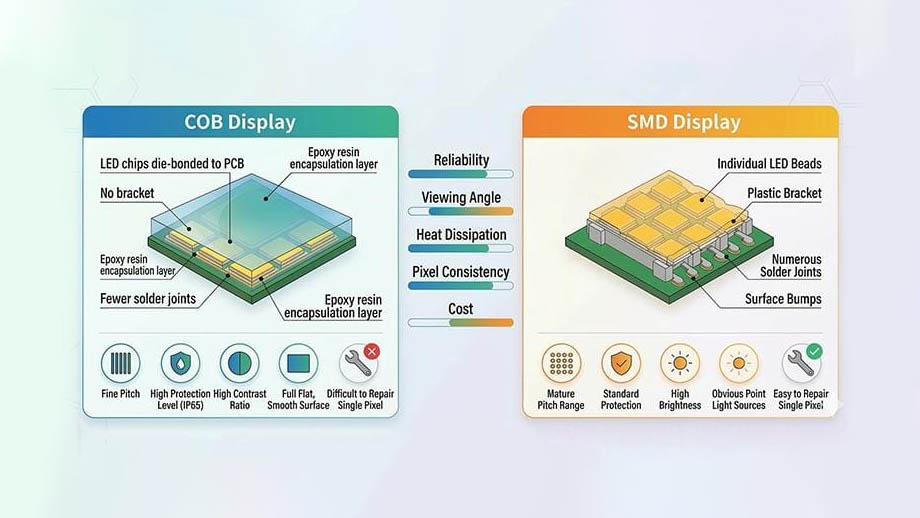
COB LED technology allows multiple LED chips to be bonded onto a PCB in a single process. This packaging method eliminates the need for the support structures found in traditional packaging techniques, reduces the number of leads, enables closer spacing between LED chips, and results in higher electrical energy efficiency.
After packaging is complete, the surface of the COB LED panel is coated with a layer of transparent epoxy resin, which effectively protects the LED chips from corrosion by harmful substances in the external environment and enhances the panel’s clarity and contrast.
SMD LED
SMD LED technology primarily employs a “3-in-1” approach, bonding and encapsulating LED chips of three different colors in a single process, then using surface-mount technology to attach the finished SMD LED lamps to the PCB.
This surface-mount packaging process is relatively simple and yields a very high product yield rate. Furthermore, the LED panels feature vibrant color reproduction, strong independence between individual LED lamps, and excellent heat dissipation and maintainability. Thanks to their low cost and excellent color reproduction, SMD LED displays are widely used in a variety of applications.
Screen Pixel Pitch
- COB LED: The LED chips are arranged more densely in bulk packaging, allowing COB LED screens to achieve a smaller pixel pitch. Typically, LED screens produced using this technology have a pixel pitch ranging from 0.6 to 1.93 mm, making them suitable for indoor display scenarios where the screen is viewed at close range.
- SMD LED: SMD LED screens support all specifications with a pixel pitch of 1 mm or greater. Common pixel pitch options range from 1.25 mm to 10 mm. You can choose a fine-pitch SMD LED screen for close-up viewing environments or a coarse-pitch SMD LED panel for medium- to long-distance display scenarios, depending on your needs.
Image Contrast
COB LED
Since a layer of black transparent epoxy resin is applied to the surface of COB LED panels, this black resin layer further enhances the panel’s strong black effect.
The black epoxy resin layer also effectively absorbs diffuse reflection caused by ambient light on the LED panel, reducing glare on the screen and making the colors on COB LED screens more vivid and pure. COB LED panels offer extremely high contrast ratios, ranging from 5,000:1 to 25,000:1.
SMD LED
The contrast ratio of SMD LED display panels falls within the standard range. If ambient light is too bright, it may cause some glare on the SMD LED panel, affecting the viewing experience.
In addition to standard SMD LED screens, the market also supports the production of high-end SMD LED panels capable of achieving higher contrast ratios. Currently, SMD LED screens on the market can reach contrast ratios of 3,000:1 to 10,000:1.
Viewing Angle
- COB LED: COB LED screens feature more compact LED chips with better light confinement. Whether viewers are looking at the screen from the front or the side, they can enjoy uniform and consistent image and color display, with a viewing angle ranging from an impressive 160° to 170°.
- SMD LED: SMD LED screens feature uniform panel brightness and vivid colors, with strong color consistency across different SMD LED lamps. The viewing angle ranges from 140° to 160°.
Panel Protection
- COB LED: Since a transparent epoxy resin layer is applied to the panel surface after encapsulation, the panel offers excellent protection against physical scratches, corrosive gases, water, and dust. Even if viewers come into close contact with the COB LED panel, the screen will not be damaged.
- SMD LED: SMD LED lamps are essentially exposed to the external environment, so installers must exercise caution and avoid direct contact with the SMD LED panel. Direct contact with the SMD LED panel may cause scratches or damage to the LEDs, or generate static electricity that could cause the LED lamps to break down.
Heat Dissipation
- COB LED: COB LED chips are relatively compact, and the resin layer covering the panel also reduces the screen’s heat dissipation efficiency; as a result, the screen’s natural heat dissipation is slightly lower than that of SMD LED screens.
- SMD LED: SMD LED lamps are independent of one another, and their surfaces are not covered by any other coatings that could affect panel heat dissipation; therefore, the screen’s natural heat dissipation is excellent.
Luminous Efficiency
- COB LED: The interconnection structure between LED chips is simpler, resulting in higher circuit efficiency. This reduces energy loss due to excess circuit resistance, leading to higher luminous efficiency.
- SMD LED: Each SMD LED has a complete mounting bracket and lead structure; the resistance within these structures consumes a portion of the electrical energy, so the luminous efficiency of SMD LED screens is lower than that of COB LED screens.
Suitable Environments
- COB LED: LED screens made with COB LEDs have a smaller pixel pitch, making them more suitable for close-up viewing. However, because COB LED chips are small and the maximum brightness of small-sized LED chips is limited, COB LED screens are not suitable for outdoor environments. COB LED displays are primarily suited for installation in high-end indoor settings.
- SMD LED: LED screens manufactured using SMD LED packaging technology support a wider range of pixel pitches. Whether you need a fine pitch LED screen for close-up viewing or a high-brightness LED screen for displaying content from a distance outdoors, you can find the ideal solution among the available SMD LED screen models.
Cost
- COB LED: The manufacturing process for COB LED screens is relatively more complex. In the past, COB technology required more advanced equipment, and COB panel production volumes were lower, resulting in higher production costs for COB LED screens; However, with technological advancements, equipment improvements, and gradually increasing production volumes, COB LED screens have actually become more cost-effective than SMD LED screens for displays with very small pixel pitches, such as those with a pixel pitch of less than 1.5 mm.
- SMD LED: SMD LED displays have consistently maintained low production costs thanks to mature technology and simple manufacturing processes. In most cases, they offer the best value for money among LED screens.
Maintainability
- COB LED: After batch packaging, the LED chips on COB LED screens are covered with a layer of resin. If a single LED chip fails, you cannot perform individual maintenance or replace the damaged chip. Instead, you must replace the faulty COB LED module directly with a spare one and return the faulty module to the manufacturer for professional maintenance.
- SMD LED: Each LED lamp in an SMD LED screen is independent. If a single LED lamp fails, you can replace the faulty LED yourself using tools; screen maintenance is very simple and convenient.
COB LED vs. SMD LED: Quick Comparison Table
| Comparison Item | COB LED | SMD LED |
| Packaging Technology | Bulk packaging of LED chips using the chip-on-board method | 3-in-1 packaging of LED chips using surface-mount technology |
| Screen Pixel Pitch | 0.6 ~ 1.93 mm | 1.25 ~ 10 mm |
| Contrast Ratio | 5000:1 ~ 25000:1 | 3000:1 ~ 10000:1 |
| Viewing Angle | 160° ~ 170° | 140° ~ 160° |
| Panel Protection | Resistant to physical scratches, corrosive gases, water, and dust | Standard |
| Heat Dissipation | Standard | Good natural heat dissipation |
| Luminous Efficiency | High luminous efficiency | Standard |
| Suitable Environments | High-end indoor settings | Indoor and outdoor settings |
| Cost | Screen costs are lower when the pixel pitch is less than 1.5 mm; screen costs are higher when the pixel pitch is greater than 1.5 mm but less than 2 mm | When the pixel pitch is greater than 1.5 mm, the screen cost is lower |
| Maintainability | Requires professional maintenance at the factory | Easy to maintain |
As can be seen, if you need to install a high-end display indoors, COB LED screens outperform SMD LED displays in terms of image contrast, viewing angle, and panel protection, making them the more ideal choice.
If you wish to install an indoor screen at a lower cost, or if you need to install an outdoor LED screen, SMD LED screens offer a wider range of supported pixel pitches, higher maximum brightness, more affordable prices, and better maintainability, making them a more suitable choice for you.
COB LED vs. SMD LED: Practical Applications
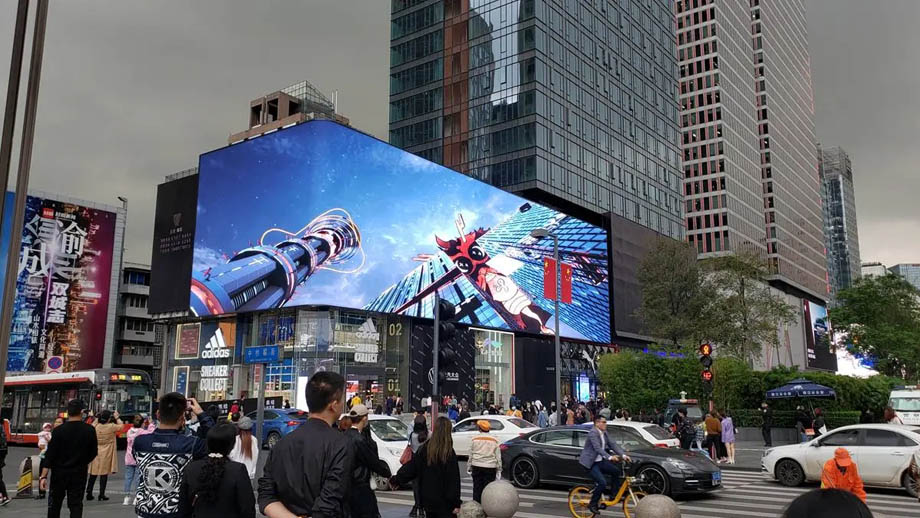
Due to differences in pixel pitch, COB LED screens are primarily used in indoor settings, while SMD LED screens are suitable for both indoor and outdoor applications.
XR Production Studios
When installed as an XR LED screen, the ultra-fine pixel pitch of a COB LED screen provides virtual production studios with lifelike, detailed imagery, high contrast, and a wide viewing angle.
This allows cameras to capture authentic and reliable virtual footage from various angles, ensuring the quality and effectiveness of subsequent video production.
High-End Business Meetings
COB LED screens feature high definition, vivid images, serving as high-end business conference LED displays, providing attendees with exceptional visual quality and a superior viewing experience. They ensure that all participants can clearly receive meeting information, thereby guaranteeing the efficiency and professionalism of the event.
Outdoor Advertising
When installed as outdoor LED billboards, SMD LED displays can produce images with ultra-high brightness of up to 6,500 nits. Even in outdoor environments with direct sunlight, the screen maintains a clear and smooth viewing experience, ensuring that the advertising campaign meets its intended impact.
Indoor Broadcasting Studios
For larger indoor broadcasting studios, you can choose SMD LED screens with a pixel pitch of 3.91 to 6 mm. With an optimal viewing distance of 3.91 to 12 meters, these screens are better suited to the viewing distances of the studio audience.
For indoor studios with more compact recording spaces, choosing a COB LED screen can provide clear and smooth images for both close-range viewers and cameras. Whether captured by a camera or viewed by the naked eye, the images are clear, vivid, and highly visible.

FAQ
COB LED vs. SMD LED: Which Has a Longer Lifespan?
Generally, LED displays can operate reliably for over 10 years. If you pay proper attention to the screen’s usage time and display brightness, and set aside a certain amount of downtime each day to let the screen rest, you can further extend its lifespan.
Do COB LED Displays Always Offer Better Image Quality Than SMD LED Displays?
Although COB LED screens may appear more refined and smooth than SMD LED screens, the clarity of an LED display is also related to pixel pitch.
For example, an SMD LED screen with a 1.25 mm pixel pitch will produce a more refined image than a COB LED screen with a 1.5 mm pixel pitch.
Can the Protection of SMD LED Screens Be Enhanced?
Yes. You can make arrangements with the supplier in advance to apply the GOB packaging process to SMD LED panels, which provides enhanced protection against physical scratches, water, and dust.
Alternatively, for outdoor SMD LED screens, suppliers can apply a transparent waterproof coating to the LED panels to improve the screen’s water resistance.
COB LED vs. SMD LED: Which Has Higher Energy Consumption?
The energy consumption of COB LED and SMD LED screens depends on a range of factors, including screen size, operating brightness, and operating duration, and must be calculated based on the specific project.
When Purchasing a P1.25 LED Screen, Is COB LED or SMD LED the Better Choice?
If you need to purchase an LED display with a 1.25 mm pixel pitch, we recommend choosing a COB LED screen. This is because COB LED displays offer higher contrast and more vibrant colors. Furthermore, for this type of fine pitch LED screen, COB LED screens are actually more cost-effective than SMD LED screens.
Summary
COB LED screens can achieve ultra-fine pixel pitches of less than 1 mm, delivering exceptionally detailed, smooth, and fluid images to on-site audiences, making them the ideal choice for high-end indoor close-viewing display environments.
SMD LED screens, on the other hand, can handle high definition fine pitch displays of less than 2 mm while also serving as wide pitch screens for various indoor and outdoor display scenarios. They are highly versatile, cost-effective LED screens that offer excellent value for money.