



LED fans are extremely popular electrical devices. They offer practical heat dissipation capabilities, and certain types also provide visual benefits.
If you’re interested in learning more about LED fans and have plans to purchase them, you’ll want to read this article for a comprehensive guide to LED fans.
What Is an LED Fan?
An LED fan refers to a fan that can be used in conjunction with LEDs to provide substantial functional benefits. Based on their intended use, LED fans are primarily divided into three types:
- Heat Dissipation and Visual Display Combination: In addition to providing heat dissipation, this type of LED fan utilizes LED components to offer visual functions, such as image display and lighting. Common examples include LED ceiling fans.
- Unique Visuals That Captivate: This category of LED fans uses the combination of fan rotation and LED lighting to create unique visual displays that quickly capture the audience’s attention; examples include 3D holographic LED fans.
- Heat Dissipation for LED Screens: This category of LED fans does not incorporate LED components to produce light or display effects; instead, they dissipate heat from LED screens to ensure stable display performance.
The specific LED fans required can vary significantly depending on the user group. Next, we’ll take a detailed look at three different types of LED fans to help you quickly determine which model best meets your project’s needs.
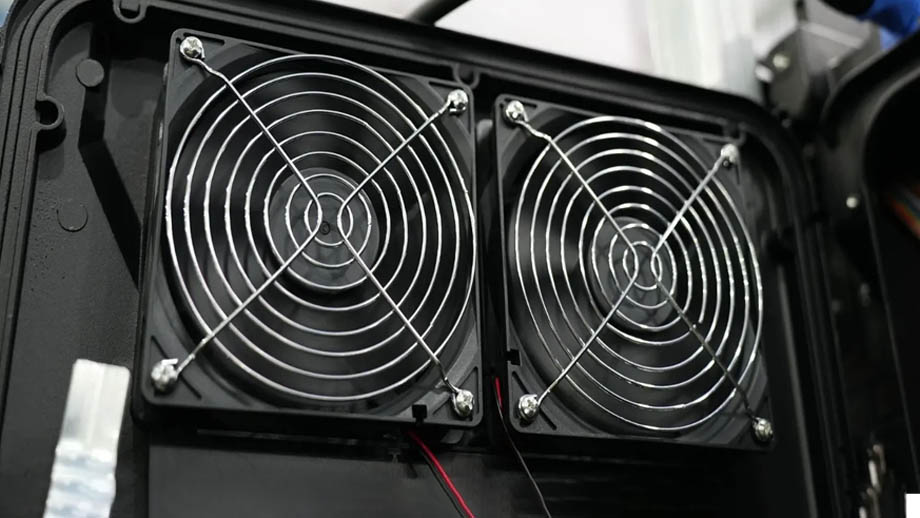
Three Common Types of LED Fans
Below is a brief description of three common types of LED fans:
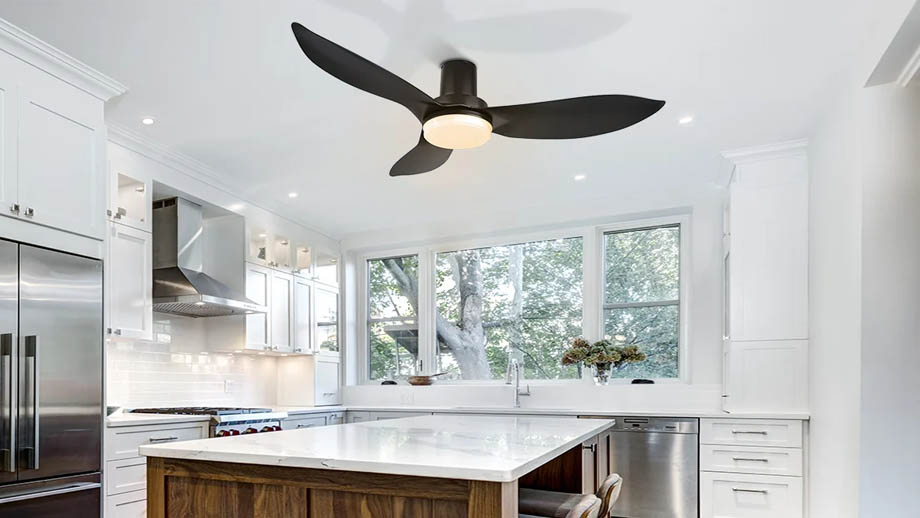
LED Ceiling Fans
An LED ceiling fan is a fan with an LED lighting fixture integrated into its center. It not only provides cooling airflow for users in the room but also illuminates the space. This device combines an LED light fixture with a fan, allowing you to enjoy two functions with a single installation.
Whether for personal use in living rooms, bedrooms, or kitchens, or in commercial settings such as stores and exhibition areas, the LED ceiling fan is a suitable and powerful solution.
Not only does it provide better airflow and lighting for your space, but its sleek, minimalist design also adds a touch of modernity to the environment.
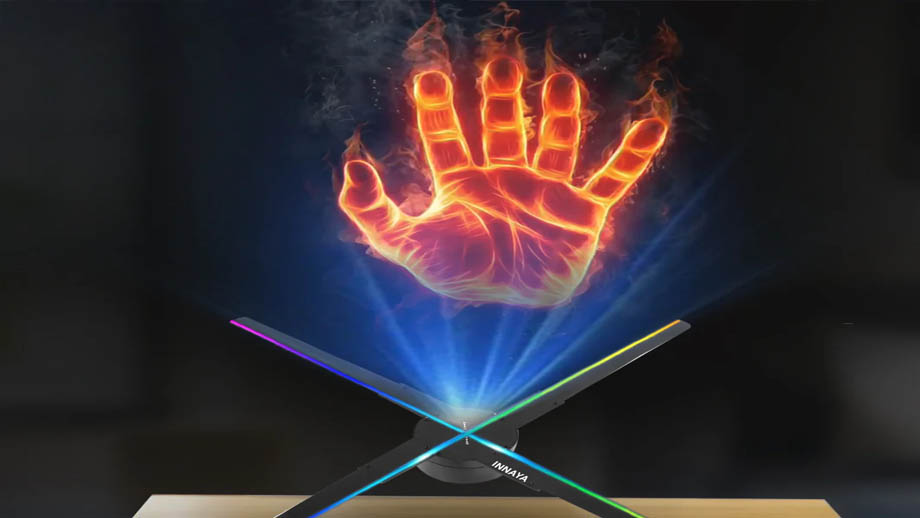
3D Holographic LED Fan
The 3D holographic LED fan features LED display images mounted on high-speed rotating blades. By leveraging the human eye’s tendency to perceive a visual afterimage of fast-moving images, the blades display the intended images as they rotate.
Since the blades of the 3D Holographic LED Fan have no visible borders when rotating, the content displayed creates a unique three-dimensional effect and a sense of suspension, delivering stunning visuals to the audience and making it extremely valuable for marketing purposes.
LED Display Cabinet Fans
An LED display cabinet fan is a fan installed on the metal chassis or exhaust port of an LED cabinet, designed to assist with active ventilation and heat dissipation.
The fan helps maintain the internal temperature of the LED cabinet below 60 °C (the operating temperature range for LED modules is -20 °C to 60 °C), thereby safeguarding the LED screen’s components and ensuring stable operation.
Unlike passive cooling ventilation systems, the active cooling provided by LED display cabinet fans enables faster heat dissipation for LED screens. In environments with high ambient temperatures, where natural ventilation alone cannot meet operational requirements, the active cooling provided by LED fans better suits your needs.
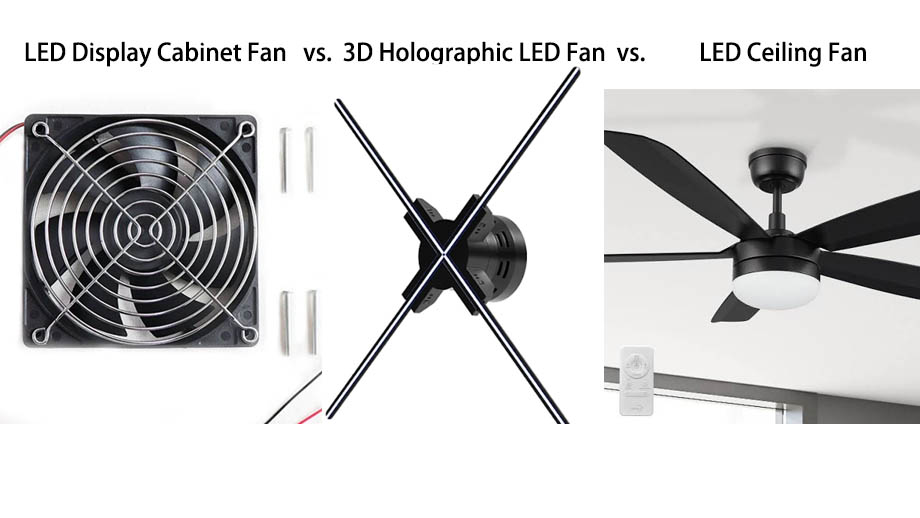
LED Ceiling Fans vs. 3D Holographic LED Fans vs. LED Display Cabinet Fans: Key Differences
Different types of LED fans vary significantly in terms of functionality, application scenarios, installation locations, and procurement costs. The following is a comparison of the key differences among these three types of LED fans:
Primary Uses
LED Ceiling Fan
LED ceiling fans are primarily used for lighting and heat dissipation in indoor or semi-outdoor environments. If you install equipment using conventional methods, you would need to install both a light fixture and a ceiling fan, which takes up relatively more space.
Installing an LED ceiling fan, however, combines these two functions into one, achieving the same effect while improving your space utilization and creating a cleaner, more aesthetically pleasing environment.
3D Holographic LED Fans
The visuals produced by 3D holographic LED fans appear to float in mid-air, creating a dreamlike effect that quickly captures the attention of nearby viewers and leaves a lasting impression of the displayed content.
As a result, 3D holographic LED fans are frequently used in commercial advertising campaigns, such as product promotions and art exhibitions.
LED Display Cabinet Fans
LED display cabinet fans are primarily used to provide efficient active cooling for LED screens, maintaining the internal temperature within an optimal range to ensure stable operation and preserve the screen’s exceptional display quality.
Installation Locations
- LED Ceiling Fans: These are typically installed on the ceilings of indoor spaces or on the overhead structures of semi-outdoor areas.
- 3D Holographic LED Fans: Stand-mounted 3D holographic LED fans can typically be placed directly on a tabletop as standalone units or mounted on walls or ceilings.
- LED Display Cabinet Fans: These fans are installed on the rear panel of the LED cabinet or near its air intake and exhaust vents to facilitate rapid heat dissipation from the cabinet.
Common Applications
- LED Ceiling Fans: Primarily used in indoor environments with ceilings, such as residences and stores, or in semi-outdoor areas with canopies.
- 3D Holographic LED Fans: Primarily used in promotional events, exhibitions, and store advertising to attract the attention of potential customers with eye-catching visuals.
- LED Display Cabinet Fans: Primarily used in outdoor advertising, extremely high-temperature environments, and large-scale LED display installations.
Purchase Cost
- LED Ceiling Fans: Prices vary depending on the fan’s design, appearance, and dimensions. The typical market price for an LED ceiling fan ranges from $ 266 to $ 1,199 per unit.
- 3D Holographic LED Fans: The price of these fans depends on various factors, including size, number of blades, rotational speed, and control systems. The reference market price for 3D holographic LED fans ranges from $ 159 to $ 3,999 per unit, with relatively significant price variations.
- LED Display Cabinet Fans: The cost of a standard LED display cabinet fan ranges from approximately $ 3 to $ 10 per unit. For standard chassis cooling fans, the price ranges from about $ 10 to $ 26 per unit, while higher-end cooling LED fans can cost between $26 and $38 per unit.
LED Ceiling Fan vs. 3D Holographic LED Fan vs. LED Display Cabinet Fan: Quick Comparison Chart
| Comparison Criteria | LED Ceiling Fan | 3D Holographic LED Fan | LED Display Cabinet Fan |
| Primary Purpose | Heat dissipation (for people), lighting | Displaying eye-catching 3D images | Heat dissipation for LED displays |
| Installation Location | Ceiling, canopy | Floor, tabletop (freestanding), mounted on walls or ceilings | Rear of LED display cabinet, near air intakes, near exhaust vents |
| Common Scenarios | Indoor and semi-outdoor spaces such as residences and stores | Commercial promotions, exhibitions, store advertisements, and similar events | Outdoor advertising, extremely high temperature environments, large-scale settings |
| Purchase Cost | $ 266 ~ $ 1,199 per unit | $ 159 ~ $ 3,999 per unit | $ 3 ~ $ 38 per unit |
If you’re simply an individual user looking to install a device for cooling and lighting in your home, an LED ceiling fan is the perfect solution for you.
If you need to host a small-scale commercial advertising exhibition to quickly promote products and run marketing campaigns, a 3D holographic LED fan can meet your needs.
If you need to install medium- or large-sized outdoor LED screens, or if the installation environment is likely to be exposed to direct sunlight, you’ll need to strategically deploy LED display cabinet fans to help dissipate heat and ensure stable operation.
Why Do LED Display Cabinets Need LED Cooling Fans?
To Accelerate Internal Heat Dissipation
Although LED displays have a relatively low thermal conversion rate, for large-scale projects, projects in high temperature environments, and professional display applications, traditional passive cooling systems cannot meet the screen’s operational cooling requirements.
You need to install LED fans to enable rapid heat dissipation within the LED cabinet and protect the safety of the screen’s internal components.
To Reduce the Impact of High Temperatures on Components
The interior of an LED display contains a wide variety of electronic components, such as driver ICs, resistors, capacitors, and metal circuits. If the internal temperature of the display exceeds the components’ tolerance range, the following issues may arise:
- Thermal runaway in components: High temperatures can cause the circuit current in components to increase uncontrollably. This increased current, in turn, generates even higher temperatures, creating a vicious cycle that causes the components or circuits to continue heating until they burn out.
- Component Expansion and Damage: Components are typically composed of multiple materials, such as glass, plastic, and metal, all of which follow the principle of “thermal expansion and contraction.” In high-temperature environments, different materials expand at different rates when heated, which can cause internal solder joints to fracture and fail.
- Transistor Leakage: Some specialized components contain transistors, which may leak a portion of the current when exposed to excessive heat, thereby damaging the component.
- Capacitor Failure: Capacitors contain a liquid electrolyte. If the internal temperature of the LED screen becomes too high, the liquid electrolyte may boil and evaporate, causing the capacitor to fail.
Therefore, you need to install LED fans on LED displays operating in high temperature environments to prevent internal component damage caused by high temperatures, which could otherwise affect display performance.
Preventing Forced Shutdown Due to Overheating Protection
The power supply inside an LED display is equipped with a protection mechanism. It typically incorporates a temperature sensor; when the internal temperature of the display exceeds the rated range, the power supply’s protection system activates, cutting off the power supply directly and forcing the screen to shut down.
Imagine if your LED screen suddenly shut down during an event; this could have a negative impact on your brand or product. Therefore, you need to install an LED fan to maintain an optimal temperature and ensure continuous operation.
How to Determine Whether an LED Screen Needs an LED Fan for Cooling?
In the section above, we detailed the benefits of installing LED fans on LED displays. However, not all LED screens require fans for cooling. We recommend considering the need for fans based on the following factors:
Installation Environment
Indoor environments have relatively stable temperatures, and for some indoor projects, simple LED cabinets can be installed. These cabinets provide excellent natural cooling, so LED fans are typically not needed to assist with screen cooling.
However, for outdoor environments, with the exception of very small LED screens, most outdoor LED displays require LED fans to provide active cooling, especially in certain specific conditions:
- Direct Sunlight: If an LED screen is installed in an outdoor environment exposed to direct sunlight, the internal temperature of the screen will rise rapidly when sunlight hits it. In such cases, LED fans are required for active cooling to ensure stable operation.
- Extremely Hot Environments: If an LED screen is installed in countries near deserts, such as Egypt or Saudi Arabia, where ambient temperatures are high, daytime temperatures can be extremely high. In such cases, the LED screen struggles to dissipate heat naturally to reach an ideal operating temperature, so LED fans or air conditioning are needed to lower the internal temperature.
Screen Size
The larger the LED screen, the more heat it generates during operation, and the greater the need for an active cooling system. We recommend selecting appropriate cooling equipment based on the following guidelines:
- LED screens under 10 m²: These small LED screens typically do not require LED fans; the ventilation openings in the LED cabinets and the efficient heat dissipation provided by the metal cabinets are sufficient to meet operational needs.
- LED screens between 10 m² and 50 m²: These medium-sized LED screens require the installation of LED fans to accelerate heat dissipation during operation and ensure reliable performance.
- Screens larger than 50 m²: These large LED displays require air conditioning to achieve rapid heat dissipation, thereby ensuring the proper functioning of internal components.
Operating Conditions
For LED screens with high-intensity operating requirements, we recommend installing LED fans to assist with heat dissipation. Examples include:
- Outdoor advertising LED displays: The screen must operate at high brightness for extended periods during the day to display advertisements. Heat accumulated from direct sunlight and heat generated by the screen’s operation both require LED fans to assist with heat dissipation.
- Sports LED displays: Screens used to broadcast live sports events feature constantly moving images at high speeds. High brightness and high refresh rates increase the screen’s power consumption and generate more heat, making it necessary to integrate LED fans for cooling.
- Professional LED displays for high-end environments: LED displays installed in high-end environments typically feature high pixel density and an extremely large number of pixels. Since they consume more power during operation and generate significant heat, installing LED fans ensures stable screen operation.
FAQ
When Purchasing an LED Screen From JYLED, Does It Come Equipped with an LED Fan?
Yes. If you are purchasing a large outdoor LED display, JYLED will provide a suitable LED fan installation solution and supply the necessary equipment.
This includes the LED screen control system; JYLED can offer a customized solution so you can install and use the screen immediately upon receipt.
Do All LED Screens Rely on LED Fans for Heat Dissipation?
No. Some indoor LED displays meet their heat dissipation needs solely through the passive cooling effect of the natural ventilation openings in the LED cabinets, while others use methods such as air conditioning, heat conduction via metal pipes, or liquid cooling.
Can 3D Holographic LED Fans Be Viewed up Close?
Yes, the display on 3D holographic LED fans supports close-up viewing, with clear images and no distortion of the image proportions. However, please note that viewers must maintain a safe distance from the fan blades to ensure the safety of both the LED fan and yourself.
Do LED Ceiling Fans Consume a Lot of Energy?
No. The energy consumption of LED ceiling fans is only slightly higher than that of standard ceiling fans. LED lighting systems have a high efficiency in converting electrical energy into light, so they won’t impose an excessive energy burden on you.
Is It Expensive to Install an LED Screen with a Fan?
The cost of installing an LED fan is largely dependent on the size of the LED screen. Since standard LED fans are relatively affordable, you don’t need to worry that deploying them will place an excessive financial burden on your project.
Summary
There is a wide range of features and prices among different types of LED fans. You should choose the right product based on your specific needs to avoid purchasing the wrong item and wasting money.
If you’d like to learn more about LED displays or LED fans, please contact JYLED for a free consultation.

