



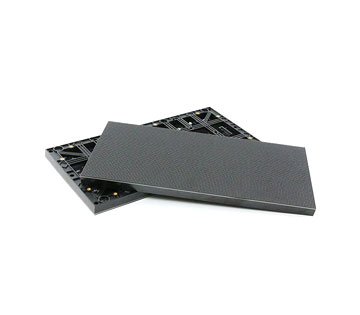
P1.83 Indoor LED Module
- Pixel pitch: 1.83mm
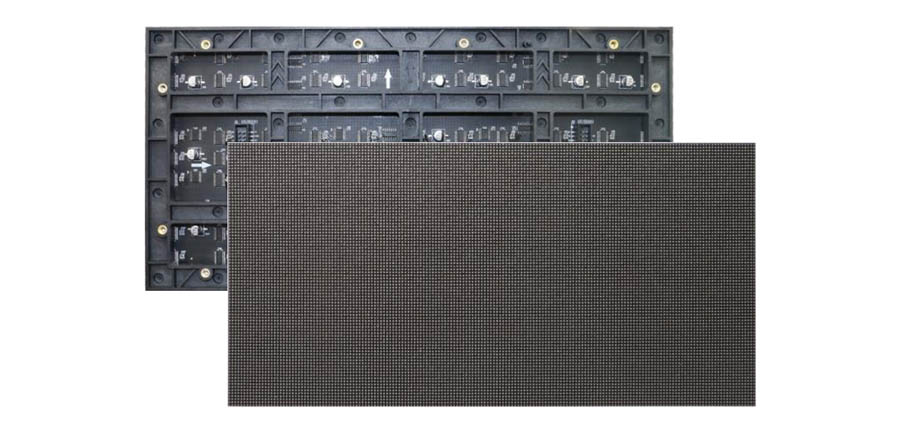
- Module size: 320*160mm
- Module resolution: 174*87 pixels
- Pixel density: 295664 dots/sqm
- Refresh rate: 3840Hz
- 2-3 years warranty
Excellent visual experience
P1.83 indoor LED module has a very fine pixel pitch, that is, its pixel density is higher at the same size, so it can present a clearer and more delicate image, even if it is viewed at a very close distance, the visual effect is also very good. Suitable for some application scenarios that require high image details.

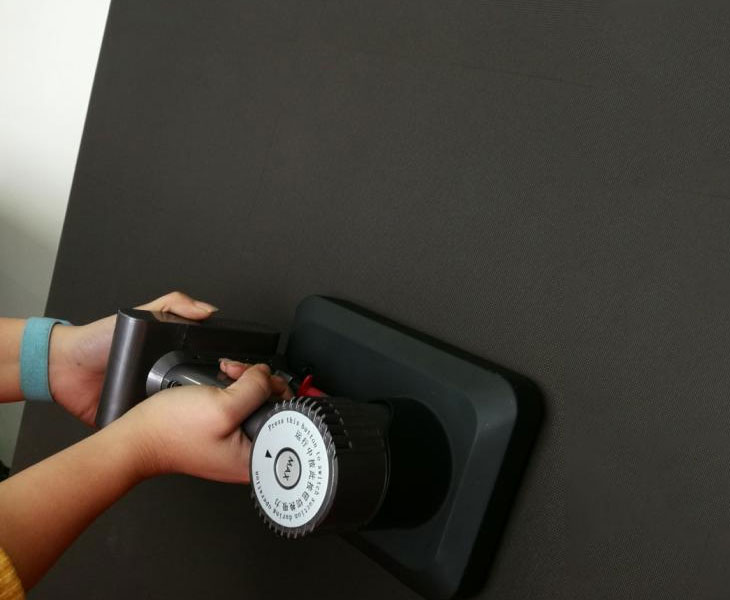
Seamless stitching
High-precision craftsmanship and point-by-point correction technology are used in the production of LED modules, so that P1.83 indoor LED module can be seamlessly spliced and there is no brightness and color difference in the entire LED screen module, ensuring the consistency of the image and greatly improving the user’s viewing experience.
Low noise operation
P1.83 indoor LED module generally uses die-cast aluminum cabinet. Aluminum has good thermal conductivity, and die-cast aluminum cabinet is seamlessly formed in one piece, which further improves the overall thermal conductivity. No fan is required for heat dissipation, so there is almost no noise during operation, and it can be installed at home and used as a TV.
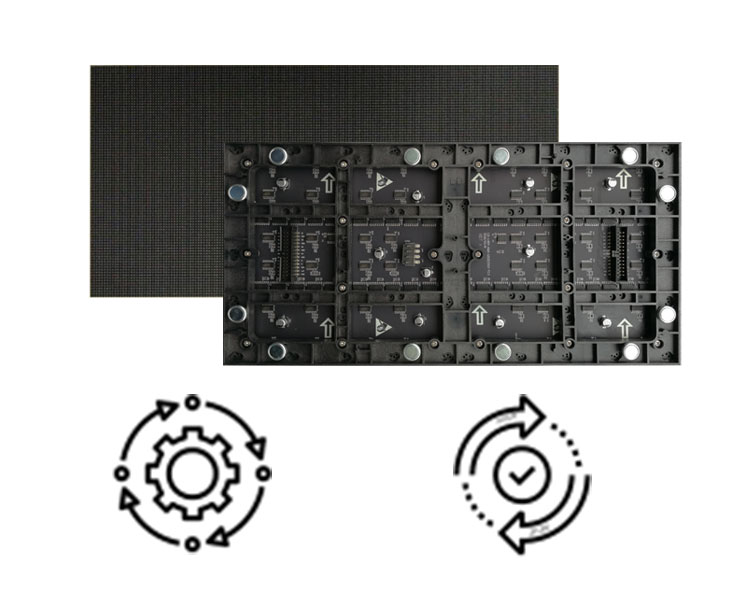
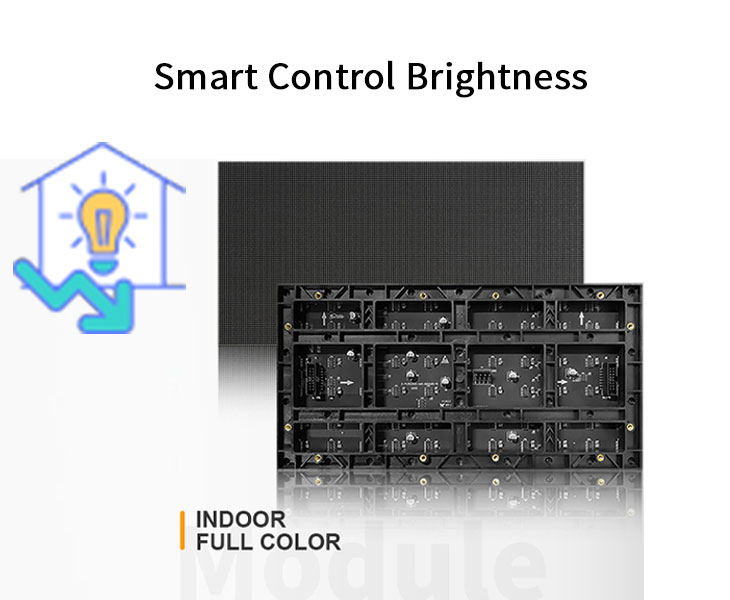
Smart control and user-friendly
P1.83 indoor LED module adopts a magnetic front maintenance design, which is easy to disassemble and assemble, and you can replace and maintain it yourself. You can change the playback content through various control methods such as WIFI, HDMI, USB, etc., and you can even add 4G function for remote control.
Long-term stability and reliability
With the use of high-quality lamp beads, IC, PCB boards and other components, P1.83 indoor LED module has smooth signal transmission and stable operation. And although it is an indoor LED module, it has also undergone certain waterproof and moisture-proof treatment to improve the adaptability of LED module in different environments and make it more reliable.

P1.83 LED Display Module Data Table
| Pixel Pitch | 1.83 |
| Module Size(mm) | 320*160 |
| Module Pixel | 174*87 |
| Brightness | 600-750 nits |
| Pixel Configuration | SMD1515 |
| Colors | 8192 x 8192 x 8192 |
| Refresh Rate (HZ) | ≥3840 |
| Pixel Matrix Per Sq.m | 295664 |
| View Angle (H/V) | 160/160 |
| Power Comsuption(max/avg) | 500/250 |
| IP Rate | IP31 |
| Input Voltage (AC) | 110/240 |
| Operating Temp. | -20-60 Celsius degree |
| Operating Humidity | 10-95% RH |
| Control Distance | Ethernet cable 100m, optical fiber 5km |


P1.83 Indoor LED Module Manufacturer in China
JYLED is a professional LED display manufacturer established in Shenzhen in 2018. With its own production facility and eight years of LED display manufacturing experience, JYLED supplies wholesale LED modules to customers in China and around the world.
When you purchase P1.83 indoor LED modules from JYLED, you can customize the specifications, request OEM services, and benefit from reliable production capacity and a consistent supply schedule.
What Is a P1.83 Indoor LED Module?
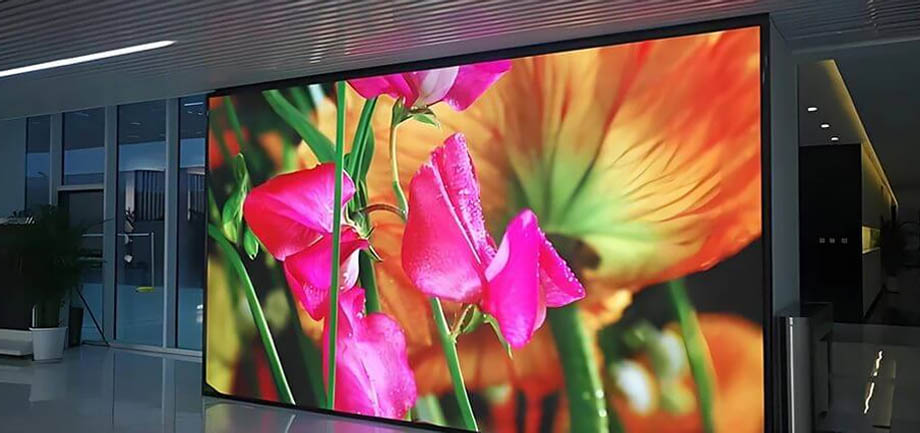
A P1.83 indoor LED module is an LED module with a 1.83 mm pixel pitch. As a fine-pitch module with a pixel pitch of 2 mm or less, it delivers clear, detailed images in indoor environments such as meeting rooms, auditoriums, control rooms, and corporate lobbies.
JYLED can customize the following aspects of a P1.83 indoor LED module:
- LED brand, which affects brightness, luminous decay, and operating life.
- Driver IC, which affects refresh rate and color gamut.
- PCB.
- Module mask.
- Protective treatment.
- Packaging, which affects your logo and a user manual.
Why Is P1.83 Suitable for Importers and LED Distributors?
The P1.83 LED module is a relatively cost-effective fine-pitch option with a wide range of potential applications. It is a practical choice for mid- to high-end LED screens installed indoors. Its main advantages for importers and distributors include the following:
A Practical Balance Between Close-Range Clarity and Project Cost
P1.25 and P1.53 modules support shorter viewing distances and deliver finer images, but they also come with higher procurement costs. P2 and P2.5 modules are generally more affordable, but they are better suited to viewing distances of approximately 2 meters or more, so they may not be ideal for compact indoor spaces.
By comparison, the P1.83 LED module provides a practical balance between close-range clarity and project cost. Adding this module to your product lineup can help you cover more project types, give customers more choices, and improve your chances of securing suitable projects.
Applications in Meeting Rooms, Control Rooms, and Commercial Display Projects
P1.83 indoor LED modules can be assembled into conference room LED displays, control room LED displays, indoor advertising LED displays, and other commercial or event display systems. Their optimal viewing distance is 1.83 to 3.66 meters, making them suitable for many indoor environments.
You can recommend a model according to each customer’s priorities. If the customer prioritizes finer detail and greater image clarity, recommend P1.25 or P1.53. If the customer places greater emphasis on cost-effectiveness, recommend P1.83 or P2.
Standard Dimensions Simplify Stocking and Project Calculations
JYLED primarily manufactures P1.83 indoor LED modules in a standard 320 × 160 mm size. This standard format offers several advantages:
- The manufacturing process is well established, and some inventory may be available in the warehouse.
- Module quantities are easier to calculate for individual projects, helping you estimate costs quickly.
- Standard-size modules are generally more economical to purchase. Custom module dimensions require additional tooling costs.
Bundled Supply of Modules, Cabinets, and Accessories
In addition to modules, we can supply matching LED cabinets, LED video controllers, power supplies, and other accessories. This allows you to offer local customers a complete LED display package and coordinate on-site installation more efficiently. For customers who want a more streamlined procurement and installation process, this can be a strong competitive advantage.
How Should You Choose Between P1.83 and Other Indoor LED Modules?
If you want to serve the market as a professional LED display distributor, selling only one model may limit the types of customers and projects you can serve. It is generally better to offer several nearby pixel-pitch options so your product range can cover more applications and buyer requirements.
The following comparison examines several models close to P1.83 in terms of performance and cost:
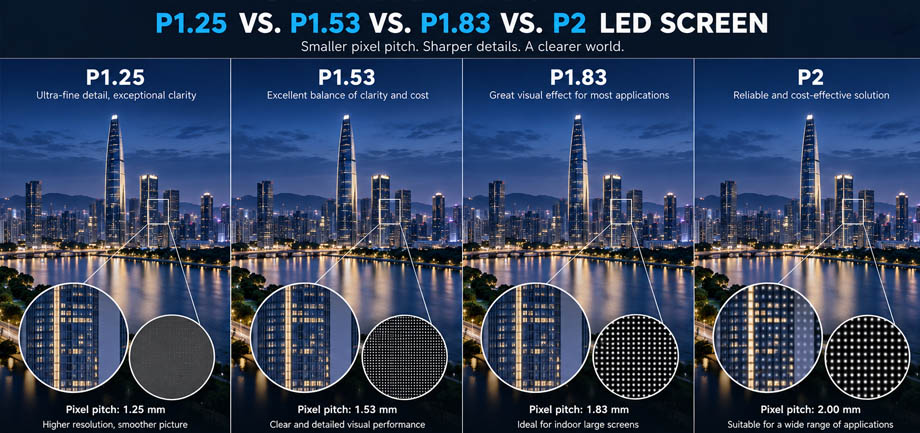
Clarity and Cost Comparison of P1.25, P1.53, P1.83, and P2 LED Modules
Image Clarity
- P1.25 LED module: A P1.25 LED panel has 640,000 pixels per square meter and can render small text with excellent clarity and detail.
- P1.53 LED module: A P1.53 LED panel has 422,500 pixels per square meter. It offers less image detail than a P1.25 panel but still delivers clear images at an appropriate viewing distance.
- P1.83 LED module: Based on a module resolution of 174 × 87 pixels and a module size of 320 × 160 mm, the pixel density is approximately 295,664 pixels per square meter, about half the density of a P1.25 panel.
- P2 LED module: A P2 LED panel has 250,000 pixels per square meter and provides good detail for medium-sized text and icons.
Optimal Viewing Distance
- P1.25 LED module: The optimal viewing distance is 1.25 to 2.5 meters.
- P1.53 LED module: The optimal viewing distance is 1.53 to 3.06 meters.
- P1.83 LED module: The optimal viewing distance is 1.83 to 3.66 meters.
- P2 LED module: The optimal viewing distance is 2 to 4 meters.
Procurement Cost
The prices below apply to standard module configurations. Customized driver ICs, LED package brands, or module types may affect the final price. Contact JYLED for a project-specific quotation.
- P1.25 LED module: Approximately USD 1165 to 1990 per square meter.
- P1.53 LED module: Approximately USD 1045 to 1790 per square meter.
- P1.83 LED module: Approximately USD 995 to 1590 per square meter.
- P2 LED module: Approximately USD 845 to 1480 per square meter.
Screen Area for a 4K Resolution Example
All of the following models are available in the standard 320 × 160 mm module size. The calculations use a 640 × 480 mm LED cabinet assembled from these standard modules:
- P1.25 LED module: The LED cabinet resolution is 512 × 384 pixels. A 4K screen requires 3840 ÷ 512 = 7.5 ≈ 8 cabinets horizontally and 2160 ÷ 384 = 5.6 ≈ 6 cabinets vertically. The screen therefore uses 6 × 8 = 48 cabinets, with a total area of 640 × 480 mm × 48 = 14.75 m².
- P1.53 LED module: The LED cabinet resolution is 418 × 314 pixels. A 4K screen requires 3840 ÷ 418 = 9.2 ≈ 10 cabinets horizontally and 2160 ÷ 314 = 6.9 ≈ 7 cabinets vertically. The screen therefore uses 10 × 7 = 70 cabinets, with a total area of 640 × 480 mm × 70 = 21.50 m².
- P1.83 LED module: Based on a 320 × 160 mm module with 174 × 87 pixels, a 640 × 480 mm LED cabinet has a resolution of 348 × 261 pixels. A 4K screen requires 3840 ÷ 348 = 11.03 ≈ 11 cabinets horizontally and 2160 ÷ 261 = 8.28 ≈ 9 cabinets vertically. The screen therefore uses 11 × 9 = 99 cabinets, with a total area of 640 × 480 mm × 99 = 30.41 m².
- P2 LED module: The LED cabinet resolution is 320 × 240 pixels. A 4K screen requires 3840 ÷ 320 = 12 cabinets horizontally and 2160 ÷ 240 = 9 cabinets vertically. The screen therefore uses 12 × 9 = 108 cabinets, with a total area of 640 × 480 mm × 108 = 33.18 m².
P1.25 vs P1.53 vs P1.83 vs P2 Quick Comparison Table
| Category | P1.25 | P1.53 | P1.83 | P2 |
| Pixel pitch | 1.25 mm | 1.53 mm | 1.83 mm | 2 mm |
| Pixel density | 640,000 pixels/m² | 422,500 pixels/m² | 295,664 pixels/m² | 250,000 pixels/m² |
| Standard LED module size | 320 × 160 mm; 200 × 150 mm; 300 × 168.75 mm | 320 × 160 mm | 320 × 160 mm | 320 × 160 mm; 240 × 240 mm; 256 × 128 mm; 128 × 128 mm |
| Optimal viewing distance | 1.25 to 2.5 m | 1.53 to 3.06 m | 1.83 to 3.66 m | 2 to 4 m |
| Scan mode | 45S, 60S, 64S | 52S | 43S | 30S, 32S, 40S, 64S |
| Peak brightness | 750 nits | 750 nits | 750 nits | 750 nits |
| Average power consumption | 220 to 240 W/m² | 240 W/m² | 220 to 240 W/m² | 220 to 240 W/m² |
| Ribbon cable | 16-pin, 26-pin | 16-pin | 16-pin | 16-pin |
| Price | USD 1165 to 1990/m² | USD 1045 to 1790/m² | USD 995 to 1590/m² | USD 845 to 1480/m² |
How Do You Choose a Pixel Pitch Based on Viewing Distance and Budget?
If the first row is approximately 1.2 meters from the screen, you can recommend a P1.25 LED module. At approximately 1.5 meters, recommend P1.53. At approximately 1.8 meters, recommend P1.83. At approximately 2 meters, recommend P2.
Following the same principle, if the venue is larger and the first row is farther from the screen, you can recommend a larger pixel pitch such as P2.5 or P3.91.
How Should Importers and Distributors Plan Their Module Inventory?
A distributor’s inventory plan should reflect the requirements of its target customers and the sales frequency of each model:
- Position each product for a specific target customer. For example, if your target market is mid- to high-end indoor display users, fine-pitch modules such as P1.25, P1.53, P1.83, and P2 are better inventory choices than P5 or P6 modules.
- Maintain higher stock levels for popular models. For frequently requested models such as P1.25 and P2, keep larger quantities in stock. Keep smaller quantities of less common models for customers with special requirements.
What Determines the Wholesale Price of a P1.83 Indoor LED Module?
The wholesale price of an LED module depends on its materials, specifications, order quantity, OEM customization, packaging, shipping, tariffs, and other factors:
- LED package, driver IC, and PCB configuration: Core component specifications are major factors in the wholesale price. For example, Nationstar LEDs cost more than Kinglight LEDs but provide better light output and more consistent long-term performance.
- Refresh rate, grayscale, and quality grade: Higher module specifications generally improve image performance and also increase the wholesale price.
- Minimum order quantity and volume pricing: Wholesale prices vary by purchase volume. In general, larger LED module orders qualify for lower unit prices. Before purchasing, ask JYLED for tiered pricing based on the order quantity.
- OEM customization, packaging, and accessory costs: Additional OEM services, such as applying your brand logo to the products and packaging, incur additional customization costs. Packaging and accessory requirements can also affect the final price.
- Freight, tariffs, and total landed cost: Ocean and air shipping involve different freight costs. Tariff rates also vary by country, affecting the final landed cost.
How Do You Choose a Reliable P1.83 LED Module Supplier?
- Confirm manufacturing capability, capacity, and lead time: Give priority to suppliers with extensive production experience and reliable capacity. JYLED, for example, has eight years of LED display manufacturing experience and a production facility with capacity for up to 200 workers, helping maintain a consistent delivery schedule and reduce delays that could affect your brand.
- Review production testing and aging procedures: A supplier with comprehensive production testing and aging procedures can deliver P1.83 LED modules with more consistent quality and long-term performance. Give priority to suppliers with stricter quality-control processes.
- Verify quality through samples or a small order: Contact the supplier for samples or place a small initial order. Evaluate the actual product quality before deciding whether to continue the partnership.
- Visit the factory: If possible, visit the facility to evaluate its production capacity, daily output, quality-control practices, and general operating conditions firsthand.
- OEM and distribution support: Choose a supplier that supports OEM customization of module labels, packaging, multilingual manuals, and related materials. Adding your logo can help strengthen brand recognition and market presence.
How Do You Calculate a P1.83 LED Display Project Configuration?
Calculate Screen Dimensions From the Target Resolution
Use the customer’s expected LED display resolution to calculate the screen dimensions, then select suitable LED module and cabinet dimensions. The final actual resolution may differ slightly from the target resolution.
Configure Power Supplies, Receiving Cards, and the Video Processor
In addition to the LED panels, the screen requires several important supporting components:
- Calculate the maximum and average power consumption of the complete LED display system to determine the required power-supply solution. Properly specified power supplies help the screen operate reliably.
- Plan the receiving-card and video-processor configuration according to the module resolution. Suitable receiving cards help ensure that the LED modules receive and display signals reliably, while the video processor provides signal switching, scaling, and image-management functions.
Determine the Cabinet Maintenance Method and Spare Parts
- The final screen dimensions depend on the cabinet dimensions. If the customer has a target resolution, adjust the cabinet quantity so the screen’s actual resolution is as close as possible to the target resolution.
- P1.83 indoor LED modules can be equipped with magnetic mounting for convenient installation and removal. When the cabinet also supports front maintenance, technicians can remove the modules from the front of the display, reducing the rear clearance required for maintenance.
How Do You Get an Accurate Wholesale Quote for P1.83 LED Modules?
To receive a P1.83 LED module quote quickly, provide JYLED with the following information:
- The required LED module quantity, display application, and country of installation.
- Whether the order is for a new project or replacement modules for an existing screen.
- The required refresh rate, LED package brand, driver IC configuration, and other module specifications.
- The screen dimensions, customization requirements, and required accessories.
- Whether you need samples or a distributor price list from JYLED.
You cannot determine compatibility from pixel pitch alone. For P1.83 and P1.875 LED modules, you must also check the module dimensions, mounting-hole positions, connectors, ribbon-cable direction, scan mode, driver IC, and calibration data.
If any item is incompatible, the modules should not be used as direct replacements.
Purchasing only one spare P1.83 LED module is not recommended. The spare quantity should reflect the screen size and maintenance conditions.
As a general guideline, keep approximately 5% of the total module quantity as spare modules from the same production batch. This supports timely replacement and reduces brightness and color differences between production batches.
No. The P1.83 LED modules discussed in this article are designed for indoor use in terms of brightness, environmental protection, heat dissipation, and structural design.
For outdoor projects, select outdoor LED modules according to ambient light, water and dust protection, temperature, viewing distance, and installation structure rather than pixel pitch alone.
At JYLED, the production lead time for a bulk order typically ranges from 14 to 20 days. Very large orders may require several additional days.
To reduce batch color differences and after-sales risk, use LED modules from the same production batch throughout a single project whenever possible.
Retain the corresponding calibration data, configuration files, and bill of materials (BOM) information. Before installing modules purchased later alongside the original modules, verify the production batch and compare their display performance.