



Both Crystal UHD and QLED are smart TVs from Samsung, so what are the differences between them? How should we choose between them? Are there other options for smart displays? Let’s analyze them in detail and make a final decision.
What is Crystal UHD?
Crystal UHD is Samsung’s version of a regular UHD TV that incorporates Dynamic Crystal technology, further enhancing its functionality and picture quality. The core of Crystal UHD is the introduction of a 4K Crystal Image Processor, which improves even lower-resolution images.
What are the main features of Crystal UHD?
- 4K resolution: Crystal UHD supports native 4K resolution (i.e., 4096×2160px) and can also upscale lower resolution images to 4K to a certain extent.
- Basic HDR support: Crystal UHD supports basic HDR, such as HDR10+ and HDR10.
- Cost-friendly: As an entry-level 4K smart TV, the Crystal UHD TV has a low cost.
What is QLED?
QLED is an abbreviation for Quantum Dot Light Emitting Diode. Televisions and monitors made using quantum dot technology are collectively called quantum dot TVs or quantum dot displays. However, it should be noted that quantum dot LED displays are generally made with LED display modules, which differ from the previous two types.
What are the main characteristics of QLED?
- Higher brightness: QLED TVs can typically reach 1300 nits, while conventional TVs and monitors typically reach around 1000 nits.
- Wider color gamut: QLED TVs have quantum dot films that can convert blue light into pure red and green light, thus expanding the color gamut of the display.
- Enhanced HDR performance: QLED TVs support more HDR formats, including HDR10+ and HDR10, as well as HLG and others.
How to quickly choose between Crystal UHD and QLED TVs using 6 dimensions?
- Budget: If the budget is low, prioritize Crystal UHD TVs.
- Usage environment: QLED TVs are preferred in environments with high brightness.
- Content type: For hardcore gamers and a professional viewing experience, QLED TVs are the preferred choice.
- HDR performance: QLED TVs offer more impressive HDR performance and are recommended as the preferred choice.
- Functionality Experience: QLED TVs integrate more functions, such as AI picture quality enhancement and air gesture operation, resulting in a better user experience.
- Future Outlook: QLED supports 4K and is compatible with 8K resolution. Even if 8K content becomes widespread in the future, it will not be immediately phased out.
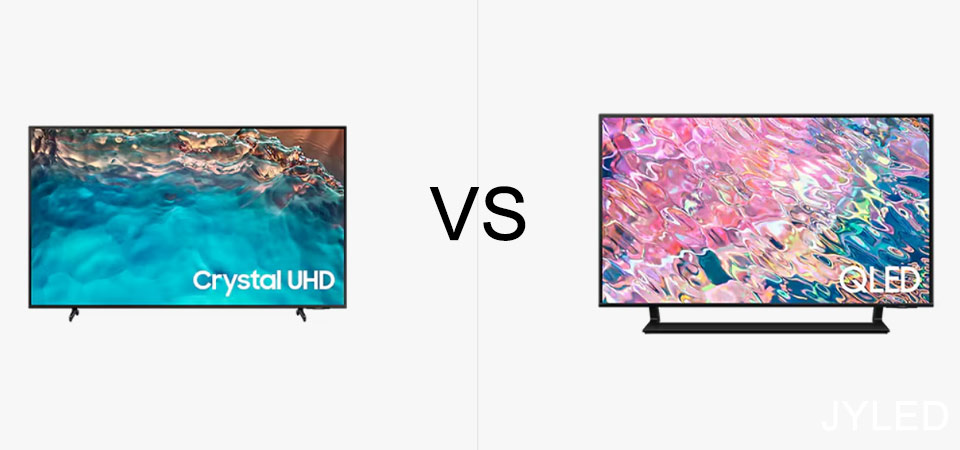
Crystal UHD vs QLED: Key Differences Comparison
Image quality performance
- Resolution: QLED TVs, equipped with quantum dot 4K processors, boast strong compatibility, supporting not only 4K resolution but also 8K. In contrast, Crystal UHD only supports 4K resolution and does not support 8K.
- Clarity and Detail: Because QLED TVs are compatible with higher resolutions, they reproduce clarity and detail better. Crystal UHD TVs are slightly inferior in this aspect.
Brightness difference
- QLED vs. Crystal UHD: QLED is made with a finer quantum dot film, which allows more backlight to pass through the film, so its brightness is 300-500 nits higher than Crystal UHD.
- Outdoor/High-Light Environment Performance: Although QLED TVs are brighter than Crystal UHD TVs, they are not suitable for outdoor or high-light environments. It is recommended to replace them with outdoor LED wall units specifically designed for outdoor or high-light environments.
Color expression
- Color gamut coverage: QLED TVs can achieve 110% NTSC coverage and 100% or even higher DCI-P3 color gamut coverage. Crystal UHD TVs can only achieve a maximum of 95% DCI-P3 color gamut coverage, slightly lower than QLED.
- Color accuracy: Although the numerical values of Samsung QLED TVs are higher than those of Samsung Crystal UHD TVs, in actual use, there is no particularly noticeable difference between the two.
Dimming and Black Level Performance
- Dimming methods: Samsung’s Crystal UHD TVs primarily use a dimming method that combines Edge-LED backlight technology with software algorithms. QLED TVs have similar dimming methods to LED displays, mainly using PWM dimming and DC dimming.
- Black levels: QLED TVs support point-to-point control of LED switching, allowing for targeted darkening of specific areas, resulting in superior black levels. In contrast, Crystal UHD TVs are not significantly different from conventional LCD monitors, offering only average black levels. Currently, neither can compare to OLED TVs, which can achieve truly pure blacks.
HDR performance
As mentioned above, Samsung’s QLED TVs use Quantum Dot HDR+, which has a stronger HDR performance than Samsung’s regular Crystal UHD, thus QLED’s HDR performance is superior.
Viewing angle
There is no significant difference between the two, but there is still a slight difference compared to COB LED displays with a viewing angle of nearly 180°.
Energy consumption and lifespan
Energy Efficiency Comparison: According to Samsung’s official website, QLED TVs are approximately 18% more energy-efficient than Crystal UHD TVs. To verify this claim, I ordered a 75″ QLED Q8F 4K Samsung Vision AI Smart TV and a 75″ Crystal UHD U8500F 4K Smart TV from Samsung’s official website. Both TVs were run for the same amount of time (5 hours per day); below is a graph showing their performance over 10 days:
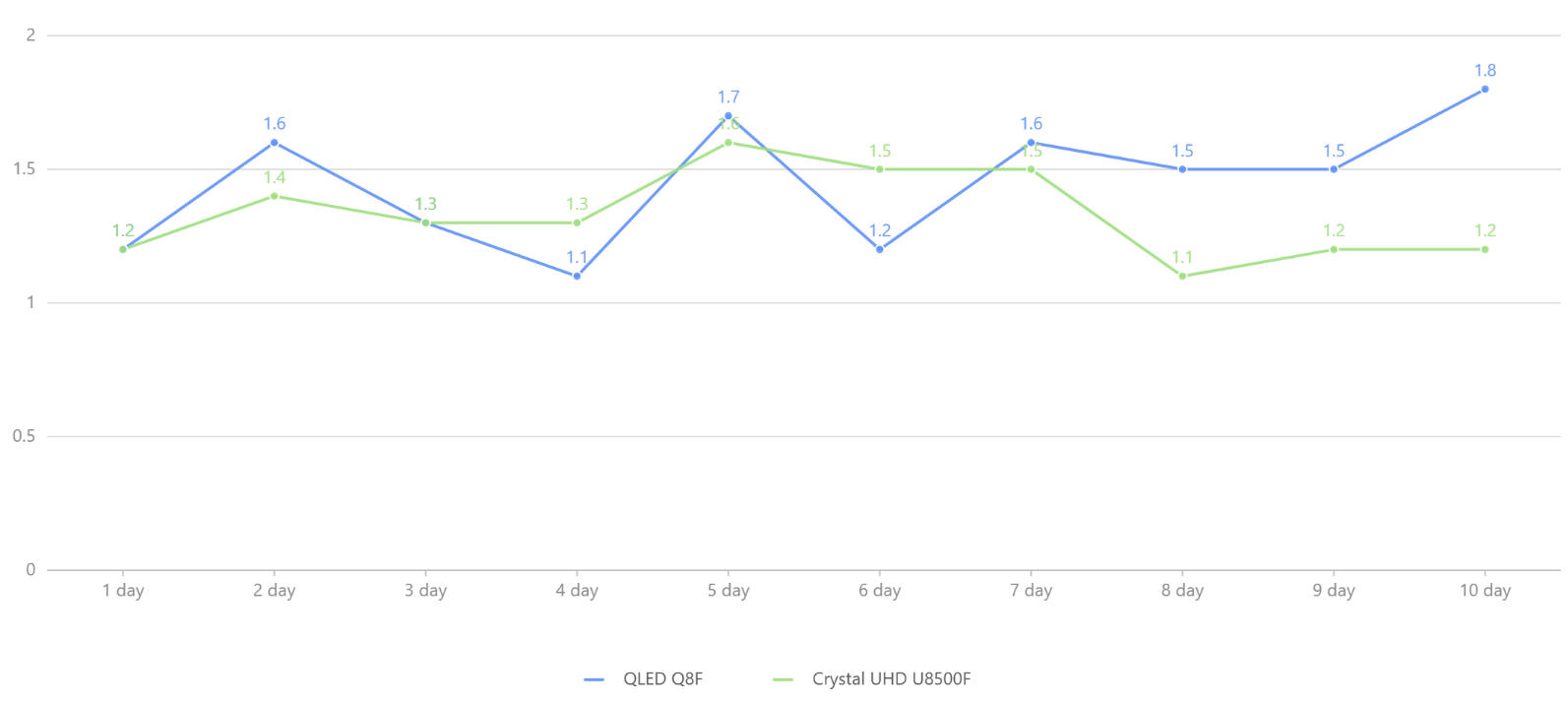
As can be seen from the fluctuation curve in the image above, the power consumption of the QLED Q8F TV is lower than that of the Crystal UHD U8500F.
Lifespan: There’s a lot of online discussion about the lifespan of QLED and UHD TVs. Some believe QLED TVs have a shorter lifespan, while others believe UHD TVs have a shorter lifespan. However, the vast majority of opinions agree that QLED TVs have a longer lifespan than UHD TVs. To verify these online claims, I carefully reviewed all products of both types. Unfortunately, I couldn’t find specific lifespan details for either on the official websites; Samsung only offers a 7-year warranty on both products on their product pages. Based on this official warranty, their lifespans should be roughly the same.
Backlight structure differences
Although both require backlighting, they are not entirely the same from a technical standpoint. QLED uses quantum dot film to filter colors, while Crystal UHD uses color filters to filter colors.
Crystal UHD vs QLED: Performance Comparison Summary Table
| Product Type | QLED | Crystal Color UHD |
| Resolution support | Supports 4K and is compatible with 8K. | 4K only |
| processor | Quantum Dot 4K Processor | Crystal 4K Processor |
| Color gamut coverage | 100% DCI-P3 | 95% DCI-P3 |
| dimming method | Supreme Ultra HD Dimming | UHD dimming |
| HDR support | Quantum HDR+, compatible with HDR 10+ | HDR, HDR 10+ |
Price Comparison: Crystal UHD vs QLED
Price Comparison of Three Best-Selling Samsung Crystal UHD and QLED TVs
| type | model | size | price | position |
| Crystal UHD | Samsung U8000F | 43″–85″ | Starting from $229 | Beginner |
| Samsung U7900F | 55″–75″ | Starting from $448 | large screen | |
| Samsung DU6900 | 43″–65″ | $282–349 | Budget | |
| QLED | Samsung Q7F | 43″–75″ | Starting from $349 | High brightness |
| Samsung Q8F | 43″–75″ | Starting from $399 | Advanced image quality | |
| Samsung QN80F | 55″–85″ | Starting from $1399 | high-end |
Application scenario comparison:Crystal UHD vs QLED
Home use
- For everyday viewing: Based on Samsung’s sales data, Crystal UHD is more suitable for everyday viewing. Crystal UHD strikes a good balance between picture quality and price, and in daily use, the difference between it and a QLED TV is almost imperceptible.
- Movies: Movies emphasize depth and detail, demanding high picture quality. While Crystal UHD performs well, it still lags significantly behind QLED. Especially when displaying close-ups in dark scenes, the Crystal UHD screen appears slightly grayish.
- Gaming: Because QLED TVs are optimized for gaming and include features such as Auto Game Mode (ALLM), AI Auto Game Mode, and mini-map zoom, they offer a superior gaming experience compared to Crystal UHD TVs.
Commercial use
- Digital signage: Compared to the more expensive QLED TVs, Crystal UHD offers greater affordability and is increasingly favored by digital signage builders.
- Commercial advertisements display: Since there is no significant difference in picture quality between the two, most regular commercial advertisements, considering costs, will prioritize choosing Crystal UHD TVs, and only some particularly high-end venues (such as luxury stores) may use QLED TVs.
- Showrooms/Hotels: Most hotels, due to cost considerations, will not use the more expensive QLED TVs. Showrooms are different; they essentially want to attract customers with vibrant visuals. The more features and the better the picture quality, the higher the customer satisfaction. Therefore, showrooms generally prioritize QLED TVs. Some showrooms with special needs often use flexible LED displays with customized shapes to quickly attract the attention of target customers.
Who should choose Crystal UHD?
- Limited Budget: As an entry-level 4K smart TV, the Crystal UHD TV is still significantly better than most 4K high-definition TVs. If you’re considering whether to choose Crystal UHD or QLED within your budget, I recommend the Crystal UHD TV. It achieves the best balance between performance and budget.
- For everyday viewing: The various configurations of Crystal UHD basically meet all the needs of everyday viewing, making it very suitable for everyday viewing.
- Don’t require the highest image quality: If you’re not looking for the ultimate image display, Crystal UHD is still the best choice.
Who should choose QLED?
- For those seeking high brightness: QLED TVs can reach a peak brightness of 1300 nits, making them a good choice for those who prioritize high brightness.
- Gamers: As we have already introduced, QLED TVs have many built-in features designed for gaming, making them a great choice for serious gamers.
- For high-end home theater users: If you want to create an immersive cinema experience at home, a QLED TV is undoubtedly the best choice. It can intelligently prompt you on the display quality to achieve the optimal solution.
Frequently Asked Questions : Crystal UHD and QLED
What is Neo QLED? How is it different from Crystal UHD and QLED?
Neo QLED is Samsung’s top-of-the-line QLED TV, essentially an upgraded version of QLED TVs, similar to the difference between the iPhone 17 and iPhone 17 Pro Max. Unlike Crystal UHD and QLED TVs, Neo QLED targets users who demand the highest quality picture experience.
Which is better, Crystal UHD or QLED?
In terms of picture quality and performance, QLED TVs are better.
Is a QLED TV worth the extra money?
It’s worth it. QLED not only introduces the latest features but also ensures compatibility with the potentially widespread 8K resolution. This means that even after 8K content becomes more common, QLED TVs can still be used for a very long time.
Which is the best, QLED or OLED TV?
Because QLED and OLED TVs use different display technologies, it’s difficult to directly compare which is better. However, I can provide a clear answer based on market shipments: QLED TVs are better than OLED TVs. According to Omdia’s “TV Market Tracker Report, February 2025,” QLED TV shipments have consistently remained in the tens of millions, while OLED TV shipments have only reached the millions.
There are two main reasons for this: firstly, OLED TVs of the same size have less integrated features than QLED TVs, yet their prices are higher. Secondly, the manufacturing process for OLED TVs is not yet mature, and the burn-in issue has not been fully resolved to date.
Do QLED and OLED TVs support installment purchases?
Yes, both TVs offer installment payment options of up to 24 months on the checkout page. However, it’s important to note that installment payments generally incur additional handling fees.
Conclusion: Crystal UHD or QLED?
Unlike most online content that resembles a standard formula, we’ve provided a comprehensive, step-by-step guide to understanding all aspects of Crystal UHD and QLED TVs.
After reading this article, you should now be able to easily decide which Crystal UHD or QLED TV to choose. For more in-depth information on display technology and screens, please visit our blog page for more informative articles.

