



What is a quantum dot LED display?
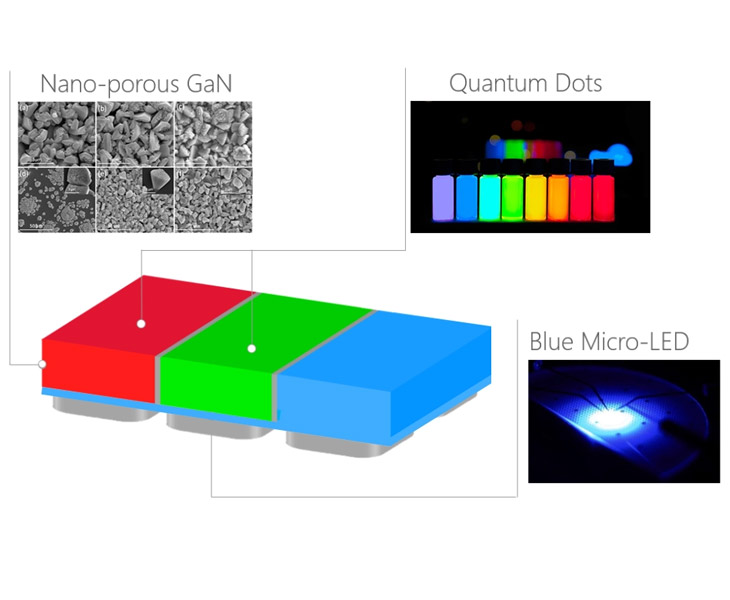
Quantum dot LED displays are made from gallium nitride, a material known for its stable performance and superior pressure resistance. This semiconductor material can be used for extended periods in high-power optoelectronic devices and emits various linear lights such as blue, green, and white. Replacing the traditional SMD packaging technology with this material enables higher contrast, smaller pixel pitch, and more durable performance.
Other indoor display product recommendations

Indoor LED displays, with their high-definition resolution and seamless splicing features, are widely applied in various indoor scenarios.

Using flexible LED panels, we can create customized LED displays for various creative applications.

A multifunctional, versatile LED poster display with wheels at the bottom, allowing it to be freely moved to any location for display.

Indoor rental LED displays constructed using rental LED display cabinets are suitable for various event scenarios such as weddings and stages.
What are the advantages of quantum dot LED displays?

The main components of the modules and cabinets that make up the quantum dot LED display have been redesigned, resulting in an overall weight that is approximately 38% lighter than conventional small-pitch LED displays.

When you need to perform simple cleaning or maintenance on the screen, you can easily remove the modules from the JYLED quantum dot LED display without any complex disassembly tools.

As the original manufacturer of quantum dot displays, JYLED supports customization of various parameters and sizes for screens. Whether you want a larger or brighter display, we can easily accommodate your needs.

When combining two or more quantum dot LED display cabinets into a larger screen, you will be surprised to find that the resulting large screen has virtually no visible seams!

The quantum dot LED display cabinets feature multiple square cooling vents. These vents not only facilitate the removal of LED modules from the screen but also allow heat to dissipate more quickly from the screen’s interior.

With its powerful intelligent control system, the quantum dot LED display can achieve adaptive energy management. When displaying dark scenes, it can directly turn off the corresponding areas to save energy consumption.
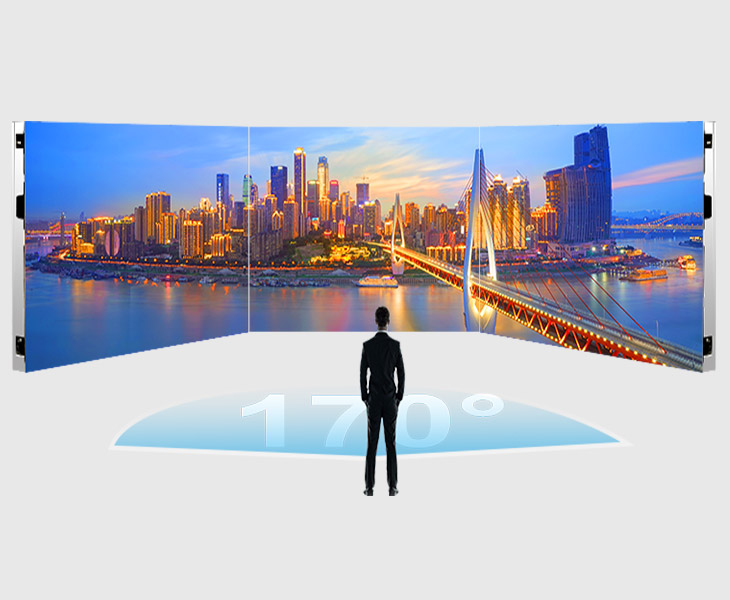
Ultra-wide viewing angle
Many indoor LED displays on the market that achieve a 145° viewing angle are already considered high-end products. However, for our quantum dot LED display, a 145° viewing angle is just the starting point—it can easily achieve a 170° viewing angle. This means that no matter where you stand to view the screen, you will enjoy exceptional clarity.
Precise color point control for perfect image quality
JYLED uses a high-precision color calibration instrument to precisely control each QLED LED on the screen, achieving perfect image quality. After years of iteration and improvement, JYLED’s quantum dot LED displays can now achieve the most perfect pure white or pure black, with no discernible color differences to the naked eye. This feature is currently unmatched by other indoor displays on the market.
Breaking the frame rate limit, up to 120Hz
The smoothness of an LED display’s image quality is typically determined by frame rate and refresh rate. Conventional LED displays have a maximum frame rate of 60Hz and a maximum refresh rate of 3840Hz. While these rates may not be noticeable to the naked eye, in high-precision scenarios such as virtual filming or live sports broadcasts, the image may exhibit flickering or water ripple effects that degrade picture quality.
To address this, we abandoned the traditional COB packaging method during the design of quantum dot LED displays and instead adopted the more challenging flip-chip COB packaging method. Although this slightly increases manufacturing costs, it enables further improvements in the frame rate and refresh rate of LED displays, achieving a frame rate of 120Hz and a refresh rate of 7680Hz.

Smart Temperature Control Technology
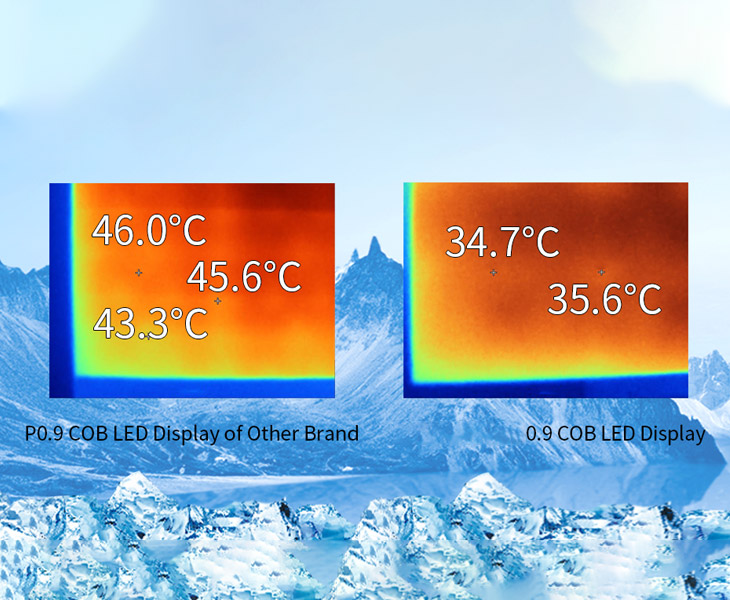
Quantum dot LED displays utilize smart temperature control technology to dissipate excess heat from the screen through ventilation holes around the edges, maintaining an optimal internal temperature and extending the lifespan of internal components.
Quantum Dot LED Displays vs Conventional LED Displays
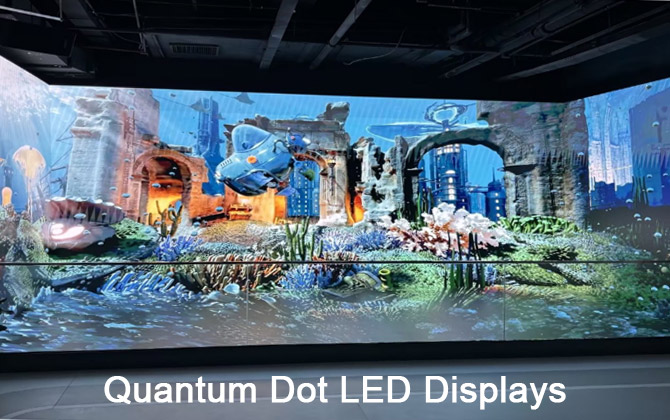

The Most Natural Pure Colors
Quantum dot LED displays utilize third-generation R-series quantum dot chips. The primary difference between these chips and SMD chips lies in their color value fluctuations.
Quantum dot LED display chips have color value fluctuations of ±0.2nm, whereas SMD chips have color values of ±5nm. As a result, quantum dot LED displays can achieve the most natural pure colors. Whether it is pure white or pure black, the colors are rendered naturally and consistently.
Higher Brightness and Lower Temperature
Generally, the higher the brightness of an LED display, the higher the screen temperature. However, our quantum dot LED display is entirely different. If you test it using a professional screen temperature measurement instrument, you will be surprised to find that, at the same brightness level, the temperature of the quantum dot LED display is approximately 8-12 degrees lower than that of a conventional LED display.
Smaller Pixel Pitch
Conventional LED displays are limited by SMT (Surface Mount Technology) machinery, making it impossible to achieve extremely small pixel pitches, which is a shortcoming for high-end display applications.
The quantum dot LED display was specifically designed to address this issue. It employs more precise QD (Quantum Dot) mounting technology, significantly reducing the distance between adjacent LED chips and easily achieving pixel pitches below 1mm.
More convenient installation and disassembly
Conventional LED displays require numerous tools for installation or disassembly. However, if you choose our quantum dot LED display, installation and disassembly will be hassle-free.
Thanks to our ingenious design structure, no tools are required during installation. Simply align the magnetic screws on the back with the corresponding positions to achieve quick installation. During disassembly, simply use the pre-drilled holes to directly remove the LED modules from the screen.
Application scenarios for quantum dot LED displays
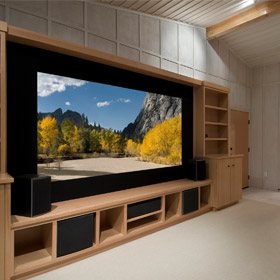
Many families aspire to create a large-screen home theater. However, unfortunately, ordinary TVs are difficult to move if they are too large, and many older residential buildings may not have elevators capable of accommodating such large sizes. In such cases, the disassemblable and modular features of the quantum dot LED display screen prove highly advantageous. You can first transport the required cabinets into the space and then assemble them on-site.
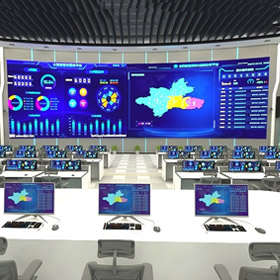
Due to the lower initial construction costs of LCDs, monitoring rooms were traditionally built using LCD technology. However, in terms of durability and aesthetics, LCDs are far inferior to quantum dot LED displays. Screens assembled using JYLED quantum dot displays have no visible seams, a feature unattainable with LCD technology. Additionally, the lifespan of LCDs typically ranges from 50,000 to 100,000 hours, whereas our quantum dot LED displays have a lifespan of up to 100,000 hours.
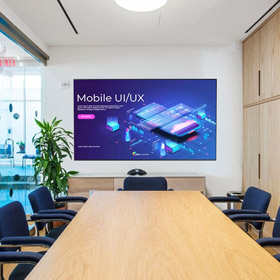
Many large enterprises or multinational corporations no longer use projectors as background displays for training or presentations, opting instead for higher-resolution quantum dot LED displays. These displays offer bright clarity and wide viewing angles, allowing participants to clearly view meeting content from any position, facilitating subsequent review.

Traditional education relies on blackboard-based teaching methods, but these blackboards are highly reflective, especially in well-lit classrooms, making it difficult for students in the back rows to see the content on the board. To improve teaching quality, high-quality quantum dot LED displays are increasingly being adopted as a replacement. They offer ultra-clear image quality and an extremely wide viewing angle, allowing students to focus fully on their studies regardless of their position in the classroom.
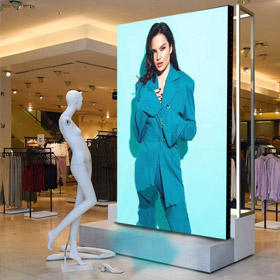
Luxury brand stores symbolize status, so everything must be of the highest quality to highlight their opulent identity. JYLED’s quantum dot LED display screens, as a product targeting the high-end display market, are exquisite and fashionable both in appearance and internal design. These advantages make them ideal for use in luxury brand stores.
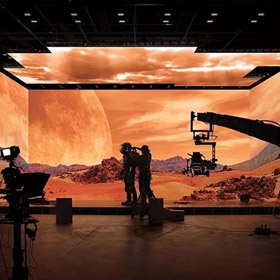
Those involved in film production know that the equipment requirements are extremely high, and even minor factors can impact the quality of the entire film. Traditional LED displays cannot meet the demands of film production, necessitating the use of more advanced equipment. As a high-end quantum dot LED display, it can now fully meet the requirements of high-quality film production.
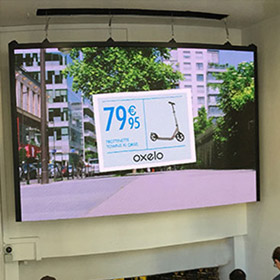
quantum dot LED displays offer far superior color saturation compared to other types of displays, resulting in vibrant and rich visuals with excellent visual effects. Using them as a LED billboard to play ads can effectively capture audience attention, and the vibrant and vivid visuals make product presentations more appealing.
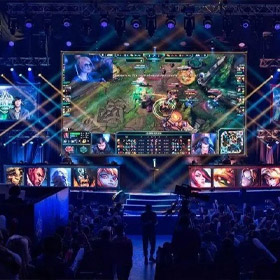
An excellent gaming experience requires a smooth-running display. Quantum dot LED displays have high-performance driver ICs, ensuring smooth gameplay. Additionally, the outstanding image color of quantum dot LED displays provides gamers with an immersive gaming experience.
Quantum dot LED display model parameters
- Parameters
| Model | P0.78 | P0.9375 | P1.25 | P1.5625 |
| Usage | Indoor | Indoor | Indoor | Indoor |
| Module Size(mm) | 150*168.75 | 150*168.75 | 150*168.75 | 150*168.75 |
| Module Resolution(mm) | 205*230 | 160*180 | 120*135 | 96*108 |
| Cabinet Size(mm) | 600*337.5*29 | 600*337.5*29 | 600*337.5*29 | 600*337.5*29 |
| Cabinet Resolution (dot) | 820*460 | 640*360 | 480*270 | 384*216 |
| Packaging Technology | Full Flip-Chip COB | |||
| Maintenance | Front | |||
| Density(dot/㎡) | 1508800 | 1137777 | 640000 | 409600 |
| Brightness(cd/㎡) | 600-1200 | |||
| Brightness Uniformity | ≥97% | |||
| Center Distance Deviation | <3% | |||
| Color Uniformity | ±0.003 | |||
| Color Temperature(K) | 3000-10000(adjustable) | |||
| Cabinet Weight (kg) | 23kg/m² | |||
| Cabinet Material | Aluminum | |||
| IP Rate | IP65(Front) / IP31(Rear) | |||
| Refresh Rate(hz) | 3840-7680Hz | |||
| Frame Change Frequency | 50/60Hz | |||
| Horizontal Viewing Angle | 170° | |||
| Vertical Viewing Angle | 170° | |||
| Best Viewing Distance | >0.7m | >0.9m | >1.2m | >1.5m |
| Input Voltage | AC110-220V | |||
| Temperature-operating | ﹣10℃~60℃ | |||
| Humidity-operating | 10%~90% | |||
| Life Span (H) | ≥100,000 | |||
| MTBF (H) | >10,000 | |||
Testimonials



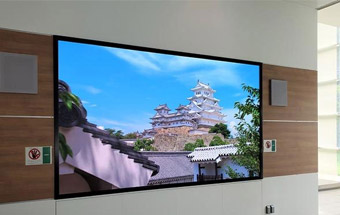
Quantum dot LED displays: The ultimate guide
A new technology called quantum dots is often used in LCD backlights and OLED color conversion layers. In recent years, it has been combined with LED screens to produce quantum dot LED displays.
Quantum dot LED displays retain the high brightness and energy efficiency of LED screens while enhancing their color and visual effects. You can learn more about quantum dot LED displays in this article.

What are quantum dots?
A quantum dot is an artificially created nanoscale particle manufactured using advanced scientific techniques. It possesses semiconductor properties and typically measures between 2 and 10 nanometers in size.
Due to the quantum confinement effect, quantum dots of different sizes exhibit distinct optical properties. Quantum dots of varying sizes can precisely emit specific colors of light. Larger quantum dots emit longer-wavelength red light, while smaller quantum dots emit shorter-wavelength blue light. This precise color emission makes quantum dots an ideal choice for display screens.
What is a quantum dot LED display?
Although quantum dots offer exceptional color performance, their reliability under strong light has been a limitation. Since 2010, quantum dot technology has primarily been applied as a color conversion layer in backlit displays or low-brightness displays.
Later, researchers began focusing on developing quantum dot LED display technology, successfully integrating quantum dots with LED chips. This quantum dot LED display offers high energy conversion efficiency, reliability, and vibrant, saturated colors.
In 2023, such quantum dot LED displays began mass production, elevating LED displays to a new level of display performance and ushering in a new era of display technology.

Quantum dot LED display features
Uniform color temperature
Traditional LED displays use gallium arsenide-based semiconductor materials for red light emitting diodes (LEDs), while green and blue LEDs use gallium nitride as the semiconductor material. The inconsistency in raw materials leads to differences in the light emission angles of red light and the other two colors, resulting in inconsistent light patterns and minor color temperature shifts at different viewing angles.
In quantum dot LED displays, the red light-emitting diodes are made using gallium nitride material. By converting the nanoscale quantum dots of potassium chloride material into red, they become red LED chips made from the same material as the blue and green light-emitting diodes.
The materials of the three-color light emitting diodes are the same, eliminating differences in light emission angles caused by varying refractive indices of different materials, thereby reducing color shifts. Quantum dot LED displays achieve remarkable color temperature consistency across all viewing angles.
Enhanced Color
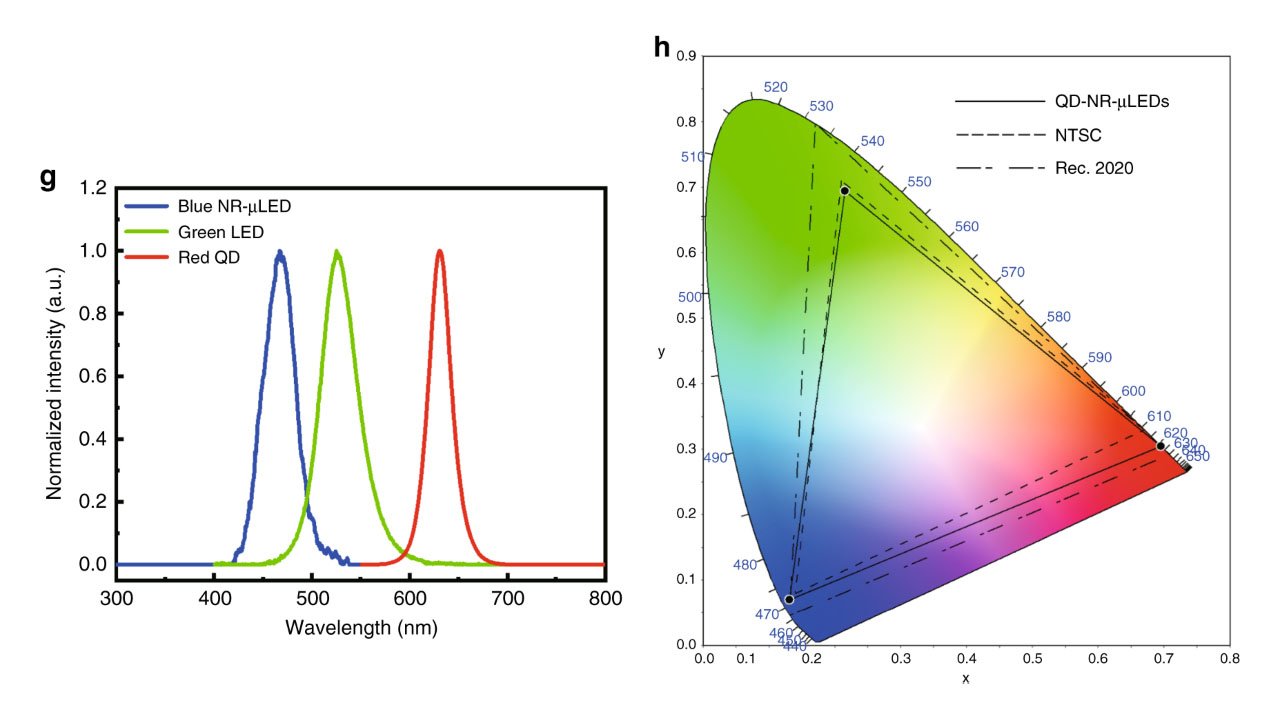
Wide Color Gamut: The improved red chips in quantum dot LED displays emit light with longer wavelengths, resulting in more vibrant colors. The three-color light emitting diodes can be arranged in more diverse combinations, yielding a color gamut that is significantly broader than that of traditional LED displays.
Vibrant Colors: quantum dot LED displays feature a black film layer on the LED module panel, achieving near-perfect black levels. The color contrast of the LED light-emitting diodes is significantly enhanced. The color performance of quantum dot LED pixel light sources is also highly rich, resulting in an overall vibrant and eye-catching display.
Color Uniformity
According to manufacturing standards, the wavelength difference between different pixel light sources on an LED display should be within 10 nm. Quantum dot LED displays typically control this difference to within 0.2 nm, resulting in minimal variation between pixels.
The harmonious uniformity of the pixels ensures superior color uniformity across the entire display, with highly consistent color performance.
Wider viewing angle
Traditional LED displays typically have a viewing angle of around 150° to 160°, while quantum dot LED displays achieve an impressive 170° vertical and horizontal viewing angles.
Under extremely harsh viewing angles, conventional LED displays may exhibit a slight bluish tint across the screen, but quantum dot LED displays show virtually no color change at different viewing angles.
Stable operation
Each pixel in an LED display is composed of red, green, and blue primary colors. Due to considerations of light-emitting characteristics, the light-emitting materials of different colored LEDs vary. LEDs with different light-emitting materials also have different drive voltages.
The three-color chips in quantum dot LED displays are made of the same material, allowing for consistent drive voltages. They can be controlled using the same drive IC, enhancing the stability and reliability of the LED display and reducing maintenance costs.
Lower power consumption
In traditional LED displays, the voltages for driving red LEDs and blue/green LEDs are different, so each pixel requires two separate circuits for the driving system. Quantum dot LED displays eliminate material differences between LEDs, simplifying the driving circuitry. All three-color LEDs can be driven by the same voltage, resulting in simpler circuits that consume less energy.
At the same brightness level, the power consumption of quantum dot LED displays is approximately 60% of that of traditional LED displays.
Environmentally friendly
While traditional LED displays also use environmentally friendly materials and pose no harm to the environment, quantum dot LED displays have made further improvements by replacing the color conversion layer of red LEDs with recyclable gallium nitride material, fully embodying the concept of environmental sustainability.
Quantum dot LED vs. other display technologies
QLED vs. LCD
LCD, as a backlit display, is inexpensive but has significantly lower brightness and color performance compared to quantum dot LED displays. Additionally, LCD has a narrow viewing angle, and viewing it from an oblique angle can cause visual distortion. Quantum dot LED displays have a wide viewing angle, with stable color and undistorted patterns from different angles.
Even when quantum dot LED is used as backlighting for LCD, its brightness and color performance cannot match those of self-emissive quantum dot LED displays.
QLED vs. OLED
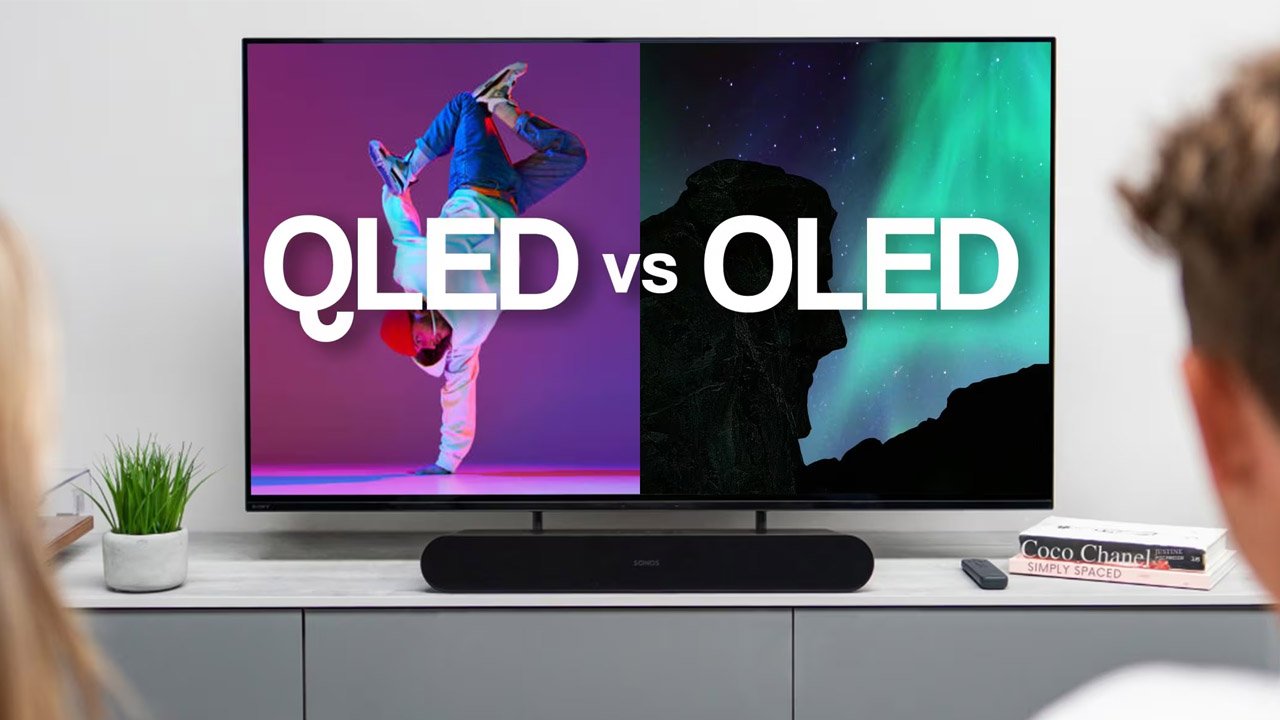
OLED is another self-emissive display technology with good color performance and higher brightness than LCD. However, the organic materials used in OLED displays have lower brightness than quantum dot LED displays. Additionally, OLED displays carry the risk of burn-in, whereas quantum dot LED displays do not.
Advanced Technology: Quantum Dot Micro LED displays
Researchers are exploring the integration of quantum dot technology into micro LED displays. The microscopic material pores of micro LEDs serve as natural containers for quantum dots and provide additional protection, enhancing their stability and reliability.
Quantum dot Micro LED displays feature extremely small pixel pitches, high brightness, and high color saturation, resulting in clear, detailed images with exceptional picture quality. They represent the future trend for high-end displays.
Conclusion
Quantum dot LED displays achieve an astonishing level of picture quality, but owning one requires a significant budget, as their ultra-high quality comes at a premium price.
If you would like to learn more about quantum dot LED displays, please contact JYLED. Our technical staff will be happy to answer your questions.