


We often see LED displays and projectors in office meetings, entertainment venues and other places, although they are both a type of display, but there are some differences. If you are not sure how to choose between LED display and projector, then let’s go through this article to understand.
What is LED display
An LED display is a multi-panel display that uses LED technology, and its composition can be divided into two parts: an LED module with several LED light beads and a cabinet that is customized according to the different sizes of the LED modules spliced together. Among other things, the LED display is able to show the picture and image out, relying on the LED beads in the LED module.
What is a projector
Projector is a device that can project images and videos onto a curtain or a flat surface, which can be connected to computers, DVDs and other playback monitors through different interfaces to get the corresponding video signals, and then process the signals and project the images into a suitable size for projection through magnifiers and lenses.
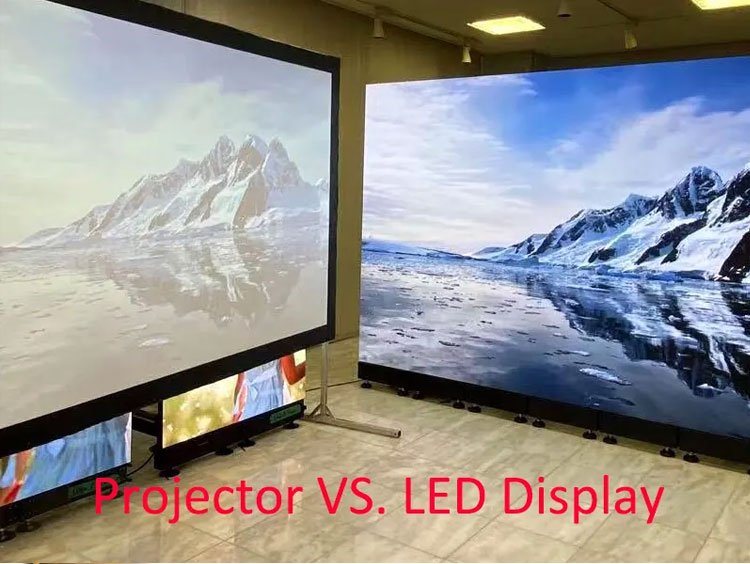
Comparison between LED display and projector
Clarity
Clarity often refers to the degree of clarity of the image that is presented when people view a display, LED displays have the clarity to have High Definition (HD) video and High Dynamic Range (HDR), whereas many projectors are displayed in standard definition. Therefore, in terms of clarity, LED displays will outperform projectors, providing the viewer with a high definition, high quality image.
Contrast
Contrast refers to the ratio of the black area to the white area in a picture or image, and the contrast of an LED display is determined by the LED beads, which have three colors, namely red, green and blue. These three colors produce white when mixed in the same proportion.
When the LED beads are turned off, the display will be black. And the projector is to be projected through the light, there is no absolute pure black, most of them are partial gray or dark gray. Therefore, the contrast ratio of the projector will be lower than that of the LED display, and will not be able to provide the audience with a better quality, more vivid picture.
Brightness
For LED displays, the overall brightness of the LED display is different because of the different environments indoors and outdoors. For outdoor LED display, its brightness range is 4000~5500cd/m2, which can ensure that the audience can recognize the content of the screen under direct sunlight, and for indoor LED display, its brightness range is 500~800cd/m2, which can provide the audience with comfortable viewing experience without affecting the indoor lighting.
Projector brightness range of about 300 ~ 1500cd / m2, its brightness can be used normally indoors, but if outdoors, there may be reflections, the picture is difficult to discern with the naked eye, if in this case for a long time to watch, it will produce a sense of fatigue on the human eye.
Color accuracy
The higher the contrast ratio, the more gradation levels from black to white areas, the higher the color accuracy, the richer the color performance. Through the above analysis of contrast ratio, we can conclude that LED display can bring the audience smoother, more colorful, vivid and realistic image screen. The image projected by the projector will look darker or paler when compared to the LED display.
Flexibility
LED display has a modular nature, can be seamlessly spliced into a variety of different sizes and aspect ratios. And it can be manufactured through the die-casting aluminum process into a variety of easy to carry, installation and dismantling of the style, so that people can be customized according to the different environments of the different sizes, can be flexible for splicing and mobile transport.
Projector installation layout is not as flexible as LED display. The projector should be installed in a place where there is an unobstructed space with the picture presented, so as to get a complete projection picture. If you want to move it, then you have to take into account some obstacles, such as hanging fixtures or low ceilings. Therefore, the projector is usually installed and fixed in place and will not be moved again.
Lifespan
During the first year of use, a projector tends to have a noticeable decrease in brightness (up to 30%), a lower contrast ratio, and difficulty displaying saturated colors. For this reason, it has a service life of up to 3,000 hours.
The LED display can maintain a stable working condition for a long time, and will not present a dull, hard, unresponsive picture, and its service life can be as high as 100,000 hours.
Maintenance
Because the projector bulb will become dim over time, so it often need to carry out regular maintenance, generally every two years to replace, and, its lens and the air vents should also be dust removal, otherwise it is easy to shorten the service life of the projector!
Although the task of maintenance itself does not require too much effort, but the maintenance of the projector often lies in the location of its installation, it is installed in the ceiling, in many classrooms or activities, need to rely on scaffolding, ladders or scissor lifts to maintain the power.
Compared to this, the maintenance of LED display will be relatively simple, just need some water or cleaner, wipe the surface with a cleaning cloth can be. And, if you find that any part needs to be replaced, then you can carry out front maintenance and back maintenance to be able to view and maintain it easily.
Cost
In the early stage, the cost of LED display will be higher than the cost of projector, the reason is that it has to be equipped with the number of modules required by the customer, and in order to improve the quality, LED display will also be manufactured after 3 days of aging test, these labor cost and time cost is the root of its expensive price.
In the later stage, the cost of LED display will be lower than the cost of the projector, the reason is that the projector after a period of time, it will need to be replaced or maintained, its replacement cost and maintenance costs are very high. While the LED display rarely needs to be replaced and maintained.
Multifunctionality
In addition to the most basic display function, LED display can also cut the screen into different parts, up to 4, which can be synchronized to obtain more information content. And it can also be paired with equipment such as cameras and professional audio, which can enhance uses such as teleconferencing or event parties. The projector’s function is relatively single, only able to project the display screen.
Applications
Projector applications will be more limited, most are used in the classroom, office meeting rooms, movie theaters and other specific neighborhoods.
LED display has a very wide range of applications, from small to large TV sets, shopping mall billboards, conference machines and other daily areas, to large in transportation, medical, industrial, scientific research, military and other professional fields.
LED display vs projector: which is better?
Through the comparison of LED display and projector, we can know that LED display will present a clearer, more detailed and colorful picture than projector. If you have a big budget, then LED display will be your best choice. If your budget is tight, as a transitional use, you can also consider using a projector.