



The viewing angle refers to the maximum angle at which viewers can see the screen. Depending on the size of the viewing angle, the viewing experience from different directions can vary significantly.
What exactly is it, and what factors influence it? The following section will provide a detailed explanation.
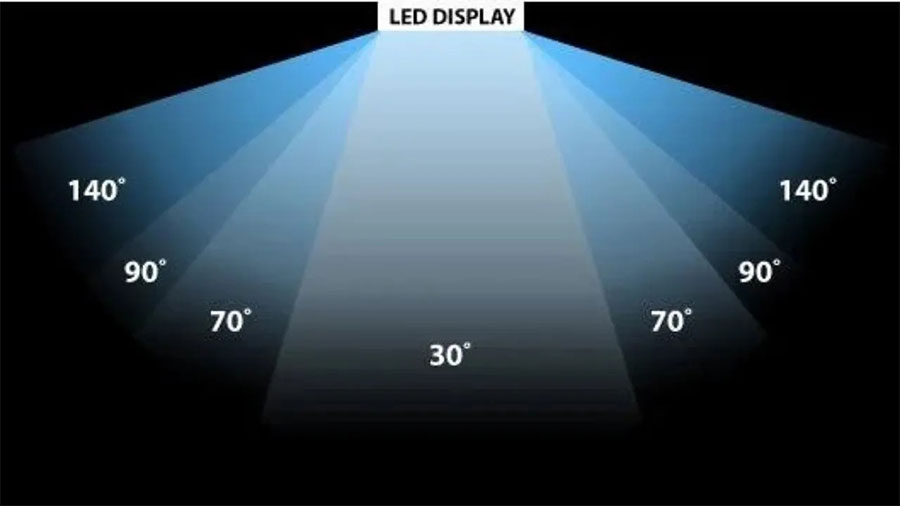
What Is an LED Screen Viewing Angle?
An LED Screen Viewing Angle refers to the maximum range of angles from which a user can view the screen from different directions while ensuring that the image or video remains clear and without any loss of brightness.
It is typically expressed as X/Y, where X and Y represent the horizontal and vertical viewing angles, respectively. These two angles are the primary components of an LED display’s viewing angle.
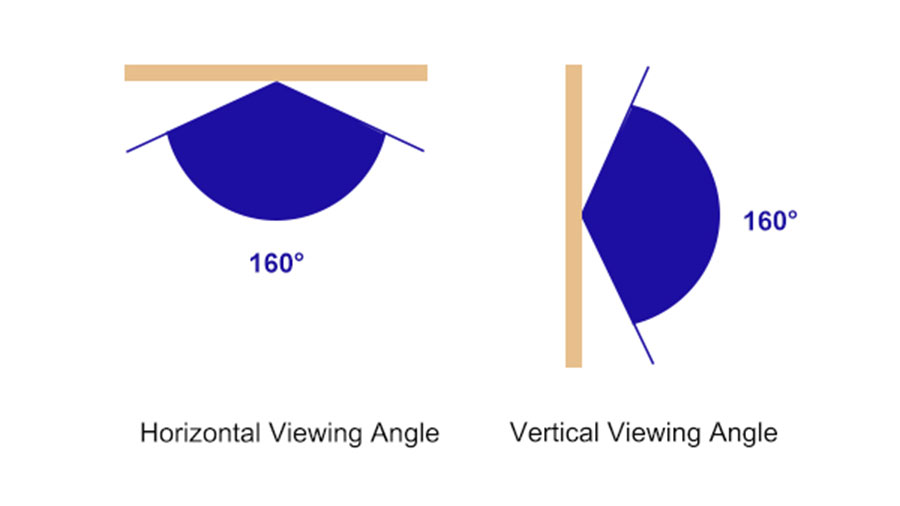
Horizontal Viewing Angle
The horizontal viewing angle refers to the sum of the maximum left and right angles relative to the screen’s vertical normal (an imaginary vertical line through the center of the display) within which the image remains clearly visible.
This value is particularly important for venues with a large number of viewers in front of the screen or where seating is spaced widely apart.
Vertical Viewing Angle
The vertical viewing angle refers to the sum of the maximum angles above and below the screen’s vertical normal within which the image remains clearly visible.
This value is closely related to the contrasts of screens; the two are inversely correlated—that is, as the vertical viewing angle increases, color contrast decreases.
For example, 140°/120° indicates that the viewer’s horizontal viewing angle is 70° to the left of the normal plus 70° to the right of the normal, for a total of 140°; similarly, the vertical angle is 120°. Content on the screen remains clearly visible within these angles.
In addition, the LED screen viewing angle includes three components: the half-brightness angle, the viewing cone, and the LED emission mode.
While these factors also influence the LED screen viewing angle to some extent, the horizontal and vertical viewing angles remain the most critical factors.
The LED screen viewing angle can also serve as a reference for assessing how different screen positions affect the display quality.
Why is the LED Screen Viewing Angle important?
The LED screen viewing angle significantly impacts its visibility. Wider viewing angles provide viewers with a superior visual experience and allow more people to see the content on screens.
Their importance lies primarily in the following aspects:
- Superior User Experience: Better viewing angles enable more people to view high-quality images clearly and conveniently, without distortion or color shift.
- Higher Return on Investment: Since LED screens are primarily used for commercial displays, a good viewing angle allows more people to see advertisements, achieving a wider reach and delivering a higher return on investment.
- Better Information Delivery: A wider viewing angle ensures that information displayed on LED screens—whether in indoor or outdoor settings—is conveyed clearly and completely.
- Superior Image Quality: Wide-viewing-angle screens not only maintain high image quality from all angles but also, to a certain extent, reduce the impact of color aberrations caused by viewing angles on the displayed images.
- Greater Versatility: Wide-viewing-angle screens are well-suited to meet viewing needs in various scenarios, including large-scale events, conference centers, and stage performances.
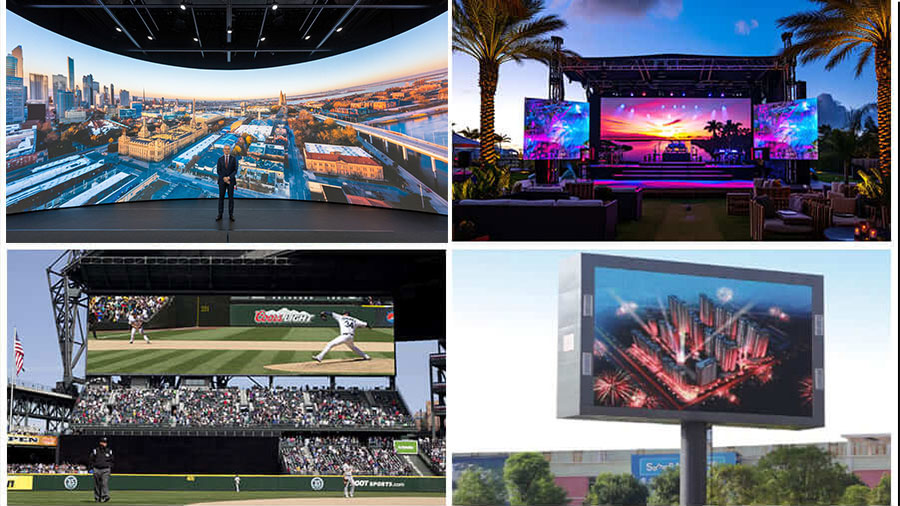
Types of LED Screen Viewing Angles
Based on the size of the viewing angle of the screens, LED screens are classified into the following four types:
Narrow Viewing Angle
When the horizontal viewing angle of the screen is within 100°, it is classified as a narrow-viewing-angle LED screen.
With a smaller viewing angle, the light is more concentrated, so images viewed directly from the front appear brighter, while brightness is slightly lower when viewed from the sides.
Narrow-viewing-angle screens are suitable for viewing locations that prioritize information privacy or a private environment, such as hotel front desks and confidential business meetings.
Medium Viewing Angle
The viewing range of a medium-viewing-angle screen is slightly wider than that of a narrow-viewing-angle screen, ranging from 100° to 140°. It offers a good viewing range and brightness while maintaining optimal image quality at the focal point.
The slightly wider viewing angle ensures clear image quality at close viewing distances in scenarios with large, dispersed audiences—such as broadcast displays and shopping malls.
Wide Viewing Angle
The viewing angle is further expanded to a range of 140°–160° or even higher, resulting in more uniform image display and a broader viewing range.
For most large public venues—such as stadiums, concert venues, and airports—a wide viewing angle meets the viewing needs of audiences from all angles, ensuring that displayed content reaches a wide audience.
Ultra-Wide Viewing Angle
The ultra-wide viewing angle offers the broadest coverage among all LED viewing angles, ranging from 170° to 180°. Due to current technical limitations, 180° has not yet been achieved; the most common specifications on the market are 178°/178°.
Giant LED displays installed in landmark buildings, large-scale public installations, and other similar settings are the ideal applications for ultra-wide viewing angles.
The table below provides a quick overview of these four types.
| Name | Field of view | Use Scenes |
| Narrow Viewing Angle | Less than 100° | Hotel reception, confidential business meetings |
| Medium Viewing Angle | 100°-140° | Public address systems, large shopping centres |
| Wide Viewing Angle | 140°-160° | Stadiums, concerts, airports |
| Ultra Wide Viewing Angle | 170°-180° | Landmark buildings, large-scale public installations |
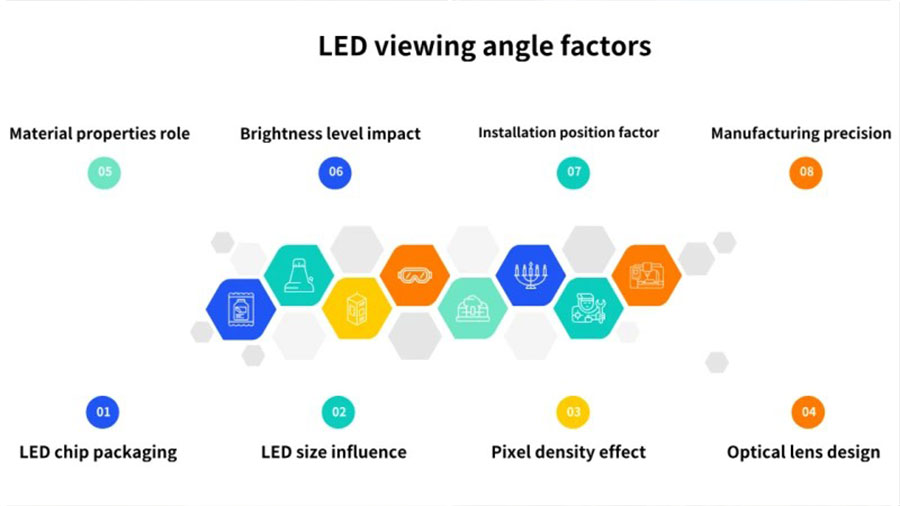
Factors Affecting the LED Screen Viewing Angle
LED Packaging Technology
Differences in LED screen packaging technology also have a significant impact on the viewing angle.
DIP
DIP (Dual In-Line Package) technology uses traditional through-hole technology to produce focused, directional light. The viewing angle of DIP LED screens typically ranges from 100° to 110°, with specific values depending on the lens design.
Although LED screens using DIP technology have lower side visibility compared to SMD and COB technologies, they offer excellent durability and high brightness, making them a good choice for outdoor applications.
SMD
SMD (Surface-Mount Device) technology involves mounting electronic components directly onto a substrate and is currently the mainstream packaging technology.
LED screens using SMD technology offer a viewing angle of 120°–140°, allowing viewers to see the display content from all directions, making them the top choice for both indoor and outdoor displays.
COB
COB (Chip-On-Board) technology involves directly mounting the chip onto a PCB. It offers the widest viewing angle of the three technologies—up to 160°+—with virtually no blind spots, meeting the demand for wider viewing angles in indoor LED displays.
Screen Size
In most cases, larger LED screens have a larger lens surface area, which can scatter light over a wider angle.
Therefore, compared to smaller screens, they typically offer a wider viewing range. As the screen size increases, it is important to ensure that the resolution and pixel density are appropriately matched to maintain image quality.
Pixel Density
Pixel density, also known as the pixel pitch of an LED screen and commonly denoted by “P,” has a certain correlation with the viewing angle.
A higher pixel density indicates a smaller pixel pitch, resulting in a slightly wider viewing angle. Conversely, a larger pixel pitch leads to a slightly narrower viewing angle.
Material Properties
Depending on the materials used (such as encapsulation materials, optical components, or lenses), the refractive index and optical properties will vary.
These factors influence the degree of light diffusion in the LED screen, resulting in variations in its viewing angle.
Differences in Manufacturing Processes
Due to differences in scale and the precision of manufacturing processes among various manufacturers, the resulting LEDs may vary in purity and quality.
For example, some LED display manufacturers with insufficient quality control may have production environments that do not meet dust-free standards.
During the manufacturing of LED lamps, minute dust particles may fall into the process, affecting the purity of the LEDs. Once assembled into an LED display, this internal dust can prevent light from diffusing as intended, resulting in a reduced viewing angle.
Brightness Differences
When used outdoors, excessively high brightness on an LED screen can cause glare for viewers. This can result in the screen content being unclear even within the intended viewing angle, effectively reducing the effective viewing angle.
In such circumstances, it may be necessary to increase the LED screen brightness appropriately or to install high-brightness LEDs to ensure that the content remains clearly visible at all times.
Screen Installation Location
The height and tilt angle of an LED screen are closely related to its required viewing angle and dead angle, resulting in varying levels of clarity for viewers in different positions.
For example, when a live broadcast screen in a soccer stadium is installed at a high elevation, it is often tilted downward slightly to align the optimal viewing angle with the spectator seating area, effectively enhancing the viewing comfort for the audience.
Optical Components
Optical components—including lenses, reflectors, and diffusers—precisely control the direction of light. The condition and structure of the lenses, in particular, play a decisive role in determining the uniformity of light diffusion at different angles. All of these factors influence the viewing angle of an LED screen.
Surface Treatment Methods
Some LED screens utilize surface treatment technologies such as optical films, anti-glare coatings, and angle-optimization layers. These effectively reduce the reflection and scattering of ambient light on the LED screen and modify the shape of the visual cone.
These technologies help maintain the viewing angle of LED screens in indoor environments and minimize visual distortions caused by excessive ambient light.
All of the above are key factors affecting the LED screen viewing angle. Once we understand these factors, we can continuously optimize them to improve the viewing angle of the LED screen and achieve the best possible viewing experience.
Summary
The viewing angle affects our experience when viewing the screen from different directions and is influenced and determined by multiple factors.
This means that when seeking the most suitable LED screen viewing angle, we must comprehensively consider various aspects—including the usage scenario, the audience, and screen technology—to ensure that everyone enjoys a clear and bright visual experience.
If you’re looking to select an LED display with the viewing angle best suited to your specific scenario but still have some concerns, please feel free to contact us at JYLED. We’ll provide professional advice and customize an LED display tailored to your needs.
FAQs
Which has a better viewing angle: OLED, LCD, or LED displays?
In high-end models, the viewing angles of all three types are comparable, and none is inherently better than the others. However, in some lower-end products, viewing angles can vary significantly due to factors such as panel materials, manufacturing processes, and factory calibration.
What is the optimal viewing angle for a screen?
The optimal viewing angle is generally directly in front of the screen, or within a 120° frontal range centered on the screen, with a vertical viewing angle of at least 60°.
Can the viewing angle of an LED display be improved?
No, it cannot be adjusted. LED displays are secured using a frame, so the screen cannot be moved or repositioned. The only exception is rental LED displays used for temporary events, which feature a curved cabinet design that allows for slight angle adjustments to improve the viewing angle.
Does the viewing angle of an LED display affect its brightness?
No, it does not. Both the viewing angle and brightness of LED displays are customized before they leave the factory.
However, factors such as viewing angle and ambient light can cause visual variations in the display’s appearance, which is why it may sometimes seem as though the brightness varies depending on the viewing angle.
How to Measure the Viewing Angle of an LED Screen
Industry standards typically define the measurement threshold as the point where brightness drops to half (50%) of the value when viewed directly from the center, or where contrast drops to 10:1. There are two methods: a standard test using professional instruments and a visual assessment for quick on-site evaluation.

