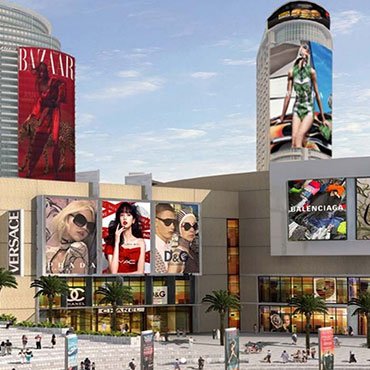
In today’s digital age, businesses and individuals have many choices when it comes to displays, and both splicing screens and LED screens are two popular choices today, both of which offer an excellent visual experience. So how do we go about making a choice? Next we’ll explore the differences between them.
What is a splicing screen
A splicing screen, known as an LCD splicing wall, is made up of multiple LCD (Liquid Crystal Display) panels integrated together to form a larger display. LCD is a technology that utilizes the optical properties of liquid crystals to change the transmittance of light by controlling the electric field to achieve an image display.
LCD is mainly composed of three parts: backlight module, liquid crystal layer and color filter. The backlight module provides the light source, the liquid crystal layer controls the transmittance of light through the electric field, and the color filter is responsible for adding rich colors.

What is LED screen
An LED screen is usually made up of multiple LED displays spliced together, each containing hundreds or even thousands of LEDs to form a pixel array.LED stands for Light Emitting Diode, a semiconductor capable of emitting light on its own without backlighting; when current passes through a PN junction made up of electrons and holes, they collide with each other and release energy.
This released energy is transmitted to the semiconductor material inside the LED chip, where it is energized to produce light. By using a combination of red, green and blue LED chips in three different colors, a full-color light bead can be obtained, and many LED light beads make up an LED display.

Advantages of splicing screen
Whether it’s a small conference or a large control center, spliced pins can tailor the display to the area without restricting the scale of the setup like traditional panels. The surface of the splicing screen is equipped with a protective layer of tempered glass, as well as a unique heat dissipation system. The latest splicing screen technology can also realize the naked eye 3D intelligent effect. The splicing screen can be placed horizontally or vertically in a variety of ways.
The splicing screen has a high resolution, and the resolution of each display unit can reach 1920×1080 or 4K. the splicing screen also adopts unique and cutting-edge digital processing technology, which allows the user to experience the effect of a full HD large screen.
Advantages of LED screen
LED screen is composed of multiple LED modules, there is no obvious seam between the modules so it will not be blocked to affect the viewing, there are two types of indoor and outdoor.
Like the outdoor LED display has a high level of protection, and resistance to high and low temperatures is also waterproof, can be used in harsh environments, even if the wind and rain do not have to be afraid. In addition, LED screen can also be customized, can be made into naked eye 3D screen, curved screen and spherical screen, etc., to achieve creative art display effect.
Comparison of splicing screen and LED screen
How it works: The splicing screen is light-emitting by refracting light, and it needs a backlight layer to illuminate the pixels, and the surface is also equipped with a protective layer of tempered glass.
Between the glass plate and the liquid crystal material is transparent electrode, divided into rows and columns, in the rows and columns of the intersection, by changing the voltage to change the rotation of the liquid crystal state.
LED that is light-emitting diode composed of the display, the LED can be self-illuminated, and each pixel can be projected red, green, blue three colors of light to form the lamp beads.
Thickness and weight: splicing screen due to the presence of backlight layer and liquid crystal layer, so relatively thick, light transmission for LED screen is poor, and not easy to do thin. And LED and relatively thin and light, because the light-emitting diode is relatively small, LED screen is also easy to realize the large size and thin and light design.
Gap problem: LED screen is a piece of LED display spliced together to provide a perfect display effect, there is no obvious module gap; LED screen can provide a truly seamless viewing experience. While spliced screens can also achieve a nearly seamless ultra-white bezel display, the physical seams between neighboring panels may still be evident in some cases.
Display brightness: the brightness of the splicing screen is adjustable, but received the backlight light source brightness range and distribution of uniformity of the limitations, but not up to the high brightness level of the LED screen. LED screen brightness is higher, even in a bright light environment can maintain a clear display effect, while the brightness is also adjustable, and can also be done than the splicing screen features, LED screen brightness adjustment can be automatically adjusted according to the environmental LED screen brightness adjustment can automatically adjust the appropriate brightness according to the ambient light changes.
Clarity and color reproduction: LED screen due to the substantial reduction in pixel pitch, can present more fine image details, LED screen with advanced light emitting technology to precise color accuracy in maintaining a high degree of contrast at the same time, but also be able to present a wider color gamut and more vibrant colors. The splicing screen has a high resolution and excellent color performance, high color reproduction and natural color transition, LED screen and splicing products can bring realistic picture effect.
Flexibility and scalability: flexibility and scalability advantage is that a variety of configurations can be achieved, ideal for screen size and screen layout needs to be regularly changed occasions. LED display screen is often used for permanent installation, thus limiting the adaptability in the environment, LED screen is not yet well suited to the need for regular and reconfiguration or scaling of the system.
However, in another case, LED displays also have excellent flexibility, and can be provided in a variety of shapes and sizes, including curved configurations, this flexibility breaks down the barriers of traditional displays, and opens up unlimited creative possibilities for architects and designers, can be spliced with larger pixels to follow the height of the LED display; for example, 16K, 32K. However, this is the splicing screen can not be easily done.
Scenarios:Splicing screen is more often used in indoor environments, especially for the need for close viewing of the scene, such as monitoring rooms, small conference rooms, and so on. The LED screen is widely used, can be applied to indoor and outdoor, LED screen also takes into account the high protection performance, not only waterproof, dustproof can also not be affected by extreme weather.
Energy-saving life: splicing screen and LED screen power are very low, compared to the splicing screen power consumption will be less than the LED screen. Among them, the splicing screen backlight layer can only be fully open or fully closed, can not be individually lit pixels of a certain system, thus increasing unnecessary light and waste of energy.LED screen is different, each of its pixels can work independently, can be individually lit and thus more energy-saving. But their service life is the same 50,000 to 100,000 hours, this life can ensure that the splicing screen can last for years of investment and do not need frequent replacement; LED in energy saving is a reliable and affordable choice for long-term use.
Engineering cooling: engineering cooling is a large size display system for long-term and stable work of the inevitable requirements, in this regard, splicing screen low-power advantage appears more significant. LED splicing screen, although also has the characteristics of low power, but the overall power consumption is still high, which means that the LED splicing screen in the heat dissipation of the system noise to be much higher.
After-sales service rate: splicing screen and LED screen after-sales situation compared to the splicing screen after-sales rate is much lower than the LED screen. Because, the splicing screen is completed with the optical properties of liquid crystal, and the shape of the more perfect rarely leakage phenomenon. And LED screen common SMD package lamp beads will appear to fall off, dead lights and other phenomena, and also appear more frequently, it will increase the after-sales rate and cost. However, now many LED display companies will have after-sales protection in the warranty period after the purchase order.
Cost: splicing screen prices tend to be more expensive than the LED screen. Splice screen is mainly integrated using LCD panels and complex bezels, but the excellent image quality of the splicing screen and the use of the life of the situation, such as the price is quite reasonable, especially in the need to apply advanced displays. the modular structure and simplified design of the LED screen can help to reduce the cost of production, the LED screen is more suitable for businesses or individuals with a limited budget.
How to choose between splicing screen and LED display?
Splicing screen and LED screen each have their own advantages, and both show their unique charm and value in different scenarios. But in the splicing screen and LED screen to choose between, must take into account the actual application scenarios, constraints, and the pursuit of performance and other comprehensive consideration.
If more concerned about modularity, low maintenance and cost-effectiveness, then the splicing screen is a good choice, especially in the monitoring room and commercial environment and other indoor space. On the other hand, for excellent visual impact, brightness and perfect display, LED screens with high visibility are a better choice for outdoor advertising, live events, and stadiums.
In short, whether you are looking for the ultimate effect or focusing on a cost-effective balance, you can find the right solution for your needs from these two projects.